Denver vs. Chicago: What Relocating Homebuyers Need to Know
Weighing Denver vs. Chicago? Compare home prices, cost of living, taxes, climate, and market dynamics to make a confident relocation decision.
Every year, thousands of Illinois residents move to Denver — and they're all asking some version of the same question: "What am I actually getting into?" Denver costs more per square foot than Chicago, taxes are lower, the sun is out more often, and the buying process works differently than what you're used to back home.
Illinois is one of the top five origin states for people moving to Denver. IRS migration data for the 2022–2023 tax year shows approximately 3,381 people made that move — across 2,546 tax returns — with a median income of $116,725 per return, one of the higher figures among all tracked origin states. You're not crazy for considering it.
This guide breaks down what the move actually looks like — home prices, cost of living, taxes, climate, and how buying works in Colorado — so you know what you're walking into before you start touring houses.
Home Prices and What Your Budget Actually Buys
The headline prices look further apart than they really are. The real gap is in what you get per square foot.
Denver home prices
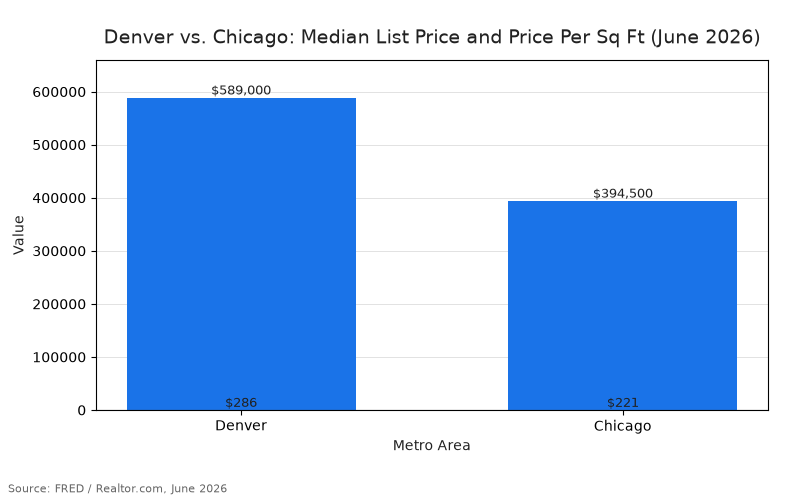
The Denver metro median list price (all home types) is $589,000 as of June 2026, down 3.4% year over year. List price per square foot is $286. Homes are sitting on the market a median of 48 days. For single-family homes specifically, the median active list price is $825,000 — a big step up from the all-types figure, which includes condos and townhomes.
- Why buyers choose Denver: Prices have come down a bit from their peak, homes are selling for about what sellers are asking, and there's enough inventory that you have real options across the metro.
- Typical prices: $589,000 median all-property-types; $825,000 median for single-family homes; $286/sqft metro-wide.
- If you're targeting single-family homes in walkable neighborhoods, expect to pay a significant premium over the metro median. And with homes moving at a 48-day pace, you can't take two weeks to decide. - Why buyers choose Denver: Prices have softened modestly from their peak, the sale-to-list ratio is 0.999 (buyers are negotiating fractionally below list on average), and inventory — while down 4.94% year over year — gives you real options across the metro.
Chicago home prices
The Chicago metro median list price (all home types) is $394,500 as of June 2026, up 3.8% year over year. Median list price per square foot is $221. Median days on market is 33 days.
- Why buyers choose Chicago: The headline price is lower, and Chicago's market is moving faster — a 33-day median versus Denver's 48. If you're selling in Chicago right now, you're likely in a competitive environment.
- Typical prices: $394,500 median all-property-types; $221/sqft metro-wide.
- Denver's $286/sqft sits well above Chicago's $221/sqft. That gap means your Chicago equity stretches less far in Denver than the headline price difference suggests. Budget accordingly.
Cost of Living: Taxes, Insurance, and Day-to-Day Expenses
Home prices are the biggest line item, but they're not the whole picture. Denver and Chicago diverge on ongoing ownership costs in a few important ways.
State income taxes
Colorado's flat state income tax rate is 4.40% on all taxable income (tax year 2025). Illinois also has a flat income tax. Colorado's rate is lower — and the higher your income, the more that difference adds up year over year.
- Colorado has no state estate tax and no inheritance tax. If you're relocating from a state with a separate estate-tax layer, Colorado eliminates that exposure entirely.
- The 4.40% Colorado rate is the statutory rate; a temporary reduction applied in 2024 under Colorado's TABOR surplus-refund mechanism, but the 2025 trigger was not met and the rate reverted to 4.40%.
Property taxes
Colorado's effective property tax rate is approximately 0.50% of market value statewide — among the lowest in the nation. Illinois property taxes are substantially higher; the effective rate in Illinois runs well above Colorado's, and it's one of the most commonly cited reasons Illinois homeowners give for relocating.
On a $589,000 Denver home, Colorado's 0.50% effective rate means a meaningfully lower annual property tax bill than you'd carry on a comparable Illinois property. That difference shows up in your monthly escrow payment and your long-term cost of ownership.
Homeowners insurance
This is where Denver surprises most Chicago buyers — and not in a good way. The average homeowners insurance premium in Colorado is about $4,963/year for $300,000 in dwelling coverage (standard $1,000 deductible). In Illinois, that same coverage averages about $2,643/year. Colorado's premium runs roughly 1.9 times higher than Illinois's, driven largely by Front Range hail exposure.
If you're budgeting for a Denver purchase, factor in a homeowners insurance premium that's meaningfully higher than what you're paying now. It's not a dealbreaker, but it's a real line item that catches Illinois buyers off guard.
Overall cost of living
By BEA Regional Price Parities, Denver runs modestly above Chicago overall, though the gap is narrower than you might expect.
| Metro | BEA Regional Price Parity (U.S. = 100) |
|---|---|
| Denver | 105.8 |
| Chicago | 103.6 |
Day-to-day expenses in Denver are slightly higher than in Chicago. The bigger differences are in housing and insurance — not groceries or services.
One note on sales tax: the combined sales tax in the City and County of Denver is 9.15% — higher than Illinois's statewide base rate. If you're shopping in Denver proper, you'll notice it.
Climate, Geography, and Lifestyle Differences
Chicago and Denver both have real winters, but they feel pretty different on the ground.
Denver climate and sunshine
Denver sits at 5,280 feet above sea level — exactly one mile high, a fact the Colorado State Capitol building marks precisely on its 13th step. That elevation shapes everything about the climate.
Denver gets approximately 245 days of sunshine per year per NOAA climate normals — roughly 115 clear days and 130 partly cloudy. That's substantially more sun than Chicago sees.
- Denver's annual snowfall averages approximately 49 inches per year (concentrated December through April, with March and April storms typically the heaviest). Snow often melts quickly between storms — a week of sunshine after a big storm is common.
- Altitude acclimation is real. Arriving from sea level, most people experience 2–4 weeks of adjustment: mild dehydration, disrupted sleep, reduced exercise tolerance. It passes, but plan for it.
Outdoor access and geography
Denver sits at the base of the Front Range, which puts you within driving distance of world-class skiing, hiking, and climbing — there's nothing like that near Chicago. That's a big reason a lot of Illinois residents make this move.
About 82% of Colorado homes have air conditioning, versus about 96% of Illinois homes. Don't assume every Denver listing has central AC the way it's standard back home — check the listing details. Older homes in established Denver neighborhoods are more likely to lack it.
HOAs are more common here than in Illinois — about 62% of Colorado homeowners are in one, compared to about 45% in Illinois. When you're looking at Denver listings, read the HOA documents carefully. Reserves, special assessments, and rental restrictions vary a lot and can meaningfully affect what you're paying every month.
How the Buying Process Differs in Colorado vs. Illinois
Buying a home in Colorado works differently than what you're used to in Illinois. Knowing what's different before you make an offer means no surprises at the worst possible moment.
Colorado contract and closing norms
Colorado closes through title companies, not attorneys. If you're coming from an attorney-closing state, this feels different at first — but it's how most western states work, and in practice it's straightforward.
The Colorado Real Estate Commission's standard Contract to Buy and Sell Real Estate governs most transactions. A few things to know upfront:
- Earnest money is negotiable — commonly around 1% of the purchase price, but set by agreement, not statute. In a competitive multiple-offer situation, going higher signals stronger commitment.
- The inspection-objection deadline is a negotiated date, not a fixed default. In Denver-area practice, it's commonly set around 7–10 calendar days from acceptance. That's a more compressed timeline than many out-of-state buyers expect — plan to have your inspector lined up before you make an offer.
- Seller's Property Disclosure: Colorado sellers complete a Seller's Property Disclosure (SPD) covering known defects and material facts. It's shorter than what California requires, but read it carefully — Colorado is largely a caveat emptor state for anything not explicitly disclosed.
Two inspection items that catch out-of-state buyers off guard:
- Expansive soils. Swelling clay soils are widespread under the Denver metro. The Colorado Geological Survey identifies them as one of the state's most significant and costly geologic hazards — the soil swells when wet and shrinks when dry, stressing foundations over time. Foundation movement is a common finding in Denver inspections. Ask your inspector specifically about it.
- Radon. About 44% of Colorado homes test at or above the EPA's 4 pCi/L action level — well above the national average. The EPA places Denver-metro counties in Zone 1, its highest radon-potential category. Test for it on every purchase.
Denver market pace and competition
Homes here are sitting on the market for a median of 48 days, and homes are selling for about what sellers are asking — you probably won't talk someone down much, but you're not likely to get pulled into a bidding war either. Chicago's market is moving faster at a 33-day median, so if you're selling there first, you're likely in a competitive environment.
The current rate environment matters for your payment math. The 30-year fixed mortgage rate stands at 6.43% as of early July 2026. At the Denver metro median of $589,000 with 5% down, that's a $559,550 mortgage and a monthly principal-and-interest payment of $3,511. With 20% down ($117,800), the mortgage drops to $471,200 and the monthly P+I is $2,957 — $554 less per month. Those are real numbers to anchor your budget before you start touring.
One note on Denver Public Schools: it runs a district-wide open-enrollment system. Families apply to schools across the district and rank multiple choices — many areas fall in shared enrollment zones rather than having a single assigned neighborhood school. Don't focus your neighborhood search on one school boundary without checking how DPS choice and zones apply to that specific address. The 30-year fixed mortgage rate stands at 6.43% as of early July 2026, down 24 basis points from a year ago.
So Which City Is the Right Move for You?
Denver and Chicago aren't competing for the same buyer.
If you're optimizing for lower housing costs per square foot, a faster-moving market, and lower homeowners insurance, Chicago wins on those metrics. Denver's $286/sqft sits well above Chicago's $221/sqft, and Colorado's insurance premiums run nearly twice as high.
But if you're optimizing for lower income taxes, lower property taxes, more sunshine, and proximity to the mountains — Denver wins clearly. Colorado's 4.40% flat income tax and 0.50% effective property tax rate are both materially lower than Illinois's. The 245 days of sunshine per year is not a marketing claim; it's a NOAA figure. And the outdoor access has no Chicago equivalent.
The buyers who make this move and don't look back are the ones who've done the math on the full cost — not just the purchase price — and are comfortable trading Chicago's lower cost per square foot for Colorado's lower taxes and the lifestyle. The buyers who struggle are the ones who underestimated homeowners insurance, didn't account for how common HOAs are, or got caught off guard by the compressed inspection timeline.
The question isn't whether Denver is better than Chicago. It's whether the things Denver costs you — in square footage, insurance, and a faster inspection clock — are worth what you get back in taxes, sunshine, and the mountains.
Thinking About Making the Move to Denver?
If you're seriously thinking about buying a home in Denver after a Chicago sale, the most useful thing I can do is walk you through what your specific budget actually buys in the neighborhoods you're considering — with current comps, not metro-median averages.
I work with Illinois-to-Denver relocators regularly. The biggest mistakes I see are budget misalignment — not accounting for insurance and HOA costs — and timeline compression — not having an inspector ready before making an offer. Both are fixable with the right prep.
If you want a no-commitment conversation about what your budget gets you in the current Denver market, reach out directly. Come with your target neighborhoods and price range; I'll come with current data.
---
Paul McCoy, Realtor | Fathom Realty | License #: FA.100105533 | (319) 325-0668 | pmccoy626@gmail.com
Paul McCoy is a licensed real estate professional in Colorado. Equal Housing Opportunity.