Selling and Buying at the Same Time in Denver: Which Path Fits You?
Selling your Denver home while buying another? All three sequencing paths — sell-first, buy-first, and contingent — with real costs and a decision framework.
If you're a move-up buyer in Denver, you've probably spent a lot of time thinking about price — what your current home is worth, what you can afford to buy next, and whether the numbers pencil out. That's the right instinct, but it's not what determines whether your move actually works. The decision that matters most is the one most buyers make last: what order do you do this in?
Sell first, then buy. Buy first, then sell. Or make a contingent offer and try to do both at once. Each path is real. Each has a real cost and a real risk. Pick the wrong one for your situation and you could end up carrying two mortgages you didn't plan for, living in a short-term rental longer than you wanted, or losing a home you loved because your offer wasn't strong enough.
This guide walks through all three options — what each one involves, what it actually costs, how Denver's market timing affects the decision, and a worked example to make it concrete. By the end you'll have a clear framework for figuring out which path fits your situation.
---
How the Denver Move-Up Market Works: Inventory, Timelines, and Leverage
Before you choose a path, it's worth understanding how Colorado transactions actually work — because all three options operate inside the same contract framework.
Colorado uses a standardized form called the Contract to Buy and Sell Real Estate (Residential), published by the Colorado Real Estate Commission [1]. Every offer you make — whether it's clean, contingent, or bridge-financed — uses this form.
One thing worth knowing if you're coming from out of state: Colorado closings happen through title companies, not attorneys. If you've bought in New York, New Jersey, or Massachusetts, you're used to an attorney coordinating the close. Here, the title company handles it. If you've bought in California, this is already familiar.
On earnest money: there's no fixed amount set by law in Colorado — it's negotiated in the contract [2]. In my experience, around 1% of the purchase price is a common starting point, but in competitive situations, putting up more tells a seller you're serious. That matters especially when you're making a contingent offer.
The inspection objection deadline is also negotiated, not printed into the contract as a fixed number [2]. In my experience it's commonly set around 7–10 calendar days from acceptance here. If you're coming from a market with a longer default contingency window, this feels compressed — and it is. You can negotiate a longer window, but sellers in a competitive market may push back.
Denver transactions typically close anywhere from a few weeks to a couple of months after you're under contract, depending on your financing — that's a rough guide, not a promise, and it's one of the key variables you'll be juggling across all three paths.
---
Option 1: Sell First, Then Buy — The Safer Path and Its Hidden Costs
Selling first is the lowest-risk path for most move-up buyers. You eliminate dual-mortgage risk entirely. You know exactly what you netted from the sale before you make an offer on anything new. And you go into the purchase as a fully qualified buyer with no contingencies attached — that's a genuinely strong position. In a competitive market, a clean offer is meaningfully more attractive to a seller than one that depends on your home closing first.
The hidden cost of this path is the gap. Between closing on your sale and closing on your purchase, you need somewhere to live — a short-term rental, staying with family, or, if you can negotiate it, a rent-back on your own home.
In my experience, rent-backs are a common tool here. When you sell, you negotiate a post-closing occupancy arrangement: the buyer takes title at closing, but you stay in the home for an agreed period afterward, typically paying a daily rate to the new owner. It sidesteps the move-twice hassle. Your agent should be building this into the offer negotiation if timing is tight.
The real downside of sell-first isn't the temporary housing — it's the pressure it puts on you as a buyer. Denver's inventory moves, especially in spring. If you sell quickly and then can't find the right home, you're either renting longer than planned or rushing into a purchase you're not fully confident in. Have a plan for that before you list.
Who this fits: you prioritize certainty over speed, you have flexibility on temporary housing, or your current home is likely to sell faster than the neighborhood you're buying into.
---
Option 2: Buy First with a Bridge Loan or HELOC — How It Works in Colorado
The appeal of buying first is simple: you find the right home, you buy it on your timeline, and then you sell. No temporary housing, no rushed decision, no compromising on the next home because the clock is running.
The tool that makes this possible is either a bridge loan or a HELOC — two different products that do the same basic thing: let you tap your current home's equity before you've sold it.
A bridge loan is a short-term loan secured against your current home's equity. The lender advances you funds — typically to cover the down payment on the new purchase — and you repay it when your current home sells. The cost is real: bridge loans carry origination fees and, in my experience, a higher interest rate than conventional financing — and that cost adds up for however long it takes your current home to sell.
A HELOC works differently. If you have an existing home equity line of credit, or can open one before you list, you can pull from it for the down payment on the new purchase. The key thing to know: lenders will count the outstanding HELOC balance in your debt-to-income calculation when you apply for the new mortgage. Talk to your lender before you draw — the order in which you open the HELOC and apply for the new mortgage matters.
One number worth knowing for the buy-first path: the 2026 baseline conforming loan limit is $832,750, and that baseline is what applies across the Denver metro [3]. If your new purchase is above it — and in Cherry Creek, Hilltop, or Wash Park at the upper end of the market, it likely is — you're in jumbo territory. Jumbo loans have different underwriting standards: lenders typically want larger cash reserves and look more closely at your debt-to-income ratio. Carrying two mortgages at once is harder to qualify for under those standards. If you're buying above that limit, get in front of a jumbo lender early — before you've found the home you want.
Who this fits: you have strong equity in your current home, solid income that can handle two payments for a stretch, and a home that's likely to sell quickly.
---
Option 3: Contingent Offer — When Denver Sellers Accept Them and When They Don't
A contingent offer means you make an offer on the new home with a clause saying your purchase depends on selling your current home first. The CREC contract has a provision for exactly this [1].
On paper, this sounds like the best of both worlds. In practice, it's more complicated, and whether it works depends heavily on market conditions and how you structure it.
Sellers who accept contingent offers typically keep the home on the market. If another offer comes in, they send you a notice to perform — you then have a short window to either drop your contingency or walk away. If you drop it and then can't close because your sale falls through, you could lose your earnest money [2]. Understand that before you sign.
Sellers tend to accept contingent offers when the market is slower, when there are fewer buyers at your price point, or when your home is already under contract or close to it. A seller who just listed in a busy spring market with showings lined up is a very different conversation than one whose home has been sitting for weeks.
The move most buyers don't think about: if you're planning to go contingent, having your current home already listed — or better yet, already under contract — dramatically improves a seller's willingness to accept. It's not just the contingency clause language. It's showing the seller that your home is actually moving.
Who this fits: you're in a slower market segment, you're at a price point where sellers have more patience, or your current home is already under contract.
---
The Real Cost of Each Path
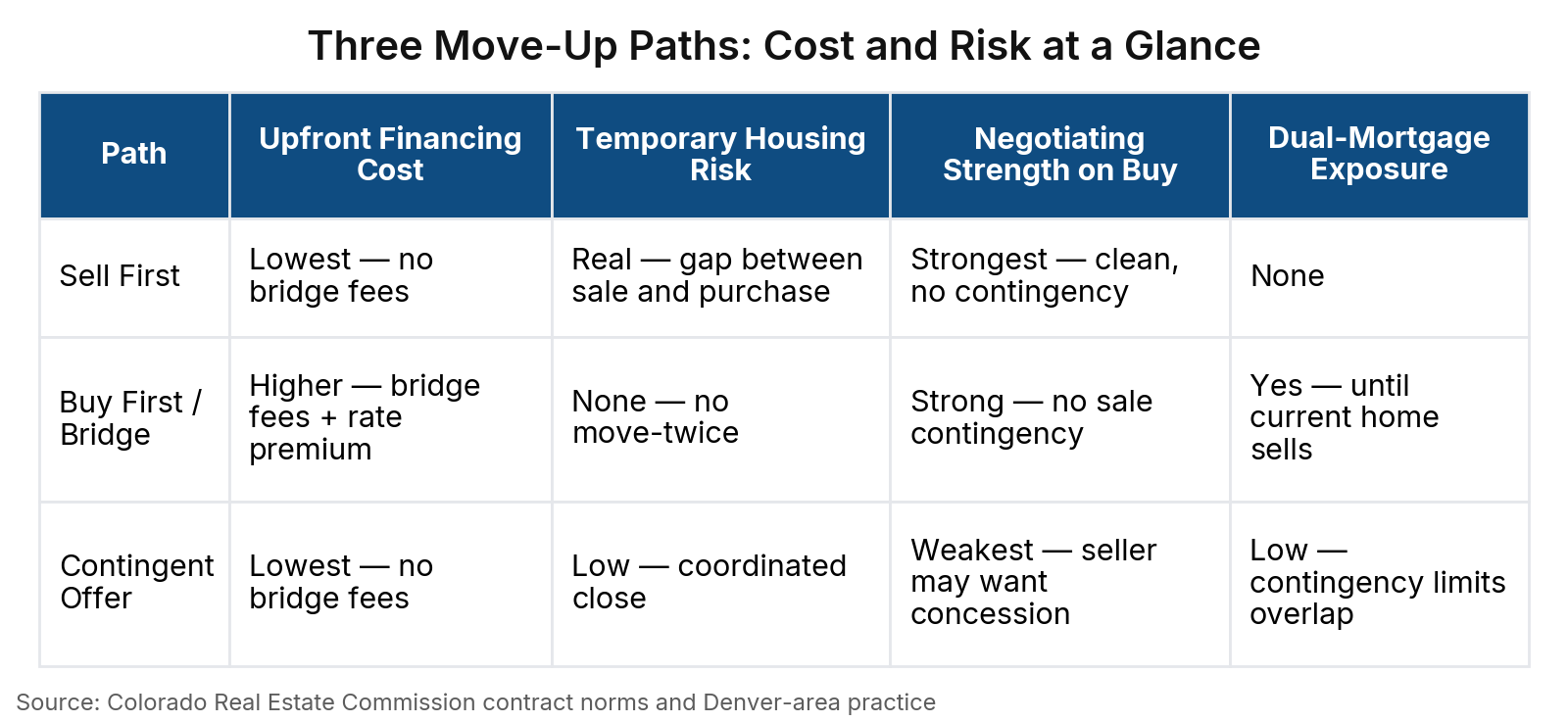
The three paths don't just differ in risk — they differ in what comes out of your pocket, and most people underestimate the gap.
Sell-first costs include your closing costs on the sale — agent commission, title fees, and prorations — plus whatever temporary housing costs you run into during the gap. That housing piece is the variable that's hardest to predict.
Buy-first / bridge loan costs include the bridge loan origination fees and the interest that piles up on the balance during the overlap period. The total depends on how long your current home takes to sell. On top of that, you're paying your closing costs on the new purchase: lender fees, title insurance, and recording fees.
HELOC carry costs are typically lower than a bridge loan, but interest still adds up on whatever you've drawn until your current home sells and you pay it back.
Contingent offer costs are the lowest upfront — you're not paying bridge fees or carrying two mortgages. But the hidden cost is negotiating leverage. Sellers who accept contingent offers often want something in return: a price concession, a longer closing timeline, or other favorable terms.
One note on property tax prorations at closing: Colorado's effective property tax rate is approximately 0.50% of market value statewide [4], among the lowest in the nation. If you own two properties at the same time — even briefly — you'll owe taxes on both for that overlap period, but at Colorado's rate, the proration math is relatively modest compared to what you'd be looking at in a higher-tax state.
---
Denver Market Timing: How Seasonal Inventory Shifts Affect Your Sequencing Decision
Denver's listing volume isn't flat year-round, and the season you're moving in shapes which path makes the most sense.
Spring — roughly March through May — brings the most competition and the most seller leverage. If you're selling in spring, you'll likely move quickly and get strong terms. The catch: you're also buying in the most competitive market of the year. Contingent offers are harder to get accepted because sellers have options. If you're selling in spring, you either need to be ready to buy fast after your sale closes, or you need a bridge loan or HELOC lined up so you can move without a contingency.
Fall — September through October — is a secondary peak for listings. Things are active but less frenzied than spring. Contingent offers are more viable because sellers have fewer buyers to choose from.
Winter is the slowest period. Inventory is thin, but so is the competition. Sellers are more open to contingent offers and more willing to negotiate on price and terms.
Rent-backs are a useful timing tool in any season. If you can negotiate one on your sale — staying in your home for a period after the buyer takes title — you buy yourself time to find the right purchase without a hard move-out deadline hanging over you. Build that into your listing strategy from the start, not after the fact.
The bottom line: the right path often depends as much on when you're moving as on your financial profile. If you're planning a spring move, have your financing options sorted out before you list. If you're moving in fall or winter, contingent offers deserve a serious look.
---
Worked Example: A Hilltop Seller Buys in Cherry Creek — Three Paths, One Decision
Here's how this typically plays out for a move-up buyer in Denver's mid-to-upper price range — a composite illustration using a real neighborhood pair and a real price dynamic, but not a specific client.
The scenario: a homeowner in Hilltop looking to buy in Cherry Creek at a price that crosses into jumbo territory. They've built solid equity over the years, have strong income, and want to be in Cherry Creek within the next few months.
Path 1 — Sell first: They list in Hilltop, accept an offer, and negotiate a rent-back so they don't have to move twice. They close on the sale, stay in the home for several weeks, then go to market in Cherry Creek as a clean buyer with no contingencies. The cost is whatever temporary housing they need if the rent-back runs out before they close, plus the pressure of buying on a deadline. The upside: they're the strongest possible buyer in Cherry Creek, and they know exactly what they have to work with.
Path 2 — Bridge loan: They open a bridge loan against their Hilltop equity and use it to fund the down payment on the Cherry Creek purchase. Because Cherry Creek crosses that conforming limit [3], they're in jumbo territory — they need to qualify under jumbo underwriting standards while also carrying the Hilltop mortgage. The cost is the bridge loan fees and interest for however long Hilltop takes to sell. If Hilltop moves quickly, the carry cost is manageable. If it takes several months, it's a real number.
Path 3 — Contingent offer: They list Hilltop first, get under contract within a couple of weeks, and then make a contingent offer in Cherry Creek. Because they're already under contract on Hilltop, the Cherry Creek seller can see the contingency is close to being resolved. This is the most viable version of a contingent offer — but the Cherry Creek seller may still want a price concession in exchange for accepting it, and there's a kick-out risk if another buyer comes along before Hilltop closes.
The decision point: which path makes sense depends on whether they can qualify for two mortgages at once at the jumbo level, how quickly Hilltop homes are moving at that price, and how much negotiating leverage they're willing to give up in Cherry Creek.
For a deeper look at how financing fits into this picture, see mortgage pre-approval mechanics for Denver buyers.
---
Which Path Is Right for You? A Decision Framework
Three questions, answered honestly, usually get you there.
Question 1: Can you qualify for two mortgages at once? If yes — your income and reserves can support both payments, and you can pass underwriting with both properties on your balance sheet — then buy-first is on the table. If no, sell-first or contingent are your realistic options. Your lender is the one who can tell you. Don't guess.
Question 2: How quickly do homes sell at your price point? If things move fast where you are, sell-first is low-risk — the gap between your sale and your purchase is short and predictable. If your segment moves slowly, sell-first puts real pressure on you as a buyer, and a contingent offer or bridge loan gives you more time to find the right home.
Question 3: How competitive is the market where you're buying? In a hot market with multiple offers, contingent offers are hard to get accepted — you need sell-first or bridge financing to compete. In a slower market — higher price points, homes sitting longer — contingent offers are viable and worth pursuing.
For most Denver move-up buyers, sell-first with a rent-back negotiated into the sale is the lowest-risk path. You eliminate dual-mortgage risk, you buy clean, and the rent-back buys you time. Bridge loans are the right tool if you have strong income and substantial equity and don't want to compromise on what you buy — but have that lender conversation before you commit. Contingent offers work best when your current home is already moving and the seller you're buying from has patience.
---
Ready to Map Your Move-Up Sequence? Let's Talk.
You now know the three paths, what each one costs, and the three questions that point to the right one for your situation. The next step is running the numbers on your specific home, your equity, and the neighborhood you're targeting — because the right path for a Highlands seller buying in Wash Park is different from the right path for a Hilltop seller buying in Cherry Creek.
I work with move-up buyers across Denver's price spectrum and can pull current comps on your home, help you work out whether the bridge loan math holds for your income and equity, and tell you honestly whether a contingent offer is realistic in the neighborhood you're targeting. Book a short consultation and let's map your sequence before you list.
Sources
- Colorado Department of Regulatory Agencies — Colorado Real Estate Commission contracts and forms: https://dre.colorado.gov/contracts-forms
- Colorado Real Estate Commission -- Contract to Buy and Sell Real Estate (earnest money set by agreement): https://dre.colorado.gov/division-resources/commission-approved-contracts
- Federal Housing Finance Agency — 2026 Conforming Loan Limit Values announcement: https://www.fhfa.gov/news/news-release/fhfa-announces-conforming-loan-limit-values-for-2026
- Tax Foundation — Property Taxes by State (Colorado effective rate): https://taxfoundation.org/location/colorado/
---
Paul McCoy, Realtor | Fathom Realty | License #: FA.100105533 | (319) 325-0668 | pmccoy626@gmail.com
Paul McCoy is a licensed real estate professional in Colorado. Equal Housing Opportunity.