Denver Market Update: October 2026
Denver metro list prices are down 5% year-over-year, but 7.4% mortgage rates add $307/month vs. last month. Here's what move-up buyers need to know.
Denver metro prices down 5% YoY — but rates at 7.4% are the real headwind for move-up buyers.

Market Trends
Denver metro list prices are down nearly 5% from a year ago — and if you're shopping in the $700K–$1M range, that's a real opening, not just a headline.
| Metric | Now | Year ago |
|---|---|---|
| Median list price (metro, all types) | $569,900 | $599,450 |
| Median list price YoY | –4.9% | — |
| Active inventory YoY | +6.7% | — |
| Median days on market | 58 days | 60 days |
| Price per sq ft YoY | –3.1% | — |
| Sale-to-list ratio | 1.00 | 0.998 |
| Closed sales YoY | –6.1% | — |
More homes are sitting on the market — inventory is up nearly 7% from a year ago — and closed sales are down 6% year-over-year. Demand isn't keeping up with supply, and that's where your room to negotiate comes from. Well-priced homes are still selling at asking, so the opening isn't unlimited, but it's real. If you're moving up from a starter home, this is a better entry point than last year. Focus your search on homes priced close to recent sales; anything sitting past 60 days is worth a conversation.
Interest Rates and Mortgage Impact
Rates have climbed sharply — the 30-year fixed is up a full 1.1 percentage points from a year ago, and that's the number that matters most right now.
| Metric | Now | 1 month ago | 1 year ago |
|---|---|---|---|
| 30-yr fixed rate | 7.40% | 6.76% | 6.30% |
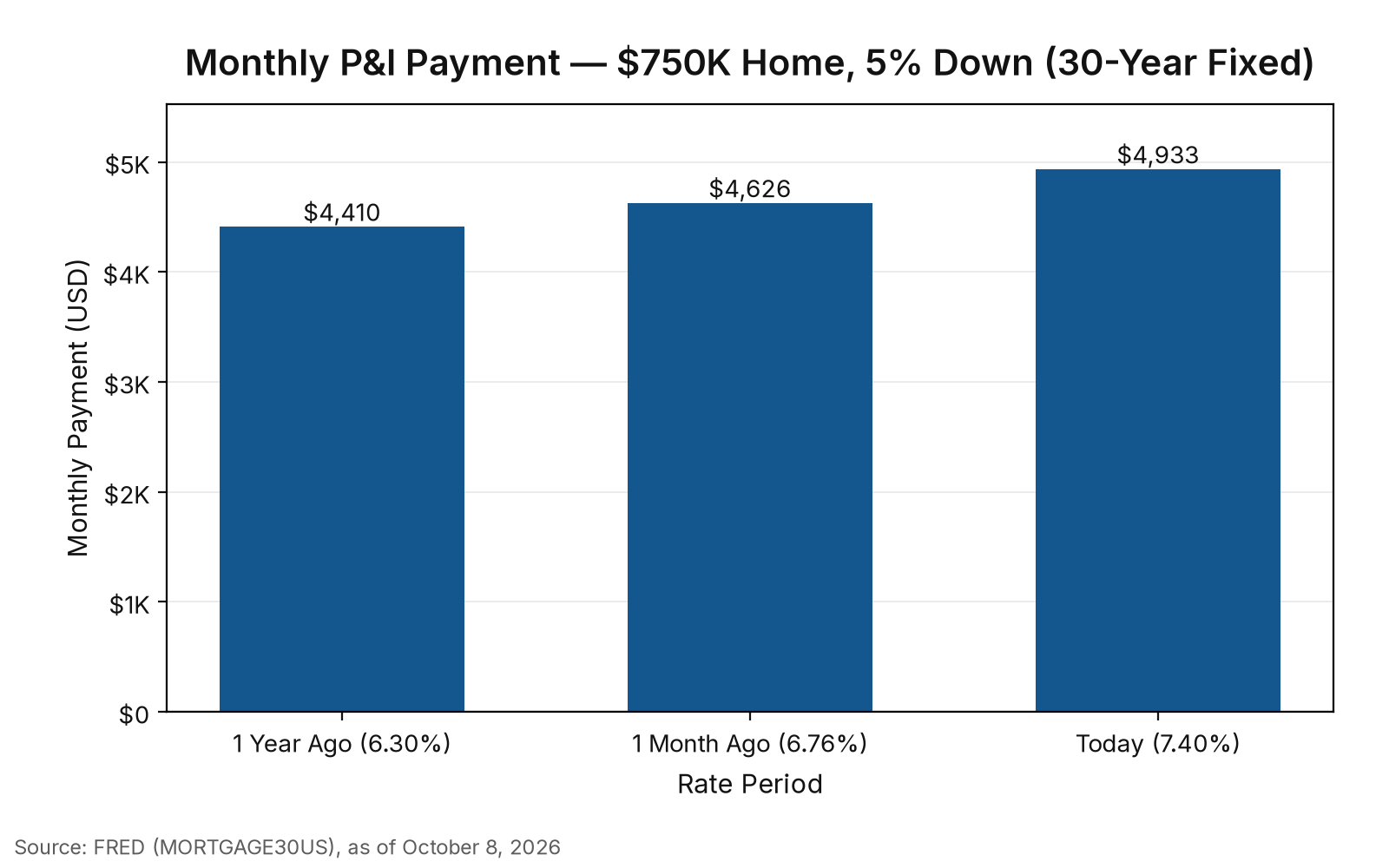
| Monthly P&I ($750K / 5% down) | $4,933 | $4,626 | $4,410 |
| Monthly payment change | — | +$307 | +$523 |
On a $750,000 home with 5% down, you're paying $307 more per month than you were in September — and $523 more than this time last year. That's a real budget constraint. One move worth asking sellers about: a 2-1 buydown. A seller-paid buydown on this loan costs about $16,896 and cuts your year-one payment to $4,001 — $932 less per month — before stepping up in year two. Compare that to taking the same $16,896 as a price cut, which only trims your payment by $117 a month permanently. When sellers are motivated and homes are sitting, the buydown is the better ask.
Homebuyer Tip
Know your escalation-clause ceiling before you write the offer — not during.
Most buyers set an escalation increment first and figure out the ceiling later. That's backwards, and it costs you in a competitive situation.
- Set your hard ceiling first. Decide the absolute most you'll pay for the home before you write anything. Your ceiling is a budget decision, not a negotiation tactic.
- Choose an increment that signals seriousness. A $1,000 increment on a $750K home reads as noise. $5,000–$10,000 increments show you mean it without giving away your ceiling.
- Request an escalation cap on the seller's counter. Ask your agent to include language requiring the seller to provide proof of the competing offer before your escalation kicks in — it's standard in Colorado and protects you from phantom bids.
- Decide your walk-away number in advance. If the escalation hits your ceiling and you still lose, you walk. Knowing that before you're in the moment keeps the decision clean.
The buyer who has done this math in advance moves faster and negotiates cleaner than the one doing it under pressure.
If you're tracking the Denver market through the end of the year, I publish this update every month. Subscribe at denverproperty.com/updates and you'll get next month's edition the day it's out.
---
Paul McCoy, Realtor | Fathom Realty | License #: FA.100105533 | (319) 325-0668 | pmccoy626@gmail.com
Paul McCoy is a licensed real estate professional in Colorado. Equal Housing Opportunity.