Denver Buyers Are Leaving Real Money on the Table Right Now
Denver sellers are offering closing cost credits, rate buy-downs, and repair allowances right now. Here's what's on the table, what it's worth, and how to ask for
As of October 17, 2026
I'm telling Denver buyers to make a seller-paid rate buy-down their first concession ask. The math is lopsided: for the same $16,848 in seller help, a 2-1 buy-down puts $929/month back in your pocket in year one — versus $115/month from the same money as a price cut. That's a $814/month difference in your favor, and sellers in today's Denver market are open to it.
Most buyers don't know to ask. That's the gap this piece closes.
Sellers Are Competing for Buyers — and the Perks Are Real
Denver sellers are actively competing for buyers right now. The tools they're using — closing cost credits, seller-paid rate buy-downs, and repair allowances — translate into hundreds of dollars a month in real savings for buyers who know to ask.
This is happening in Denver right now — homes are sitting longer, inventory is up, and sellers need to do something to get deals done. Three things are on the table: seller-paid closing cost credits, mortgage rate buy-downs, and repair or price allowances. Knowing which to ask for — and when — is how you capture real value here.
How a Softer Market Puts Money in a Buyer's Pocket
When homes sit longer than sellers expect, sellers face a choice: cut the price or offer something that makes the deal more attractive without changing the headline number.
Sellers often prefer concessions over price cuts because the list price stays intact for the appraisal. But for the buyer, a well-structured concession can be worth more per dollar than the equivalent price reduction.
A closing cost credit reduces what you bring to the table at closing. A seller-paid rate buy-down reduces your monthly payment for the first one or two years, when you're most stretched. A repair allowance puts cash back in your hands after closing. Each flows through a different part of the deal — knowing which one solves your actual problem is what makes the ask land.
What the Denver Market Looks Like Right Now
Buyers have the advantage here — homes are sitting, prices are down from a year ago, and sellers are closing below asking price on average.
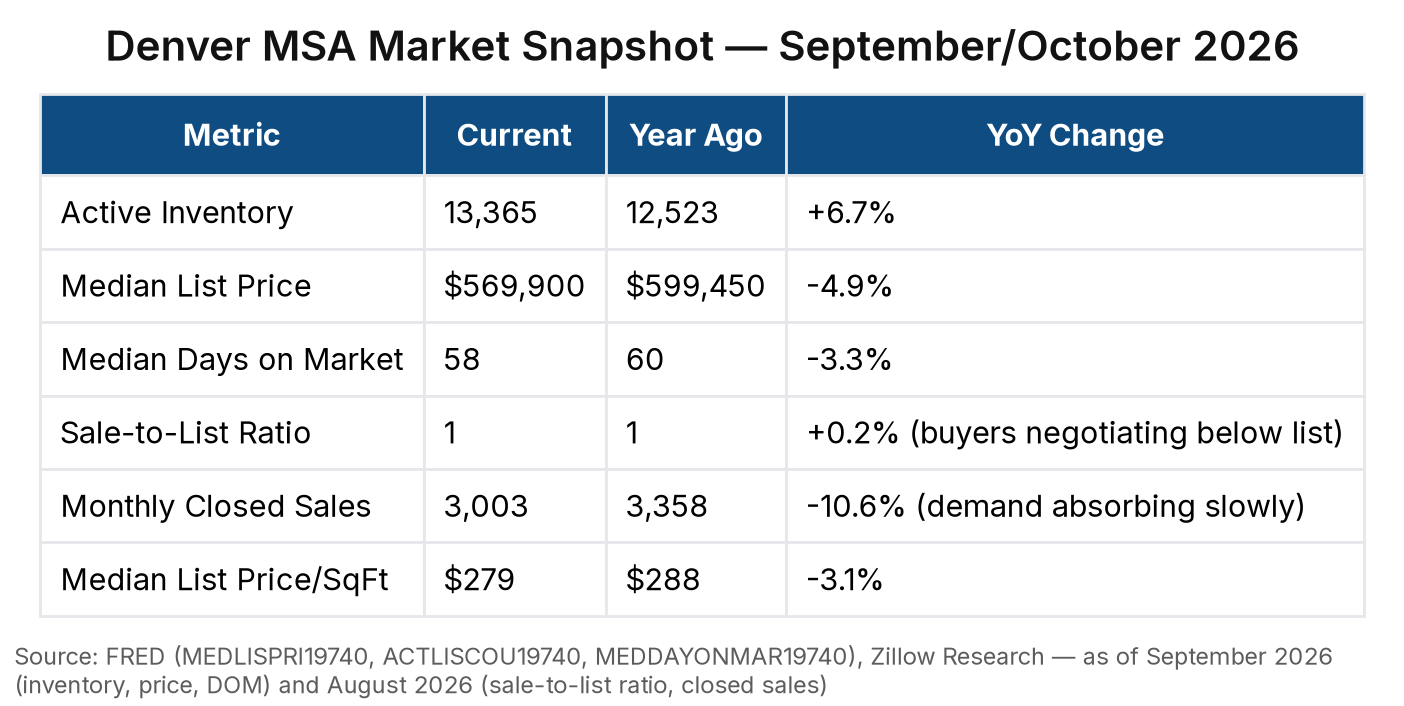
These numbers mean you have room to ask — and the next section shows exactly what to ask for.
Why This Matters More in Denver Than the Headlines Suggest
Denver's price point is what makes concessions so valuable here. At a median listing price of $569,900 (all property types, FRED MSA, as of September 2026), a 1–2% closing cost credit is real money back at the table — enough to cover most of your closing costs outright.
A seller-paid rate buy-down on a Denver-sized loan is even more powerful. On a $750,000 home with 5% down, the current monthly payment at today's 7.32% rate is $4,894. A 2-1 buy-down drops that to $3,965 in year one — $929/month less. That's a car payment.
The Take: Concessions Are the Deal Right Now
Here's the ranked order of dollar impact for a typical Denver buyer:
1. Seller-paid 2-1 rate buy-down. On a $750,000 purchase with 5% down, the seller funds $16,848 and you get $929/month in year-one relief. The same $16,848 as a price cut saves you $115/month. The buy-down front-loads the relief into years one and two — when you're most stretched. It's a near-term move, not a lifetime discount — and that's exactly why it closes deals right now.
2. Closing cost credit. At Denver's price point, a closing cost credit of a couple percent is thousands of dollars you don't have to bring to the table at closing. If you're cash-constrained at closing, this is the ask.
3. Repair or price allowance. If the inspection turns up real issues, a repair allowance puts cash in your hands after closing. Less powerful than the buy-down in most cases, but the right tool when condition is the sticking point.
What to Do With This — Buyers and Sellers
If you're buying:
Before you make an offer, ask your agent what concessions similar homes in this price range have been offering. Most buyers don't know to ask, and the answer changes your opening position.
If you're choosing between a price reduction and a seller-paid rate buy-down, run the monthly payment math on both. On a Denver-sized loan, the buy-down saves $814/month more in year one than the equivalent price cut. That's not close.
One move most buyers don't make: confirm the concession type before the offer goes in. A vague "seller will contribute to closing costs" is not the same as a funded 2-1 buy-down. Get specific in the contract.
If you're selling:
A seller-paid buy-down can win a buyer without touching your list price — which matters for the appraisal and for what your neighbors' homes will be priced at next month.
If your home has been sitting, a targeted concession is often more effective than a price reduction of the same dollar amount, because it solves the buyer's actual problem rather than just lowering the number. Homes in Denver are selling for almost exactly what sellers are asking right now — buyers are negotiating, but not dramatically. You have room to work with concessions before a price cut becomes necessary.
Make the concession visible in the listing. If you're offering a buy-down or a credit, say so — it changes who shows up.
Let's Talk About What You Can Actually Get
Seller concessions aren't a sign of a crashing market. Denver is in a market where inventory is up and sellers need to compete — concessions are just how deals get done here. Inventory is up, sellers need to compete, and the buyers who know how to structure a concession ask are capturing real value.
I'm happy to walk through what concessions are realistic on a specific home or price range you're targeting — what's been offered on comparable homes, what the buy-down math looks like on your loan size, and how to structure the ask in your offer. Schedule a 20-minute conversation and let's run the numbers for your situation.
---
Paul McCoy, Realtor | Fathom Realty | License #: FA.100105533 | (319) 325-0668 | pmccoy626@gmail.com
Paul McCoy is a licensed real estate professional in Colorado. Equal Housing Opportunity.