Who Has the Advantage in Denver Right Now — Buyers vs. Sellers
Denver's months-of-supply and days-on-market figures tell a clear story about who holds the advantage right now — and what buyers and sellers should do about it.
As of August 8, 2026
Denver's housing market has landed in a place most buyers and sellers don't expect: genuine balance. Homes are selling at exactly list price, sitting on the market for a median of 46 days, and prices have softened modestly from a year ago without collapsing. This isn't a hot market or a cold one — it's one where strategy matters more than timing, and where both sides can come out ahead if they know what's actually going on.
If you've been watching the national headlines trying to figure out whether Denver is a buyer's or seller's market right now, the plain answer is: it's neither — and that changes what you should do.

How Supply and Timing Figures Translate Into Negotiating Power
Two numbers tell you more about who has the advantage than anything else: how many homes are on the market and how long they're sitting before they sell.
The first one answers a simple question: if no new homes came on the market today, how long would it take to sell everything currently available? Under three months generally favors sellers, over six months generally favors buyers, and the range in between is balanced. Six months is considered a healthy, even market. It's a rough guide, not a precise number, but it's the clearest single signal we have.
The second tells you how long a typical home sits before going under contract. When that number climbs, sellers are waiting longer — and a seller who's watched their listing sit for six weeks is a different negotiating partner than one fielding offers on day three. Patience shifts. Room opens up.
When supply is rising and homes are sitting longer, buyers gain room to negotiate on price, repairs, and concessions. When supply is tight and homes move fast, sellers can hold firm. Neither number predicts where the market goes — they describe conditions on the ground right now, which is what determines what you should do this week.
What the Numbers Actually Show
Right now, Denver's housing market is balanced — not tilted sharply toward either side, but with enough price softening and enough time sitting that buyers have real room to work with.
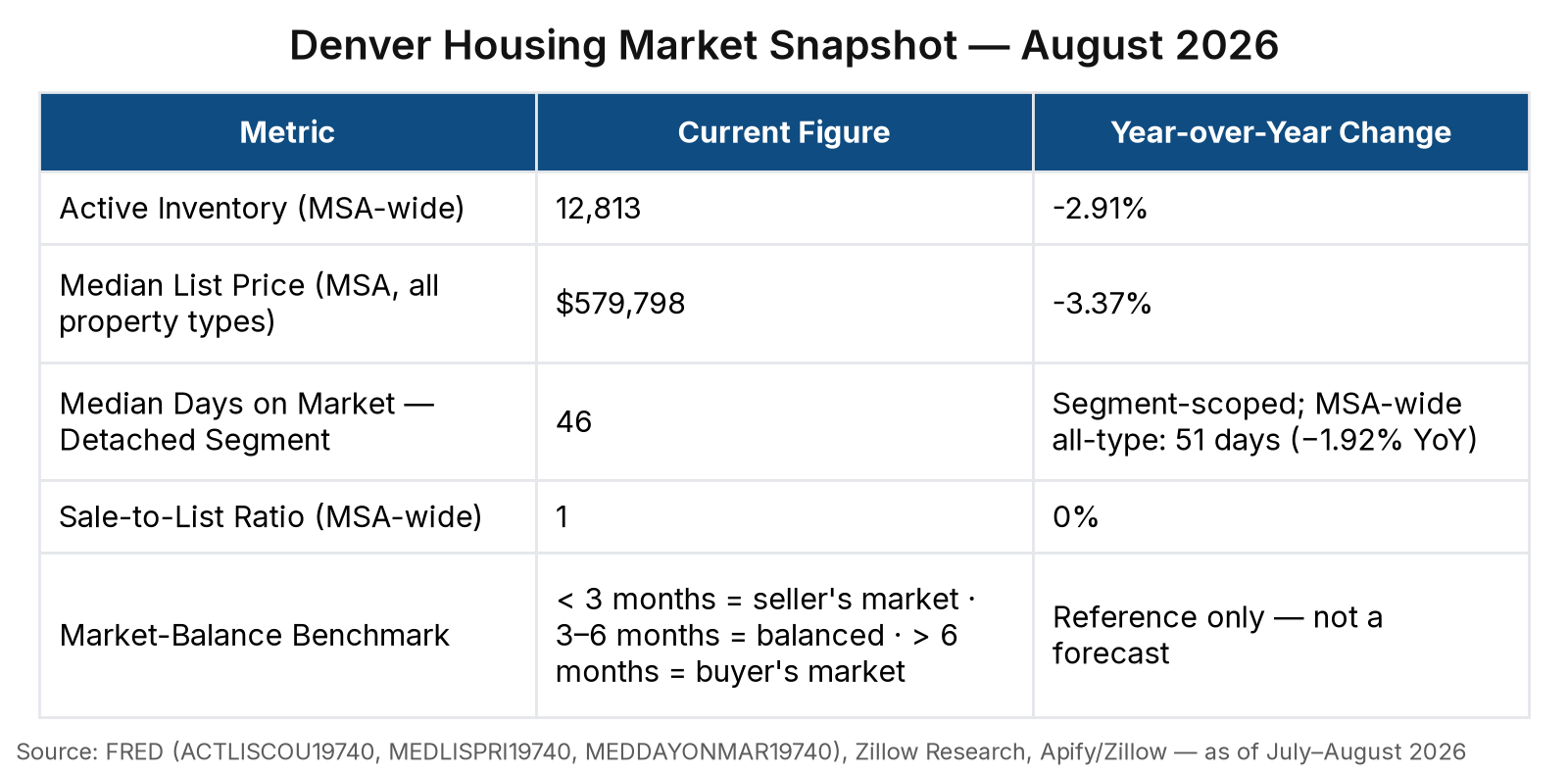
Homes are selling for exactly what sellers are asking — no broad bidding wars, no systemic discounting. The modest year-over-year price softening means buyers aren't fighting over a shrinking pool of affordable homes the way they were two years ago.
If you're deciding whether to buy or sell in the next 30 days, the most important thing to know is that the advantage isn't dramatic on either side.
Why Denver Doesn't Match the National Headlines
The national housing story tends to run in one of two directions — either inventory is dangerously tight everywhere, or the market is cooling fast. Denver doesn't fit neatly into either frame.
Across Denver, there are 12,813 homes for sale as of July 2026, down slightly from a year ago. That's why prices haven't collapsed even as they've softened — supply isn't flooding the market, and homes are still selling at exactly list price as a result.
The Denver-wide figures are the right starting point, but conditions on a specific street or in a specific price range can look very different. A home priced at $800,000 in a well-located neighborhood is a very different situation than a $930,000 listing that's been sitting for 209 days. Think of these numbers as a starting point; your specific neighborhood and price range may look different.
The Plain Read: Who Holds the Advantage
Buyers hold a modest advantage right now — not a dominant one, but a real one.
With homes sitting a median of 46 days and selling at exactly list price, you're not in a position to lowball. But you are in a position to ask for things: repairs, closing cost credits, a seller-paid rate buy-down. Those asks were long shots in a hot market; they're realistic today.
If you price correctly, you can still get a strong outcome — closed sales volume is up year-over-year, which tells you buyers are out there. The market is moving. It's just doing it at list price, not above it, and with more patience required on both sides.
What to Do If You're Buying — and What to Do If You're Selling
If you're buying:
The move most buyers aren't making right now — but should — is asking for a seller-paid rate buy-down. With the 30-year fixed at 6.69% as of August 6, 2026, a 2-1 buy-down on a $750,000 purchase (5% down) costs the seller about $16,368 and cuts your payment by $902/month in year one. The same amount as a straight price cut lowers your payment by just $106/month. The buy-down puts $796/month more back in your pocket in year one for the same seller outlay. In a balanced market where sellers aren't fielding competing offers, this ask lands.
A buy-down front-loads the relief into years one and two, when you're most stretched after a purchase. It's not a lifetime discount — it's targeted relief right when you need it most, and that's exactly why it closes deals in this rate environment. The current conditions reward preparation over speed. Check out the Denver Buyer's Newsletter: April Market Update for more on navigating the current market.
If you're selling:
The price you list at is doing more work than it used to. With homes sitting a median of 46 days before going under contract, an aggressive opening price costs you time and money — carrying costs, price reductions, and the stigma of a listing that won't move. A well-chosen price from day one is worth more than a high ask you'll have to walk back.
If you understand what the market is doing right now, you can still get a strong outcome. Price to the data, present the home well, and be ready to offer something on concessions if a qualified buyer asks. That's not weakness; it's how you get to the closing table. For a deeper look, The Denver Home Selling Process: What Sellers Need to Know walks through what to expect from list to close.
Want to Know Where You Stand Specifically?
Denver's market conditions shift faster than the national headlines reflect. The buyers and sellers who act on the actual local data — not the lagging national story — are the ones who come out ahead. The figures above are the Denver-wide picture as of early August 2026; your neighborhood, your price range, and your timeline may look different.
I'm happy to pull a current read on how these conditions apply to your specific situation. Schedule a 20-minute conversation and we'll look at what's actually on the market in your target area, talk through what a realistic offer or list strategy looks like right now, and figure out what makes sense for you.
---
Paul McCoy, Realtor | Fathom Realty | License #: FA.100105533 | (319) 325-0668 | pmccoy626@gmail.com
Paul McCoy is a licensed real estate professional in Colorado. Equal Housing Opportunity.