Holly Hills, Denver: A Quiet Enclave with Cherry Creek Schools
Holly Hills is a walkable, mid-century residential enclave on Denver's south side — Cherry Creek School District, ranch-style homes, and a quieter pace than the
Holly Hills at a Glance
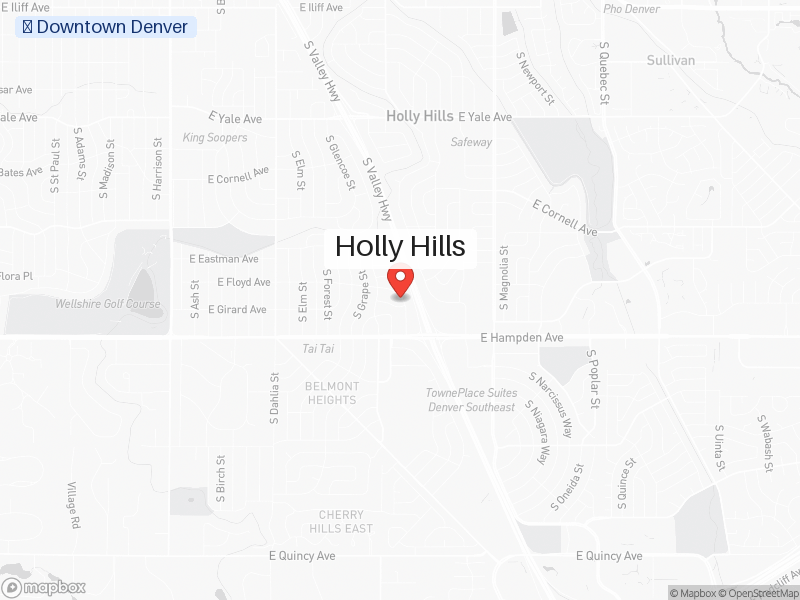
Holly Hills sits on Denver's south side — mostly single-family homes on generous lots, quieter than neighborhoods closer to downtown, and more walkable than you'd expect this far from the urban core. A Walk Score of 83 means most everyday errands are reachable on foot [1]. The homes are largely mid-century ranch-style, and the pace matches. The Cherry Creek School District boundary runs through here, which draws buyers who want that district without paying Cherry Creek or Hilltop prices.
The median single-family list price in Holly Hills is $837,500, with the 75th percentile at $1,075,000 — sitting just above the Denver Metro detached median of $825,000 [2]. Homes are moving at a median of 49 days on market, somewhat slower than the metro-wide single-family homes median of 39 days, which means you have a bit more room to be deliberate here than in tighter parts of the city [2]. The sale-to-list ratio across the metro sits at 0.995, confirming buyers are negotiating modestly below list on average [3].
Living in Holly Hills
Getting Around
Holly Hills is genuinely walkable for a south Denver neighborhood — more so than most comparable neighborhoods on the south side [1]. The High Line Canal Trail runs through the area, giving you a low-traffic route for biking. That said, most people here own a car and use it. Transit is a bonus, not the main reason to live here.
| Neighborhood | Walk Score | Bike Score | Transit Score |
|---|---|---|---|
| Holly Hills | 83 | 78 | 55 |
The Houses and Streets
Holly Hills is ranch territory. Most blocks are single-story brick ranch homes — built for the south Denver buyer who wanted space, a real yard, and a quieter street than the neighborhoods closer to downtown. You'll see the occasional two-story or split-level mixed in, but the ranch is what defines the neighborhood.
Walking the streets, you'll see older brick construction, mature trees, and lots that feel generous compared to newer parts of Denver. A lot of homes have had their kitchens and baths updated while keeping the original footprint — but this isn't a neighborhood being torn down and rebuilt. If you're shopping here, you probably know that going in, and that's fine.
What's Around
Holly Hills has Holly Park right in the neighborhood — about 3 acres — and the High Line Canal Trail runs nearby, connecting you to a roughly 71-mile regional trail system. If you want more space, Cherry Creek State Park is about 7 miles southeast: 4,000 acres with a reservoir for boating, fishing, and swimming. Kennedy Golf Course, a public 27-hole facility, sits just south [4].
For shopping, you're between two good options: Cherry Creek Shopping Center is 5 miles north, and The Streets at SouthGlenn is about 4.6 miles south [4]. Neither is walkable, but both are a short drive. There's no retail strip in the neighborhood itself — the high Walk Score comes from everyday errands along nearby arterials, not a destination shopping area.
Schools
Holly Hills is served by Cherry Creek School District [5]. All three assigned schools — Holly Hills Elementary, Campus Middle School, and Cherry Creek High School — carry the top-tier Performance Plan rating in the Colorado Department of Education's 2024-25 accountability framework [5].
Who Lives Here
Most residents here are owners — 64% of homes are owner-occupied, which is on the higher end for Denver neighborhoods [6]. Median household income is $165,000, well above the Denver citywide figure [6]. Households tend to be smaller. Homes don't change hands often, and that keeps inventory thin no matter where the broader market sits.
Buying in Holly Hills
The Market
Holly Hills is priced just above the Denver median for single-family homes, and the spread inside the neighborhood is what matters most. The typical home lists at $837,500 at $278 per square foot; higher-end homes are around $1,075,000 at $373 per square foot [2]. That's a wide range for one neighborhood — and it's driven by condition and finish, not location. Well-updated homes with modern kitchens and baths pull toward the upper end; original-condition ranches sit closer to the median.
Homes are sitting on the market for about 49 days, slower than the 39-day pace across Denver [2][3]. One listing has been active for well over a year — an outlier that nudges the median up. Take that out and the picture is more competitive, but the 49-day pace still means you have time to be thoughtful. Across the metro, homes are selling for a little below asking right now — negotiating is the norm, not the exception [3]. The median single-family list price is $837,500 and the median price per square foot is $278; the 75th percentile sits at $1,075,000 with a p75 price per square foot of $373 [2].
Strategy
The wide spread between the median and the upper end is your biggest strategic signal here [2]. This isn't a neighborhood where every home is priced the same — the gap between a well-updated ranch and an original-condition one is real and significant. Figure out which side of that spread you're on before you make an offer.
That 49-day pace gives you room to be deliberate [2]. You don't need to rush. Watch new listings closely — freshly listed homes at realistic prices are moving faster than the median suggests, while homes priced away from recent sales are dragging the average up. When something well-priced drops, be ready to move within a week. When something has been sitting for 60-plus days, that's a negotiating opportunity, not a red flag about the neighborhood.
The 30-year fixed has moved up over the past three months, from 6.11% to 6.52% [7]. That matters for what you'll pay each month, but it doesn't change the core picture: Holly Hills is priced close to the Denver median, the Cherry Creek School District boundary is a durable demand driver, and well-priced homes don't sit long. The right home and the overpriced home can look similar from the outside — the difference shows up in the data. The 30-year fixed has moved up 41 basis points over the past three months, from 6.11% to 6.52% [7].
Ready to See Holly Hills for Yourself?
If you're weighing Holly Hills against University Hills, Virginia Village, or another south Denver option, I'm happy to walk you through recent sales and what's active at your price point. The Cherry Creek School District boundary and the walkability are real draws — quieter pace, ranch-style homes, and a price point close to the Denver median without the premium you'd pay closer to Cherry Creek proper. Reach out — happy to talk through your situation.
For a broader read on where Denver's market sits right now, the Denver Market Update: May 2026 covers the metro-wide picture.
Sources
- Walk Score (walkscore.com)
- Zillow listings data — Holly Hills (June 2026)
- Zillow listings data — Denver Metro Detached (June 2026); FRED (MEDLISPRI19740, ACTLISCOU19740, MEDDAYONMAR19740, MEDLISPRIPERSQUFEE19740); Zillow Research sale-to-list ratio (March 2026)
- OpenStreetMap
- CDE District + School Performance Framework (2024-25)
- U.S. Census Bureau ACS 5-year (2020-2024)
- FRED — MORTGAGE30US (June 2026)
---
Paul McCoy, Realtor | Fathom Realty | License #: FA.100105533 | (319) 325-0668 | pmccoy626@gmail.com
Paul McCoy is a licensed real estate professional in Colorado. Equal Housing Opportunity.