LoHi, Denver: Inside the North-Side Restaurant District
LoHi sits just north of downtown Denver with walkable streets, a dense restaurant corridor, and a competitive buyer market. Here's what the data says about living
LoHi at a Glance
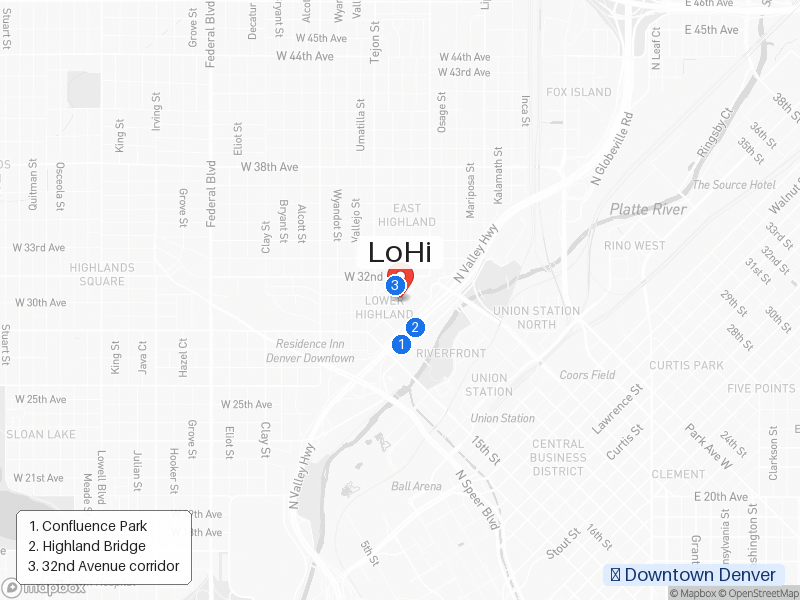
LoHi — Lower Highlands — sits just north of downtown Denver, separated from the city core by I-25 and connected to it by the Highland Bridge, a pedestrian crossing that puts Union Station about a 10-minute walk away [1]. The neighborhood's defining feature is the 32nd Avenue corridor: a dense stretch of restaurants, bars, and cafes that draws diners from across the metro. With a Walk Score of 93 — Walker's Paradise — LoHi ranks among the most walkable neighborhoods in Denver, and its Bike Score of 87 puts it firmly in the Very Bikeable tier [2]. This is a neighborhood where you can genuinely leave the car at home most days.
The buyer market here reflects that location premium. The median single-family list price is $1,145,000, with the 75th percentile at $1,699,000 — well above the Denver metro detached median of $825,000 [3]. Homes move at a median of 44 days on market, which is modestly above the metro single-family homes's 39-day pace [3]. Inventory is tight across the metro — active listings are down 7.2% year-over-year — and LoHi's proximity to downtown keeps demand steady [4].
Living in LoHi
Getting Around
You can get almost anywhere you need without a car here. Nearly every errand — groceries, coffee, dinner — is walkable, and the 87 bike score reflects real infrastructure: dedicated lanes and a direct connection to the South Platte River Trail and Cherry Creek Trail at Confluence Park [1]. Transit is solid too — a 66 Transit Score puts LoHi well above most Denver neighborhoods, with frequent routes and nearby stops, though there's no light rail stop in the neighborhood [2]. If you're driving, downtown is a quick hop across I-25.
The Houses and Streets
LoHi doesn't have one defining look. Walk a single block and you might pass a century-old brick bungalow next to a brand-new three-story townhome — older homes sitting alongside new construction that's gone up as the neighborhood has filled in. If you have a specific architectural taste, you'll likely find something here. Lots tend to be smaller.
What's Around
Start with Confluence Park, where Cherry Creek meets the South Platte River at the neighborhood's southern edge. From there, the South Platte River Trail and Cherry Creek Trail connect outward as part of a regional paved-trail network — a genuine asset for cyclists and runners who want to cover distance without navigating traffic. The Highland Bridge makes the Union Station transit hub and the downtown core accessible on foot in roughly 10 minutes [1].
The real draw is 32nd Avenue. There are at least 43 restaurants, bars, and cafes along the strip [1] — favorites include Little Man Ice Cream, Linger, El Five, Williams & Graham, and Postino [1]. The range runs from casual neighborhood spots to date-night destinations, which is why people come from well outside LoHi to eat here.
Schools
LoHi is served by Denver Public Schools [5]. Per the Colorado Department of Education's 2024-25 accountability framework — which rates schools on a four-tier scale of Performance Plan, Improvement Plan, Priority Improvement Plan, or Turnaround Plan — the assigned schools are rated as follows [5].
| School | Grades |
|---|---|
| Edison Elementary School | Performance Plan |
| Skinner Middle School | Performance Plan |
| North High School | Improvement Plan |
Who Lives Here
LoHi skews heavily toward renters — the share of owner-occupied homes is approximately 30%, which is low relative to most Denver neighborhoods and reflects the neighborhood's urban density and apartment stock. Median household income is $118,444, well above the Denver metro median. Households here are small — an urban residential base where single- and two-person households dominate [6].
Buying in LoHi
The Market
LoHi is priced well above the rest of Denver. A typical single-family home lists around $1,145,000, and higher-end homes are around $1,699,000 [3] — the gap between those two is driven by condition and finish: whether you're looking at a renovated bungalow or a new-construction townhome makes a real difference. The median price per square foot is $437, with higher-end homes at $553 per square foot [3]. For context, the Denver median sits at $825,000, so you're paying a significant premium to be here [4].
Median days on market is 44 days [3]. That's modestly above the metro single-family homes's 39-day pace. The metro-wide sale-to-list ratio of 0.995 confirms buyers are negotiating slightly below list on average across the metro — not a bidding-war environment, but one where list-price discipline matters [4]. Highlands' median sits at $1,275,000 ($457/sqft) [3] — the same price tier as LoHi. Highlands is a few blocks north and shares some of the same character; what sets LoHi apart is the Walk Score of 93 [2] and the density of the 32nd Avenue restaurant corridor.
Strategy
At this price point, precision matters. The gap between the median and the higher end is all about condition and finish, not location — a renovated bungalow and a brand-new townhome can be on the same block at very different prices. Compare recent sales carefully before making any offer, and don't treat the median as a guide if you're targeting new construction, and don't assume the higher-end price is what a well-maintained older home should cost.
The 30-year fixed rate was 6.52% as of June 2026 — up from three months earlier [7]. At this price point, that adds real pressure to your monthly payment. Rates are still lower than they were a year ago, so if you were priced out in mid-2025, you're in a slightly better spot now [7]. The three-month direction matters more for timing than the year-over-year comparison.
Well-priced homes in LoHi move at that 44-day pace — but some listings sit for well over 100 days. That's a pricing or condition issue, not a neighborhood problem. If you come across a listing that's been sitting, that's a fact you can use when negotiating. The right home and the overpriced one can look similar from the outside; the difference shows up when you dig into the numbers.
Ready to See LoHi for Yourself?
If you're weighing LoHi against Highlands, RiNo, or another north-side option, I'm happy to walk you through current comps and what active inventory looks like at your price point. Check out the current Denver market updates for the broader metro context. Reach out — happy to talk through your situation.
Sources
- OpenStreetMap — LoHi amenities
- Walk Score
- Zillow listings data — LoHi (June 2026)
- Zillow listings data — Denver Metro Detached (June 2026)
- CDE District + School Performance Framework (2024-25)
- U.S. Census Bureau ACS 5-year (2020-2024)
- FRED — MORTGAGE30US
---
Paul McCoy, Realtor | Fathom Realty | License #: FA.100105533 | (319) 325-0668 | pmccoy626@gmail.com
Paul McCoy is a licensed real estate professional in Colorado. Equal Housing Opportunity.