Platt Park, Denver: A Walkable South-Side Neighborhood
Platt Park sits just south of Wash Park with tree-lined streets, a walkable Pearl Street corridor, and mid-century bungalows. Here's what buyers need to know.
Platt Park at a Glance
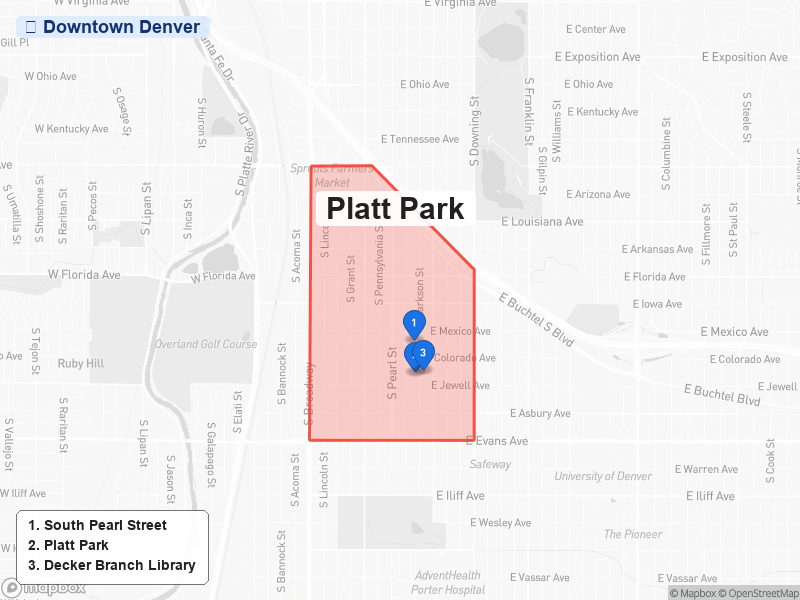
Platt Park sits just south of Washington Park, with Pearl Street running through the heart of it — a walkable stretch of local restaurants, cafes, and shops that you won't find in many south Denver neighborhoods. The park itself — about 5 acres — sits right in the middle of the neighborhood. Biking is where Platt Park really stands out — you're well-connected to Wash Park and South Broadway, and most of south Denver is reachable by bike or on foot [1].
Homes here typically list around $849,000, with higher-end homes around $1,150,000 [2] — a step above the Denver median. Homes are moving at about 36 days on market [2], right in line with the broader Denver pace [3]. Biking is the standout way to get around, with a Bike Score of 76 (Very Bikeable) — and the neighborhood's position between Wash Park and the South Broadway corridor means you're connected to a broader network of south Denver destinations by bike or on foot [1]. That puts Platt Park above the Denver metro detached median of $825,000 [3] — a premium that reflects the Pearl Street walkability and the neighborhood's proximity to Wash Park.
Living in Platt Park
Getting Around
Biking is Platt Park's strongest suit — you're well-connected to Wash Park, South Broadway, and most of south Denver on two wheels [1]. Most daily errands are reachable on foot too. Transit is the weak spot: bus coverage exists, but it's not frequent enough to replace a car for most people [1]. Transit is the weak spot: a Transit Score of 49 (Some Transit) means bus coverage exists but isn't frequent enough to replace a car for most buyers [1]. Walkability is solid too, with a Walk Score of 70 (Somewhat Walkable), meaning most daily errands are reachable on foot even if you'll want a car for some trips.
The Houses and Streets
Platt Park is bungalow territory — most blocks are lined with classic older brick bungalows, the kind of house that defines old-Denver south-side neighborhoods. You'll see some newer construction mixed in, but the bungalow sets the tone. Lots tend to run smaller here.
What's Around
Pearl Street runs through the heart of Platt Park — local restaurants, coffee shops, and retail all within walking distance. The park itself sits right in the middle of the neighborhood and is the main green space here [4]. South Broadway's dining and nightlife scene is easy to get to from here, and Wash Park is a short bike ride north.
On the dining side, the neighborhood has a real local scene. favorites include Duffeyroll Cafe for morning pastries, Bird and Sexy Pizza for casual meals, Kaos Pizzeria and Uno Mas Taqueria for neighborhood staples, and Yemen Grill and Cafe rounding out the mix [4]. That's 35 OSM-tagged restaurants, bars, and cafes within the neighborhood — a floor count, since smaller or newer spots often aren't in the database yet [4].
Schools
Platt Park is served by Denver Public Schools [5]. Per the Colorado Department of Education's 2024-25 accountability framework — which rates schools on a four-tier scale of Performance Plan, Improvement Plan, Priority Improvement Plan, or Turnaround Plan — Platt Park is in the Southwest/Central Elementary School Enrollment Zone, which means buyers can choose from 3 Denver Public Schools rather than being strictly assigned to one: Asbury Elementary (Performance Plan) and McKinley-Thatcher Elementary (Performance Plan) are two of the zone schools; Godsman Elementary received an Improvement Plan rating. Grant Beacon Academy (grades 6–8, 1751 South Washington Street, Denver 80210), the assigned middle school, received a Performance Plan rating. South High School (grades 9–12, 1700 East Louisiana Avenue, Denver 80210), the assigned high school, received a Performance Plan rating [5].
Who Lives Here
Platt Park skews toward owners — owner-occupancy runs approximately 62%, and median household income is $181,592, well above Denver citywide [6]. Households here are relatively small, consistent with a neighborhood where long-term owners hold and turnover stays measured [6].
Buying in Platt Park
The Market
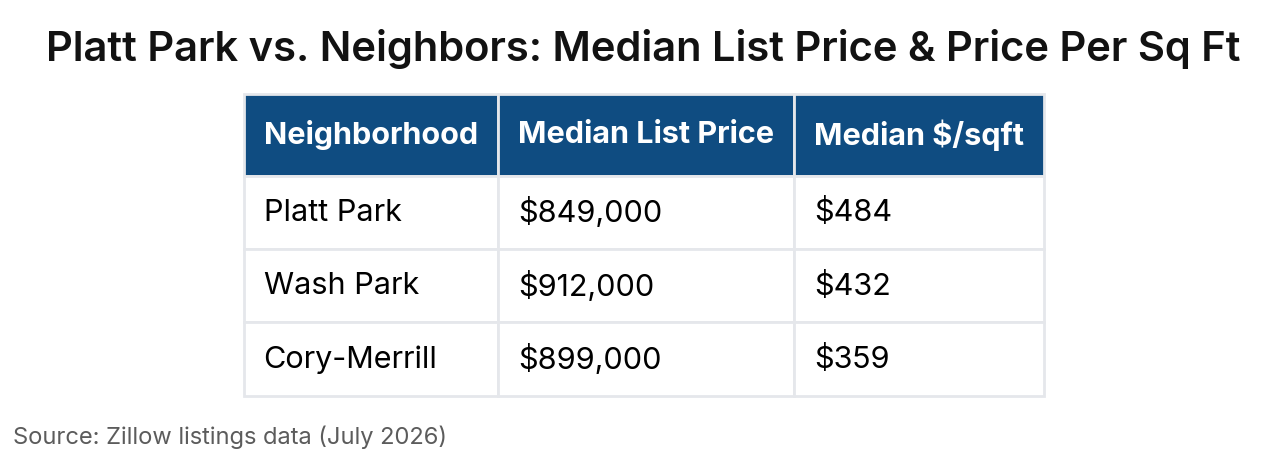
Platt Park sits above the Denver median in price — homes typically list around $849,000, at about $484 per square foot, with higher-end homes around $1,150,000 [2]. Homes are moving at about 36 days on market [2], right in line with the broader Denver pace [3].
For comparison: Wash Park's median is $1,599,000 ($514/sqft) and Cory-Merrill's is $872,950 ($422/sqft) — so Platt Park sits between the two. If you want more square footage for a similar spend, Cory-Merrill is worth a look [2].
Across Denver, homes are selling for just about what sellers are asking [3]. That holds here too — well-priced homes move, and the ones sitting are usually overpriced. The MSA-wide sale-to-list ratio of 0.999 [3] tells you buyers are negotiating fractionally below list on average. The median single-family list price is $849,000, with the median price per square foot at $484; the 75th percentile reaches $1,150,000 at $619 per square foot [2].
Strategy
At that price and pace, being ready matters more than being patient [2]. The spread between the typical home and the higher-end ones is wide — driven by how updated the home is, finish level, and lot position, not location. A renovated bungalow and a less-updated one can sit at very different price points on the same block, so you'll want to go through recent sales carefully before you make an offer.
The 30-year fixed rate is currently 6.49%, down from 6.72% a year ago [7] — so you're carrying a lower rate than buyers a year ago. That said, the rate has ticked up over the past three months, so the recent trend has been upward even as the year-over-year comparison is favorable [7]. Use the rate direction as a rough guide, not a precise number — run your own figures at your price point before settling on a monthly payment.
If you see a listing that's been sitting a while, that's a fact you can use when negotiating — not a reason to avoid it. The right home and the overpriced one can look similar from the outside; the difference shows up when you pull the comps. The 30-year fixed rate is currently 6.49%, down 23 basis points year-over-year from 6.72% [7]. The spread between the $849,000 median and the $1,150,000 p75 is wide — that gap is driven by condition, finish, and lot position, not location.
Ready to See Platt Park for Yourself?
If you're weighing Platt Park against the Wash Park neighborhood spotlight or another south Denver option, I'm happy to walk you through current comps, recent closings, and what active inventory looks like at your price point. Check out the latest Denver market update for the broader metro context. Reach out — happy to talk through your situation.
Sources
- Walk Score
- Zillow listings data — Platt Park (July 2026)
- Zillow listings data — Denver Metro Detached (July 2026)
- OpenStreetMap
- CDE District + School Performance Framework (2024-25); DPS SchoolChoice boundary lookup
- U.S. Census Bureau ACS 5-year (2020-2024)
- Federal Reserve Economic Data (FRED) — MORTGAGE30US
---
Paul McCoy, Realtor | Fathom Realty | License #: FA.100105533 | (319) 325-0668 | pmccoy626@gmail.com
Paul McCoy is a licensed real estate professional in Colorado. Equal Housing Opportunity.