RiNo, Denver: Inside the Art District Turned Urban Core
RiNo (River North Art District) is Denver's most transformed neighborhood. Here's what homes cost, what the streets look like, and who buys here.
RiNo at a Glance
RiNo — the River North Art District — sits just north of downtown Denver, along the South Platte River. In roughly a decade it went from industrial warehouses and light-rail yards to one of Denver's most active neighborhoods. Murals cover every block, breweries operate out of former machine shops, and new residential construction goes up next to buildings that still show their commercial past. If you want a neighborhood with a real visual identity — and the best biking in Denver, with a 97 Bike Score — RiNo is the place [1].
There aren't many single-family homes for sale here, and the ones that come up don't sit long. The median list price is $659,500, and higher-end homes are around $857,500 — both below Denver's typical single-family home price of $825,000, but that's because the homes here are smaller and more varied, not because RiNo is a bargain on location [2][3]. Homes are selling in about 37 days, roughly in line with the rest of Denver [2][4]. With only 13 homes for sale — take these figures as a rough guide, not a precise number — when something well-priced comes up, you'll want to move fast.
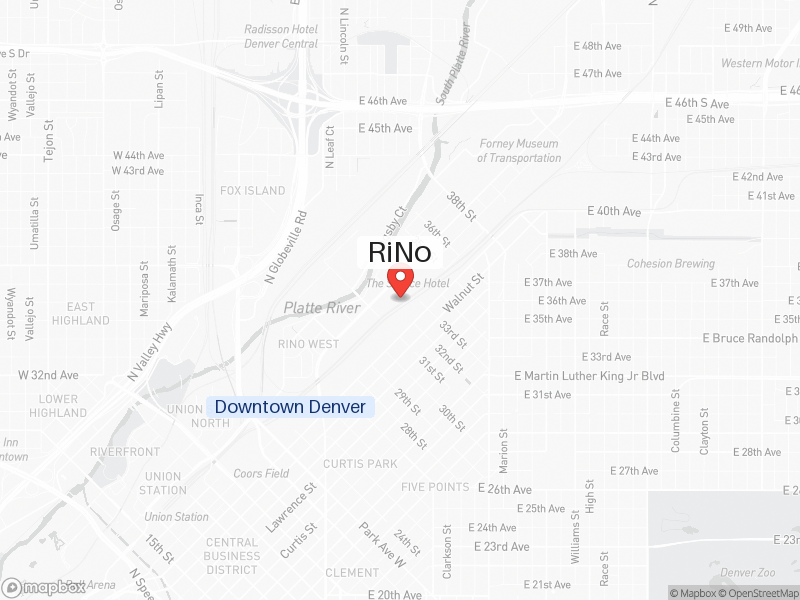
Living in RiNo
Getting Around
RiNo's standout transportation metric is its Bike Score of 97 out of 100 — Biker's Paradise — driven by an extensive network of bike lanes, strong road connectivity, and high bike-commuting patterns. The Platte River Trail runs approximately 1.33 miles through the neighborhood, connecting riders north and south along the river corridor [5]. Walking is easy too: a Walk Score of 76 out of 100 (Very Walkable) means most daily errands are on foot. Transit is functional — a Transit Score of 54 out of 100 (Good Transit) reflects meaningful bus and light-rail access — but if you're car-dependent, RiNo's proximity to I-70 and downtown makes driving straightforward [1].
The Houses and Streets
The homes here are genuinely mixed — there's no single defining style, but if you have a specific architectural taste, you'll likely find something. Walking the blocks you'll see older brick industrial conversions, newer townhomes and row homes, and a handful of smaller single-family homes that were here before the neighborhood changed. Residential and commercial uses sit side by side throughout.
New homes built between the older ones have picked up fast — modern townhomes and live-work units going up on lots that were previously commercial or vacant. You'll regularly see an older brick building sitting next to a brand-new three-story townhome on the same block. Lots here tend to be smaller than in most other Denver neighborhoods — that's what you give up to be this close to downtown and the river.
What's Around
RiNo's amenity profile is anchored by green space and an unusually dense food-and-drink scene. Globeville Landing Park is the largest named park in the area at approximately 10.4 acres, followed by Mestizo-Curtis Park at approximately 9.0 acres and RiNo Promenade at 7.2 acres [5]. The Platte River Trail connects the neighborhood to a broader trail network running north and south through the city [5].
The dining and drinking scene is one of the densest in Denver — the neighborhood contains over 60 bars, cafes, pubs, and restaurants within its boundaries [5]. favorites include Comal Heritage Food Incubator, Acorn, Izakaya Ronin, Will Call Tavern, Wystone World Teas Cafe, and Caffe Figurati [5]. The concentration of breweries and creative food concepts reflects the neighborhood's industrial-conversion character — these aren't white-tablecloth establishments, they're the kind of places that draw people from across the city on a Friday night.
Schools
RiNo is served by Denver Public Schools [6]. RiNo is in the Greater Five Points/Central Elementary School Enrollment Zone, which means you can choose from 8 Denver Public Schools rather than being assigned to one. The zone schools are: Cole Arts and Science Academy (Priority Improvement Plan), Columbine Elementary (Performance Plan), Garden Place Academy (Improvement Plan), Swansea Elementary (Priority Improvement Plan), University Prep - Arapahoe St. (Improvement Plan), University Prep - Steele St. (Performance Plan), Whittier ECE-8 School (Performance Plan), and Wyatt Academy (Performance Plan) [6].
At the middle level, RiNo is in the Near Northeast Middle School Enrollment Zone, offering 4 DPS choice schools: Bruce Randolph Middle School (Improvement Plan), DSST: Cole Middle School (Improvement Plan), Manual Middle School (Improvement Plan), and Whittier (Performance Plan) [6].
At the high school level, RiNo is assigned to Manual High School (1700 East 28th Avenue, Denver 80205; grades 9-12; enrollment 313), which received a Priority Improvement Plan rating in the 2024-25 framework [6].
Who Lives Here
Most residents here are renters — only 22% of homes are owner-occupied, among the lowest of any Denver neighborhood [7]. Neighbors move more often than you'd see somewhere with more owners, so if you're planning to stay a while, that's worth thinking about. Most households here are one or two people [7]. Median household income is $116,461, and average household size is 1.7 persons — consistent with a younger, smaller-household profile [7].
Buying in RiNo
The Market
Homes here are priced below Denver's typical single-family home, but that's because they're smaller and more varied — not because you're getting a discount on the location [3]. The median list price is $659,500, and higher-end homes are around $857,500, with prices per square foot ranging from $419 at the median to $568 at the upper end. Homes are selling in about 37 days, roughly in line with the rest of Denver [2][4].
With only 13 homes for sale, take those figures as a rough guide, not a precise number — there's more uncertainty here than in a higher-volume neighborhood. A newer townhome or live-work unit sells for materially more per square foot than an older single-family home on the same block, so what you're buying matters a lot [2]. Five Points next door — which shares a lot of RiNo's character — shows a median of $789,000 and homes selling in 25 days on a much larger sample of 47 listings, which gives you a useful sense of what the broader area looks like [8]. The spread between the $659,500 median and the $857,500 p75 is meaningful, and it reflects real variation in the stock: a newer townhome or live-work unit commands a materially different price per square foot than an older single-family home on the same block [2].
Strategy
That 37-day pace tells you the market is moving, but the thin inventory means you're not shopping from a wide selection. When a well-priced single-family home comes up here, you're competing against a small group of buyers who know the neighborhood well. Be ready to move within the first week — the homes that sit are the ones priced away from recent sales, not the ones priced right.
The gap between the median and the higher-end price is your signal that condition and finish drive price here more than location within the neighborhood [2]. A renovated or newer-construction home at the top of that range is a different buy than an unrenovated older home at the lower end. Know which you're buying before you make an offer — comparing recent sales looks different for each.
Rates are slightly higher than they were three months ago — the 30-year fixed is at 6.52% as of June 11, 2026 — but they're still lower than they were a year ago [9]. If you were priced out last summer, it's worth running the numbers again. The right home and the overpriced one can look similar from the outside — the difference shows up when you dig into the sales data. The rate environment adds some pressure: the 30-year fixed has climbed 41 basis points over the past three months to 6.52% as of June 11, 2026, though it remains 32 basis points below where it was a year ago [9].
Ready to See RiNo for Yourself?
If you're weighing RiNo against Five Points, LoHi, or another north-side Denver neighborhood, I'm happy to pull recent sales, show you what's active at your price point, and walk you through how the thin single-family supply here affects your options. Check out the Denver Market Update: May 2026 for the broader Denver context. Reach out — happy to talk through your situation.
Sources
- Walk Score
- Zillow listings data — RiNo (June 2026)
- Zillow listings data — Denver Metro Detached (June 2026)
- Federal Reserve Economic Data (FRED) — MEDDAYONMAR19740 (May 2026)
- OpenStreetMap
- CDE District + School Performance Framework (2024-25)
- U.S. Census Bureau ACS 5-year (2020-2024)
- Zillow listings data — Five Points (June 2026)
- Federal Reserve Economic Data (FRED) — MORTGAGE30US (June 2026)
---
Paul McCoy, Realtor | Fathom Realty | License #: FA.100105533 | (319) 325-0668 | pmccoy626@gmail.com
Paul McCoy is a licensed real estate professional in Colorado. Equal Housing Opportunity.