30-Year Fixed at 6.49%: The Buy-Down Is the Real Lever for Sellers
The 30-year fixed sits at 6.49% as of June 25, 2026. Here's the present-tense math on seller-paid buy-downs — and what Denver buyers and sellers should do about it.
As of June 27, 2026
If you're buying in Denver right now, stop negotiating the price and start negotiating the concession. The 30-year fixed is at 6.49% as of the week of June 25, 2026 — and at that rate, a seller-paid 2-1 buy-down delivers $790/month more payment relief in year one than the same dollars applied as a price cut. That's not a close call. That's the whole negotiation.
The Rate This Week: 6.49% and What It Actually Means
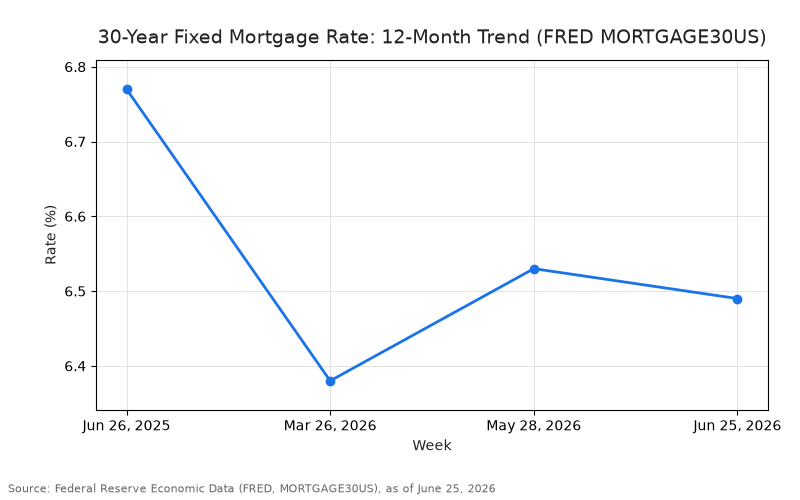
The 30-year fixed came in at 6.49% for the week of June 25, 2026, per FRED [1]. That's down from 6.77% a year ago [2] — a real improvement over that stretch, though it's been choppy recently: rates were at 6.38% in late March [1] and 6.53% in late May [1].
Here's what that looks like in dollars: on a $750,000 Denver purchase with 5% down — a $712,500 mortgage — your monthly principal and interest payment at 6.49% is $4,499 [3]. That's $132/month less than you'd have paid at last June's 6.77% [4]. The year-over-year improvement is real. But at that rate, the payment still stretches most buyers — and that's exactly where asking for a buy-down earns its keep.
What 6.49% Costs You — and What a Buy-Down Changes
Let's use the same scenario throughout: $750,000 purchase, 5% down, $712,500 mortgage, 30-year fixed at 6.49%.
At that rate, your payment is $4,499/month [3]. Now here's what a seller-paid 2-1 buy-down does to that number:
- Year one (rate: 4.49%): payment drops to $3,606/month — a $893/month reduction [6][8]
- Year two (rate: 5.49%): payment is $4,041/month — a $458/month reduction [6][8]
- Year three onward: payment steps back up to the full $4,499 at the 6.49% note rate [6][8]
The cost to the seller: approximately $16,212 — the total payment subsidy over those first two years [7].
Now compare that to the alternative. Take that same $16,212 and apply it as a straight price cut. The loan drops from $712,500 to $696,288, and the buyer's monthly payment falls by $103/month — permanently [9].
Same $16,212 from the seller. The buy-down delivers $893/month in year one. The price cut delivers $103/month. That's the math [10].
Why This Is the Right Moment to Negotiate in Denver
Denver's detached single-family market in June 2026 is the setup this strategy was built for. The metro-wide sale-to-list ratio sits at 0.999 [18] — buyers are negotiating fractionally below ask on average. Active inventory is down 7.2% year-over-year [14], so supply is tighter than it was, but the median days on market for single-family homes is 37 days [13], and there's a meaningful stale-inventory tail: individual listings have sat for 201, 267, and 407 days [20][21][22], signaling that sellers on those properties have real motivation.
The median detached list price in the active Denver market is $800,000 [11], well above the metro-wide all-property-type median of $589,000 [24]. At that price point, buyers are stretched — and sellers who want to move their listing have a tool that costs them roughly the same as a price cut but moves the buyer's payment far more.
This is a Denver story, not a national one. Inventory is still tight, homes are moving at that 37-day pace, and sellers are getting essentially what they're asking. That means sellers are competing for buyers — and the buy-down is the most efficient concession they can offer.
The Take: A Buy-Down Moves More Payment Per Dollar Than a Price Cut
For the same $16,212 in seller help, a 2-1 buy-down delivers $790/month more payment relief in year one than an equivalent price reduction [10]. That's not a close call.
The short window is actually a feature, not a flaw. The buy-down front-loads the relief into years one and two — when you're most stretched, carrying moving costs, furnishing the new place, and adjusting to a new payment [8]. By year three, the payment steps back to 6.49%. You know this going in. You're not hiding anything from yourself — you're solving the right problem at the right time.
A price cut's $103/month relief is permanent — but it's small enough that you probably won't feel it day-to-day. The buy-down's $893/month in year one is large enough to change the decision. That's why it closes deals.
You don't need a rate forecast here. This works at today's rate regardless of where rates go. If rates fall and you refinance in year two, you've captured the benefit for the period you needed it most. If rates stay flat, you've had two years of materially lower payments. Either way, the math at closing favors the buy-down over the price cut.
What It Means for Denver Buyers and Sellers
If you're buying at today's 6.49% rate, a seller-paid 2-1 buy-down is a legitimate negotiating ask — not an exotic request. On a $750,000 purchase, you're asking the seller to fund approximately $16,212 in concessions structured as a buy-down rather than a price reduction. In exchange, your year-one payment drops from $4,499 to $3,606 — $893/month back in your pocket when you need it most [6][8]. In a market where homes are selling for about what sellers are asking [18] and some listings have been sitting for months [20][21][22], this is a reasonable ask on the right property.
If you're selling, know this before you default to a price cut. The Denver single-family median is $800,000 [11] and buyers at that price are stretched on payment. Offering $16,212 as a buy-down instead of a price reduction costs you roughly the same net — but it moves the buyer's payment by nearly nine times as much in year one [10]. On a listing that's been sitting, that's the difference between a deal and another week on market.
Run the Real Numbers on Your Denver Purchase or Sale
We run this math for our clients every week — the buy-down cost, the year-one savings, the break-even against a price cut, all of it specific to your purchase price and down payment. If you're buying or selling in Denver and want to see how this works on your actual numbers, reach out directly. No rate speculation — just the math that applies to your situation today.
---
Paul McCoy, Realtor | Fathom Realty | License #: FA.100105533 | (319) 325-0668 | pmccoy626@gmail.com
Paul McCoy is a licensed real estate professional in Colorado. Equal Housing Opportunity.