Lock or Float? The Rate Decision Denver Buyers Face Right Now
The 30-year fixed rate is moving. Here's the plain-language math Denver buyers need to decide whether to lock now or float — no guessing, no predictions.
As of August 11, 2026
If you're under contract on a Denver home right now — or about to go under contract — you're sitting with a real decision: lock your rate today or float and hope for something better at closing. At 6.67% on the 30-year fixed (FRED, week of August 13), that choice has a concrete dollar value. On a $750,000 purchase with 5% down, a quarter-point move in either direction shifts your monthly payment by $119 up or $117 down. That's not abstract. That's your grocery budget.
How a Rate Lock Actually Works — and Where the Risk Lives
A rate lock freezes your interest rate for a defined window — typically 30 to 60 days — so the payment your lender quotes you today is the payment you close with, regardless of what rates do between now and then.
Floating means you don't set your rate until closing. If rates fall, you get the lower rate. If they rise, you pay more. Neither choice is free.
Locking removes both the upside and the downside. You give up the chance of a lower rate in exchange for knowing exactly what your payment will be. Floating keeps both possibilities open — but on a Denver-sized loan, the range of outcomes is wide enough that the uncertainty itself has a price tag.
The question isn't where rates are going. Nobody knows that. The real question is: how much payment uncertainty can you absorb, and what is it worth to eliminate it?
What the Numbers Actually Show Right Now
At today's 6.67% rate, a buyer putting 5% down on a $750,000 Denver home carries a $712,500 mortgage with a monthly principal-and-interest payment of $4,583. If rates move a quarter point in either direction before closing, here's what happens to that payment:
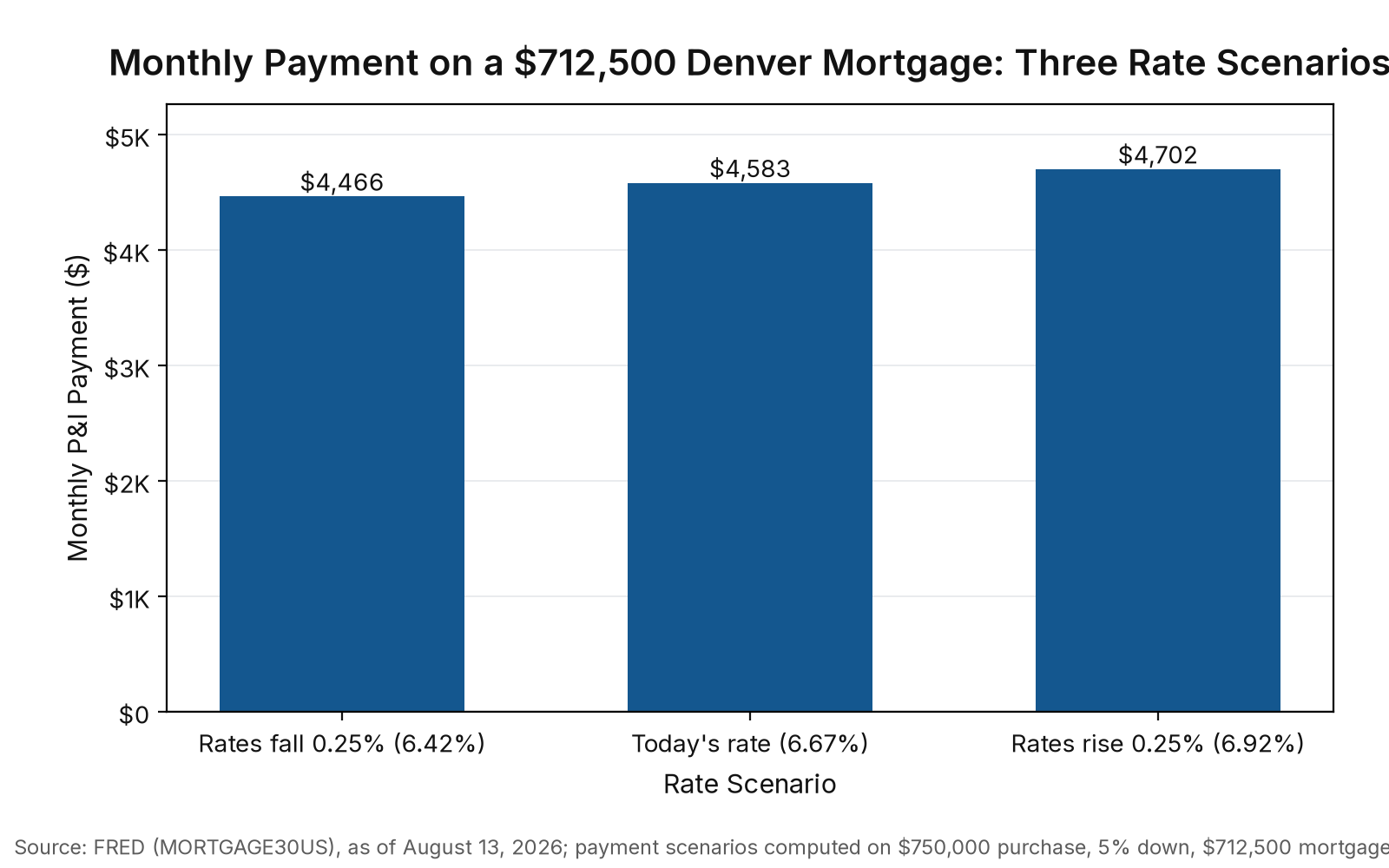
The spread between the worst and best scenario — $119/month up versus $117/month down — is the price of the uncertainty a float carries. Locking today buys you certainty that your payment stays at $4,583. Floating keeps the door open to $4,466, but also to $4,702.
For context: over the past three months, the 30-year fixed has risen from 6.36% in mid-May to where it sits today — a move that's already added $56/month to the payment on this same loan. Standard rate locks run 30 to 60 days; extensions are available but typically come with a fee — check with your lender on the specifics.
Why This Decision Hits Differently in Denver
Denver loan sizes are larger than the national median. The Denver-area median listing price across all property types is $579,798 (FRED MSA, July 2026) — and buyers targeting single-family homes are looking at a median active list price of $800,000. On a larger loan, the same quarter-point rate move produces a larger dollar swing than it would in most U.S. markets — and at that loan size, a quarter-point rise costs $119/month more.
The second Denver-specific angle: the current market is balanced enough that sellers are open to concessions. Homes across Denver are selling for about what sellers are asking (Zillow Research, June 2026). In that environment, asking for a seller-paid rate buy-down is a legitimate negotiating move — and locking your rate and asking for a buy-down concession are not mutually exclusive. You can do both.
The Plain-Language Verdict: When Locking Makes Sense Right Now
For most buyers under contract with a closing date inside the standard 30-to-60-day lock window, locking is the right default — not because rates are going up (I'm not predicting that), but because knowing exactly what your payment will be is worth giving up the chance of a slightly lower rate. Locking eliminates that exposure entirely.
The one legitimate reason to float: if your closing timeline is longer than a standard lock window and your lender offers a float-down provision — meaning you can capture a rate drop without being exposed to a rise — that's worth asking about. Availability varies by lender; don't assume it's on the table.
If you build your offer around a payment you've locked in, you're in a much stronger position than if you're building around a rate you're hoping for.
What This Means for Buyers — and for Sellers
For buyers:
- Confirm your lock window covers your actual closing date. A mismatch means either paying for an extension or floating the tail end of the transaction. Get the exact window from your lender before you lock.
- Ask your lender whether a float-down option is available. It typically costs more upfront, but it lets you capture a rate drop without giving up your floor.
- Ask the seller for a rate buy-down instead of — or in addition to — a price cut. A seller-paid 2-1 buy-down on this loan costs the seller $16,344 and cuts your payment by $901/month in year one and $461/month in year two. The same $16,344 as a price cut lowers your payment by $105/month — permanently, but far less relief when you're most stretched.
For sellers:
- Your ability to close is tied to your monthly payment, not just the purchase price. Offering a buy-down concession directly addresses the payment problem and can be more effective at keeping a deal together than a price reduction of the same dollar amount.
- If your home has been sitting, the rate environment may be part of what's slowing things down. A buy-down offer moves the payment needle in a way a modest price cut often can't match. For more on how the current Denver market is shaping buyer and seller leverage, see Who Has the Advantage in Denver Right Now — Buyers vs. Sellers.
Run the Real Numbers on Your Denver Deal
Rate volatility isn't going away — it's the environment you're buying in right now. The buyers who move with confidence are the ones who know their payment before they make their offer, not after.
If you're working through the lock-vs-float decision on your specific loan, timeline, and closing date, I'm happy to run through it with you. Schedule a 20-minute conversation and we'll look at your actual numbers — so you can decide based on your situation, not a general rule.
---
Paul McCoy, Realtor | Fathom Realty | License #: FA.100105533 | (319) 325-0668 | pmccoy626@gmail.com
Paul McCoy is a licensed real estate professional in Colorado. Equal Housing Opportunity.