Uptown, Denver: A Walkable Urban Neighborhood Guide
Thinking about living in Uptown Denver? Get the real picture — walkability, home prices, schools, and what the market looks like right now — in one place.
Uptown at a Glance
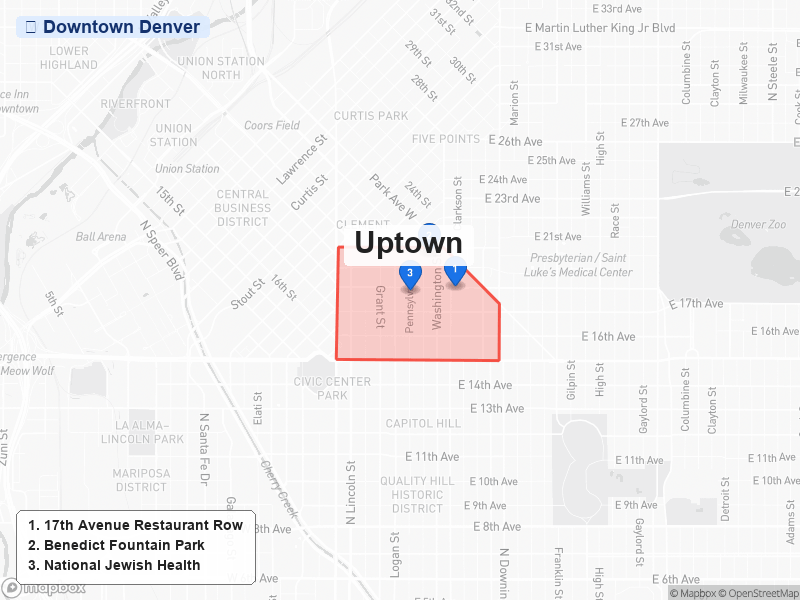
Uptown is just a few blocks northeast of downtown and puts you right in the center of everything. It's one of Denver's most walkable and bikeable neighborhoods — almost every errand can be run on foot, and you have easy access to public transit as well [1]. The dining and nightlife scene along East 17th Avenue is what most buyers come here for first, and the neighborhood delivers on that front with over 40 restaurants, bars, and cafes packed into a compact area [2].
The single-family market here is small and moves slowly — homes are sitting on the market well above the Denver metro pace, and the handful of detached listings available at any given time means you're working with limited options [3]. If you're comparing Uptown to Capitol Hill next door, both neighborhoods carry similar price points in the upper six figures to low seven figures for single-family homes [3][4].
Living in Uptown
Getting Around
You can get anywhere you need quickly and easily and run almost every errand on foot, with a Walk Score of 95 and a Bike Score of 97 [1]. Transit access is also strong — Uptown's Transit Score of 77 leads most Denver neighborhoods, making it a genuinely useful option for car-light living [1].
| Neighborhood | Walk Score | Bike Score | Transit Score |
|---|---|---|---|
| Uptown | 95 | 97 | 77 |
| Capitol Hill | 95 | 97 | — |
Uptown and Capitol Hill score the same on walkability and biking — where Uptown pulls ahead is transit, and it's not close [1]. If transit is important to you, you'll want to pay close attention to where in the neighborhood you live, since access can vary by a few blocks.
The Houses and Streets
Uptown is mostly multi-family — apartments, condos, and older brick buildings make up the bulk of what you see walking the streets. Single-family homes are less common here, but there are older brick and Victorian-era homes scattered through the neighborhood that do come up for sale. The housing mix reflects the neighborhood's dense, urban character: smaller lots, buildings close to the street, and a lively pedestrian environment right outside the front door.
New construction has filled in some gaps alongside the older stock, so you'll see a range of building ages and styles on the same block. If you have a specific architectural taste, you'll likely find something — the variety here is real.
What's Around
Uptown gives you a premier dining and nightlife scene with over 40 restaurants, bars, and cafes [2]. Popular spots include City Grille and 1Up Colfax Arcade & Bar for nightlife, Fluid Coffee Bar for your morning routine, and Shish Kabob Grill and Velvet Banjo for casual dining [2]. Since you are right next to downtown, the one trade-off for the lively scene is less access to parks and green open space — but City Park is a great option a short distance to the east.
Schools
Uptown is served by Denver Public Schools [5]. For elementary school, Uptown falls within the Greater Five Points/Central Elementary School Enrollment Zone, which means you can choose from eight DPS schools through the SchoolChoice process rather than being assigned to one [5]:
| School | Grades |
|---|---|
| Cole Arts and Science Academy | K–5 |
| Columbine Elementary | K–5 |
| Garden Place Academy | K–5 |
| Swansea Elementary | K–5 |
| University Prep - Arapahoe St. | K–5 |
| University Prep - Steele St. | K–5 |
| Whittier ECE-8 School | ECE–8 |
| Wyatt Academy | K–5 |
From there, students feed into DSST: Cole Middle School (grades 6–8) and East High School (grades 9–12) [5].
Who Lives Here
Most residents in Uptown are renters — only about 13% of homes are owner-occupied, which is among the lowest of any tracked Denver neighborhood [6]. Households tend to be small, averaging about 1.4 persons, and median household income is approximately $83,161 [6]. With renters making up the vast majority of the neighborhood, turnover is higher than in owner-heavy neighborhoods. If you're planning to stay a while, that's worth thinking about.
Buying in Uptown
The Market
Uptown's single-family market is thin and moves slowly. The median list price sits at $975,000, with higher-end homes around $1,297,500 — so there's a wide range depending on what you're looking at [3]. Homes here are sitting on the market for a median of 102 days, well above the Denver metro's pace [3][4]. That extended time on market reflects the small buyer pool for single-family homes in a neighborhood that's predominantly rental and multi-family.
| Neighborhood | Median list price | Price per sq ft | Median days on market | As of |
|---|---|---|---|---|
| Uptown | $975,000 | $292 | 102 days | Aug 2026 |
| Capitol Hill | $1,100,000 | $326 | 69 days | Aug 2026 |
| Denver metro (detached) | $800,000 | — | 41 days | Aug 2026 |
The sample here is small — only a handful of detached listings at any given time — so take these figures as a rough read rather than a precise benchmark [3]. The wide price range across listings reflects significant variation in property size and condition.
Strategy
That pace tells you something important: buyers here are not in a rush, and sellers know it. You have time to be selective and thorough. That said, the thin inventory means genuinely well-priced homes are rare — when something good comes up, it's worth moving on it.
The wide spread between the median and the upper end of the market means comp selection matters a lot here. Homes that look similar from the outside can be priced very differently based on condition, interior finish, and lot position. I'd recommend getting a detailed comp analysis before making any offer — not just a quick neighborhood average. The right home and the overpriced home can look similar from the outside; the difference shows up when you compare recent sales, and that's exactly what I'll walk you through.
Ready to See Uptown for Yourself?
If you're weighing Uptown against Capitol Hill, RiNo, or other walkable central Denver options, the lifestyle and price trade-offs are real and worth walking through with current data in hand. Uptown's transit access and dining scene are hard to match — but the thin detached inventory and high renter turnover are factors that matter depending on what you're looking for. Check out the Denver Market Update for the latest on how the broader market is moving, and if you want to dig into what's available in Uptown specifically, I'm happy to pull recent closings and show you what's active at your price point. Book a consultation and let's talk through your situation.
Sources
- Walk Score
- OpenStreetMap
- Zillow — Uptown listings (August 2026)
- Zillow — Capitol Hill listings (August 2026); FRED (MEDDAYONMAR19740, July 2026)
- Denver Public Schools SchoolChoice; CDE District + School Performance Framework (2024-25)
- U.S. Census Bureau ACS 5-year (2020-2024)
---
Paul McCoy, Realtor | Fathom Realty | License #: FA.100105533 | (319) 325-0668 | pmccoy626@gmail.com
Paul McCoy is a licensed real estate professional in Colorado. Equal Housing Opportunity.