Jumbo Loans in Denver: What Buyers Need to Know
Buying above Denver's conforming loan limit? Learn how jumbo loans work, what lenders require, and how to navigate financing in Denver's luxury market.
If you're shopping for a home in Denver above the mid-$800s, there's a good chance you'll end up in jumbo loan territory — whether you planned on it or not. The typical single-family home in the Denver Metro lists at $800,000, and higher-end homes are around $950,000. Put 10% down on a home at either of those price points and your loan amount likely clears the 2026 conforming loan limit. You're looking at a different loan with different rules.
That shift matters more than most buyers realize. A jumbo loan isn't just a bigger conforming loan — lenders hold it on their own books instead of selling it to a government agency, which changes the underwriting standards, the documentation requirements, and how much rates vary between lenders. Understanding loan requirements Denver buyers typically face at this price level before you start touring is the difference between a smooth pre-approval and a deal that falls apart after you've found the home you want.
This post walks through what a jumbo loan is, how the underwriting differs from a conventional loan, what rates look like, how Denver's luxury neighborhoods translate into loan sizes, and what to prepare before you talk to a lender.
Why Jumbo Financing Comes Up So Often in Denver
Denver's price structure pushes a lot of buyers into jumbo territory without them expecting it. The typical single-family home in the Denver Metro lists at $800,000 — and that's the midpoint, not the top. Higher-end homes are around $950,000. When you factor in a 10% or 20% down payment at those price points, the resulting loan amount frequently crosses the 2026 FHFA conforming loan limit for Denver County.
The conforming limit is the threshold that separates conventional mortgages — the ones Fannie Mae and Freddie Mac can buy — from jumbo loans. Denver County is part of the Denver-Aurora-Lakewood metro area, and the 2026 limit for this area wasn't available when this was written. What is clear from the market data: at those price points, a lot of buyers will find their loan amount above whatever that limit is, especially if they're putting less than 20% down.
The current rate environment for Denver buyers adds another layer. The 30-year fixed conforming rate is 6.65% as of late August 2026. Jumbo rates move independently of that benchmark — sometimes higher, sometimes right in line with it.
What a Jumbo Loan Actually Is
A jumbo loan is a mortgage whose principal exceeds the FHFA conforming loan limit for the county where the property is located. Once your loan amount clears that threshold, Fannie Mae and Freddie Mac cannot purchase or guarantee the loan. That's the defining line.
Why does that matter? Conforming loans are pooled and sold to Fannie and Freddie, which keeps rates relatively competitive. Jumbo loans don't work that way. The lender keeps the loan on their own books, which changes the risk math entirely — they're on the hook for the full amount for the life of the loan, and they underwrite accordingly.
The practical result: jumbo loans have stricter qualification standards, more documentation requirements, and rates that reflect each lender's own appetite for risk rather than a standardized agency rate. Two lenders can offer meaningfully different rates on the same jumbo loan because there's no agency floor setting a baseline.
How Jumbo Underwriting Differs from a Conventional Loan
Jumbo underwriting is stricter than conforming in four ways. Here's what you need to clear.
Credit Score
Jumbo lenders typically want a score of 700 or above, and some set the bar even higher. A score that qualifies you for a conforming loan may not be enough for a jumbo. If you're in the high-600s, get your score up before you apply — this isn't a gap a lender can work around.
Down Payment
Most jumbo lenders require at least 10% down, and many prefer 20%. Some lenders will go lower if you have strong assets, but 10–20% is the range you should plan around. At Denver's price points, that's a significant capital commitment before you even get to closing costs.
Debt-to-Income Ratio
Conforming loans allow debt-to-income ratios up to 45–50% in some cases. Jumbo lenders typically run tighter — many cap it in the low-to-mid 40s, and some go lower. If you're carrying student loans, car payments, or other debt alongside a large mortgage, run your numbers before you apply.
Cash Reserves
This is the one that catches the most buyers off guard. Jumbo lenders commonly require six to twelve months of your full housing payment — principal, interest, taxes, and insurance — in liquid assets after closing. That means after your down payment and closing costs, you still need to show a substantial cushion. If you've depleted your savings to make the down payment, you may not clear this test even if your income and credit are strong.
One important note: jumbo guidelines vary by lender because these are portfolio products, not agency rules. If you don't qualify at one lender, you may qualify at another with a slightly different set of guidelines. Shopping multiple lenders isn't optional — it's how you find the right fit.
Jumbo Loan Rates: How They Compare to Conforming Rates
The 30-year fixed conforming rate is 6.65% as of August 20, 2026, up 7 basis points from a month ago and up 7 basis points year-over-year from 6.58% a year prior.
Jumbo rates have historically tracked conforming rates closely — sometimes running slightly higher, sometimes right in line or even below, depending on how aggressively banks want to build their jumbo books. When banks are actively growing those books, they price aggressively to attract high-balance borrowers. When they're pulling back, the gap widens. Where rates sit right now between the two wasn't available when this was written, which is exactly why shopping around matters more in the jumbo market than in the conforming market.
On a loan of $1 million or more, a 0.25-point difference across lenders adds up to real money every month — and compounds significantly over the life of the loan. There's no agency floor setting a rate baseline in the jumbo market. Every lender prices based on their own book, their own cost of funds, and their own risk appetite. That variation is your opportunity if you shop it.
What to do: Get rate quotes from at least three lenders with active jumbo portfolios before you commit. Include a private bank or wealth management lender if you have an existing relationship — those relationships can influence rate and terms in ways that don't exist in the conforming market.
What Denver's Luxury Price Bands Mean for Your Loan Size
The conforming limit gets real fast when you look at what homes actually cost in Denver's higher-priced neighborhoods. Cherry Creek, Hilltop, and Wash Park are three of the neighborhoods where buyers most commonly encounter jumbo territory — and the price points there make the math clear.
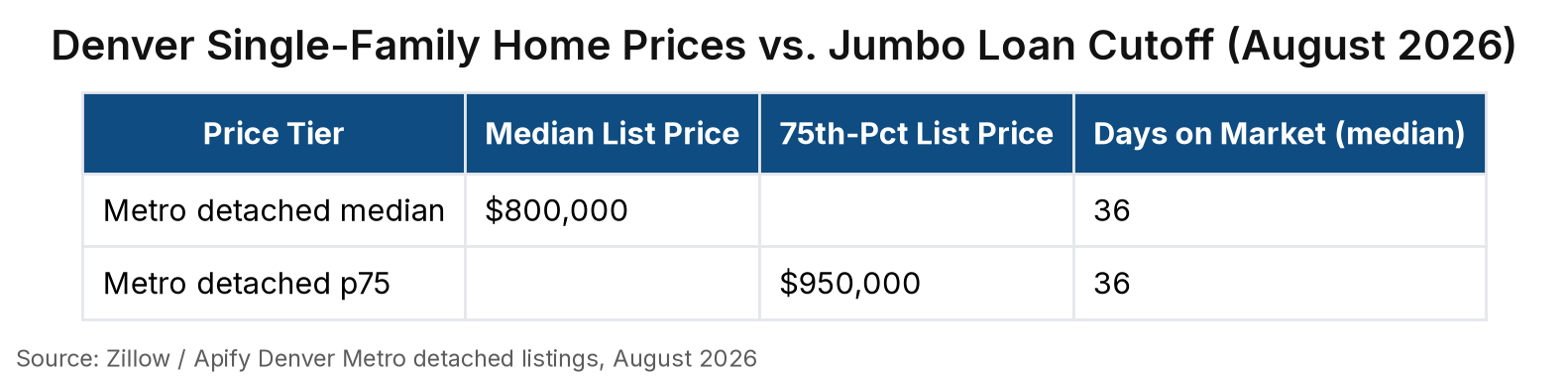
The table below shows how the metro-level price data translates into loan sizes at two common down-payment levels.
| Scenario | Home Price | Down Payment % | Loan Amount |
|---|---|---|---|
| Metro detached median, 10% down | $800,000 | 10% | Likely above conforming limit |
| Metro detached median, 20% down | $800,000 | 20% | Near or above conforming limit |
| Metro detached p75, 10% down | $950,000 | 10% | Likely above conforming limit |
| Metro detached p75, 20% down | $950,000 | 20% | Near conforming limit |
The point isn't the specific loan amounts — it's that at Denver's current detached price levels, even a 20% down payment on a median-priced home leaves you close to or above the conforming threshold. In Cherry Creek and Hilltop, where upper-tier inventory runs well above the metro median, jumbo financing is the default assumption, not the exception.
If you're shopping in any of these neighborhoods, start your jumbo pre-approval conversation before you start touring. Finding a home you love and then discovering your financing doesn't work is a painful way to learn this lesson. For more context on who holds the advantage in Denver's market right now, the current market dynamics are worth understanding before you make an offer.
The Jumbo Pre-Approval Process: What to Prepare
Jumbo pre-approval takes longer and requires more documentation than a conforming loan. Plan for 30–45 days minimum — jumbo loans stay on the lender's books and get reviewed manually, which takes more time than the automated process for conforming loans.
Here's what a jumbo lender will typically want beyond a standard conforming application:
- Two years of tax returns — both W-2 and, for self-employed buyers, business returns. The lender is looking at your income history, not just your current earnings.
- Two months of bank and investment statements — all accounts, including retirement accounts that count toward reserves.
- Documentation of all liquid reserves — this is where the post-close reserve requirement gets verified. Every account that contributes to your reserve cushion needs a paper trail.
- For self-employed buyers: a CPA letter or year-to-date P&L — lenders want to see that your business income is stable and that your reported income reflects what you're actually earning today.
One distinction worth knowing: jumbo loans are portfolio products. If you have a private banking relationship or a wealth management account at a bank that also does jumbo lending, that relationship can get you a better rate and terms. Ask before you assume you need to start from scratch with a new lender.
Common Jumbo Pitfalls Denver Buyers Run Into
Assuming the Rate Will Be Close to Conforming
Jumbo rates vary widely by lender. If you get one quote and assume it's representative, you can easily leave a real rate difference on the table. The conforming market has an agency floor that compresses variation; the jumbo market doesn't. Shop at least three lenders.
Underestimating the Reserve Requirement
If you put 20% down on a $950,000 home, that's a significant outlay. If it depletes your liquid savings, you may not clear the reserve test even if your income and credit are strong. The reserve requirement is based on your full housing payment — principal, interest, taxes, and insurance — and six to twelve months of that on a large loan is a substantial number. Know where your reserves stand before you commit to a down-payment amount.
Appraisal Risk on High-Value Properties
Jumbo lenders often order two appraisals on high-value properties, and a low appraisal on a home above the conforming threshold can derail a deal. In a market where what it actually costs to buy the median Denver home is already a stretch for many buyers, an appraisal gap on a $1.5M+ property is a serious problem. Make sure how you put the offer together accounts for this risk — and know what your options are if the appraisal comes in short.
Self-Employed Income Documentation
Two years of declining business income can disqualify you even if your current income is strong. Jumbo lenders look at the trend, not just the most recent year. If your business had a down year — even if you're now earning more — the lender may average the two years or use the lower figure. If you're self-employed, review your tax returns carefully before applying and talk to a lender early about how your income will be calculated.
Ready to Finance Above the Conforming Limit?
Understanding the jumbo threshold and underwriting criteria is step one. Knowing which lenders and loan structures fit your income, assets, and target price range is the work — and that's where having the right agent matters.
When we talk, here's what I'll bring: lender referrals with active jumbo portfolios and real experience in Denver's higher-priced neighborhoods, a clear read on how your target price range translates into loan size relative to the conforming limit, and a plan for how to sequence your pre-approval before you start touring. You bring your target neighborhoods, your timeline, and a rough sense of your income and assets. We'll figure out the right path from there.
Book a consultation and let's work through your situation.
---
Paul McCoy, Realtor | Fathom Realty | License #: FA.100105533 | (319) 325-0668 | pmccoy626@gmail.com
Paul McCoy is a licensed real estate professional in Colorado. Equal Housing Opportunity.