Denver vs. Dallas Cost of Living for Relocating Buyers
Comparing Denver and Dallas on home prices, taxes, cost of living, and market pace — so relocating buyers know exactly what to expect before they move.
If you're relocating from Dallas to Denver, the first thing to know is that these two cities are not a straight swap. Home prices are higher here, taxes work differently, and the market moves at a different pace. What you're used to in DFW won't map cleanly onto what you'll find here.
Thousands of people make this move every year — Texas is the second-largest source of new Denver residents here, behind only California. They figured it out. This guide will help you do the same, faster, with the actual numbers in front of you.
We'll cover home prices and market pace, overall cost of living, and what's genuinely different about owning a home in Denver versus Texas. By the end, you'll have a clear picture of what your dollar buys here and what to budget for that you might not have thought about. The good news: roughly 10,486 people made this move in the most recent IRS migration data — Texas ranks as the second-largest source of new Denver-metro residents, behind only California.
Home Prices and Market Pace
Denver homes cost more per square foot than Dallas, and the gap is real.
Dallas median list price and price per square foot
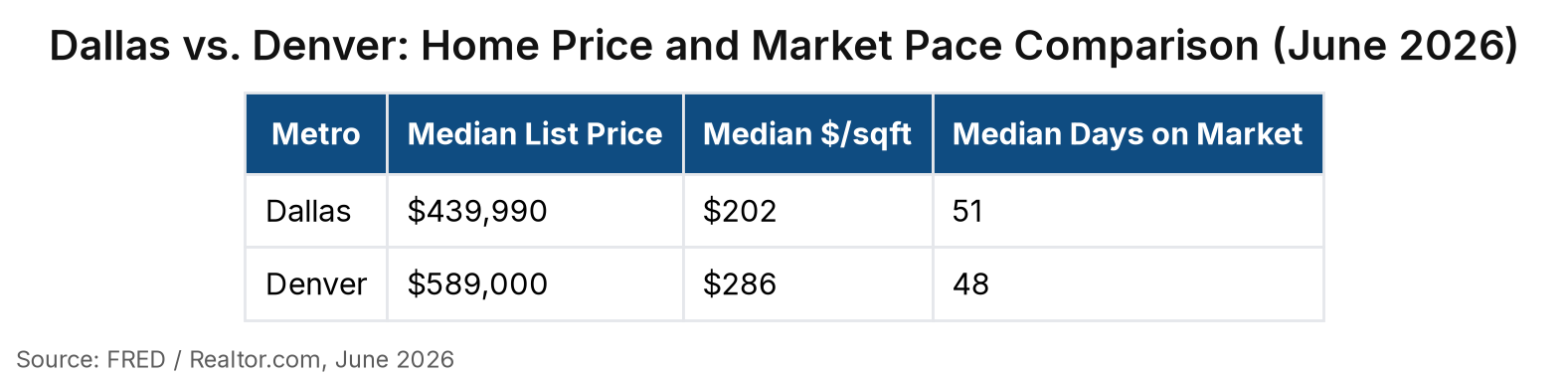
The Dallas metro's median list price across all home types was $439,990 as of June 2026 — essentially flat year over year. At $202 per square foot, DFW delivers a lot of space for the money. Homes in Dallas sat on the market for a median of 51 days in June 2026 — active, but not frantic.
- Why buyers love it: Large lots, newer construction, and more square footage per dollar than most major metros
- Typical prices: $439,990 median (all home types); $202/sqft
- Market pace: 51 days median on market — buyers have time to think
If you've been shopping in DFW, you're used to getting more house for your money. Reset that expectation before you start touring here.
Denver median list price and price per square foot
Denver's median list price was $589,000 in June 2026 — down 3.4% year over year. Prices have come off their peak, but at $286 per square foot you're still paying well above what you'd pay in Dallas. Plan around that gap.
- Why buyers love it: Proximity to mountains, 245 days of sunshine per year (per NOAA climate normals), and a walkable urban core in neighborhoods like Capitol Hill and Highlands
- Typical prices: $589,000 median (all home types); $286/sqft
- Market pace: 48 days median on market — slightly faster than Dallas
Single-family homes specifically have a median list price of $800,000 in July 2026, with higher-end homes starting near $999,500. If you're targeting a house rather than a condo or townhome, budget from that number — the all-property-types median understates what you'll actually pay.
Days on market: how fast each city moves
Denver and Dallas are closer in pace than most people expect — Dallas at 51 days, Denver at 48. Neither city is a bidding-war market right now. Homes here are selling for about what sellers are asking, not above it. You can negotiate, but don't expect a big discount off a well-priced listing.
- Why this matters: You have time to do proper due diligence — inspection, title review, financing — without the pressure of a 72-hour offer deadline
- Watch for: Homes that have been sitting on the market a long time — those usually have a pricing or condition issue, not a market-wide problem
- The pace signal: Closed sales in Denver rose 5.12% year over year in June 2026, so the market is moving faster than a year ago even as prices have softened
Overall Cost of Living: What Your Dollar Buys in Dallas vs. Denver
Home prices are the biggest line item, but they're not the whole picture. Here's how the two cities compare on cost of living and taxes.
BEA Regional Price Parity index — Dallas vs. Denver
The Bureau of Economic Analysis measures overall consumer prices across metros using Regional Price Parities, indexed to the U.S. average of 100. Dallas scores 103.1 for 2024 — about 3.1% above the national average. Denver scores 105.8 — about 5.8% above the national average. Overall consumer prices in Dallas run about 3% lower than in Denver.
- Why this matters: Groceries, services, dining, and everyday expenses cost somewhat more in Denver than in Dallas — not dramatically, but it adds up across a year
- Typical spread: The gap is real but not the dominant factor; housing is where the bigger adjustment happens
- The takeaway: Budget for a modest cost-of-living step-up beyond just the home price difference
State income tax: Texas zero vs. Colorado flat rate
Texas has no state income tax. Colorado charges a flat 4.40% on all taxable income (tax year 2025). That's a real difference on your paycheck, and it's worth running through your specific situation with a CPA before you move. The flat rate means it doesn't escalate as you earn more — every dollar gets taxed at 4.40%, which is well below what high earners pay in states like California. But compared to zero in Texas, it's a new line item.
- The offset: Colorado has no state estate tax and no inheritance tax — relevant if you're thinking about long-term wealth transfer
- Sales tax: Denver's combined sales tax rate is 9.15% (state plus RTD, Cultural Facilities District, and city), which is higher than Texas's statewide base rate — worth factoring into your day-to-day spending
Property tax effective rates: Texas vs. Colorado
Denver buyers are often surprised by how low property taxes are here. Colorado's effective property tax rate is approximately 0.50% of market value statewide — among the lowest in the nation. Texas property taxes are substantially higher; DFW suburbs run well above that rate.
- The practical effect: On a higher-priced Denver home, your annual property tax bill may be lower than what you paid on a less expensive Texas home — the rate difference is that significant
- Colorado reassesses to current market value — there's no Prop 13-style cap locking in an old assessed value, so your tax bill will move with the market over time
- Bottom line: The income tax you gain in Colorado is partially offset by the property tax you save — the net depends on your income and purchase price
What's Different About Owning a Home in Denver
Beyond price and taxes, owning a home in Colorado is genuinely different from Texas in a few ways. These are the ones that tend to catch people off guard.
Homeowners insurance: hail and wildfire exposure
You might expect Colorado to be cheaper to insure than Texas — it's not. The average homeowners insurance premium in Colorado runs about $4,963 per year for $300,000 in dwelling coverage (standard $1,000 deductible), versus about $4,085 per year in Texas. The difference comes down to hail. Denver gets significant hailstorms along the Front Range and insurers price that in.
- Why buyers are surprised: Texas has a reputation for severe weather, but Colorado's hail frequency in the metro area is underestimated
- Wildfire: Properties on the urban-wildland interface (foothills, mountain communities) carry additional exposure — less relevant for core Denver neighborhoods, more relevant if you're considering Jefferson County or the foothills
- Budget line: Plan for homeowners insurance costs above what you paid in Texas, not below
Air conditioning prevalence and altitude adjustment
About 95% of Texas homes have air conditioning — it's essentially universal. In Colorado, that figure drops to about 82%. Don't assume every Denver home has central AC the way it does in DFW; check the listing. Denver's lower humidity and higher elevation make summers more comfortable than Texas, but July and August afternoons still get hot, and a home without AC will feel it.
The altitude is real too. Denver sits at 5,280 feet above sea level. If you're coming from Dallas — essentially at sea level — expect 2 to 4 weeks to adjust: mild dehydration, some sleep disruption, and reduced exercise tolerance while your body catches up. It passes, but plan for it.
- Practical check: When touring homes, ask specifically whether the property has central AC, a swamp cooler, or nothing — the listing description doesn't always make this clear
- Snowfall: Denver averages approximately 49 inches of snow per year, concentrated December through April. It often melts quickly between storms, but you'll need a snow strategy — clearing the driveway, winter tires, and understanding that March and April are often the heaviest snow months
HOA prevalence in Denver vs. DFW suburbs
About 62% of Colorado homeowners live in an HOA, condo, or co-op — compared to about 32% in Texas. HOAs are far more common here, especially in newer suburban developments and condo buildings. If you're coming from a DFW neighborhood without one, you'll likely run into them here.
- What to read carefully: HOA reserve funds, special assessment history, and rental restrictions — these vary enormously and can materially affect your ownership experience and resale options
- Denver-specific: Denver Public Schools runs a district-wide open-enrollment system rather than strict neighborhood attendance boundaries. A home's address doesn't automatically lock in a specific school — you apply through the SchoolChoice process. Verify school options directly with DPS rather than assuming proximity equals enrollment
- Colorado contract mechanics: Real estate transactions here close through title companies, not attorneys. The inspection period is a negotiated date — commonly around 7 to 10 calendar days from acceptance, which is shorter than most out-of-state buyers expect. Earnest money is negotiable and typically around 1% of the purchase price. Radon testing is worth doing on almost any Colorado purchase — about 44% of Colorado homes test at or above the EPA's action level, well above the national average
So Which City Makes More Sense for Your Move?
Dallas gives you more square footage per dollar — $202 per square foot versus Denver's $286 — and a lower overall cost of living, no state income tax, lower homeowners insurance, and fewer HOAs. If getting the most space for the least monthly cost is your priority, Dallas wins.
Denver gives you something different: Colorado's 0.50% effective property tax rate (well below Texas's), 245 days of sunshine per year, direct access to mountains, and a flat 4.40% income tax that's lower than what high earners face in most other states. Prices are down 3.4% year over year, and homes are selling for about what sellers are asking — not above it.
The buyers who make this move and don't regret it are usually here for the lifestyle and planning to stay a while — not chasing the lowest possible monthly payment. If you're coming from Dallas with equity and a clear picture of what Denver costs, the math works. If you're expecting Dallas prices with Denver geography, you'll be disappointed.
The question isn't whether Denver is better than Dallas. It's whether what Denver offers — the mountains, the climate, lower property taxes, the specific neighborhoods you're targeting — is worth the premium you'll pay per square foot. For the thousands of people who made this move, it was.
Thinking About Relocating from Dallas to Denver?
If you're seriously looking at this move, I work with buyers coming from Dallas regularly and can show you exactly what your budget gets you in the neighborhoods you're considering — not city-wide averages, but specific streets and price points.
I also cover moving from Austin to Denver and a Denver vs. Chicago cost-of-living comparison if you're comparing multiple destinations.
Reach out and tell me your target neighborhoods and price range. I'll come back with recent comparable sales and a clear read on what's actually moving right now.
---
Paul McCoy, Realtor | Fathom Realty | License #: FA.100105533 | (319) 325-0668 | pmccoy626@gmail.com
Paul McCoy is a licensed real estate professional in Colorado. Equal Housing Opportunity.