City Park, Denver: Living Next to Denver's Signature Park
City Park sits at Denver's geographic and cultural center — home to the zoo, natural history museum, and a 315-acre park. Here's what buyers need to know about
City Park at a Glance
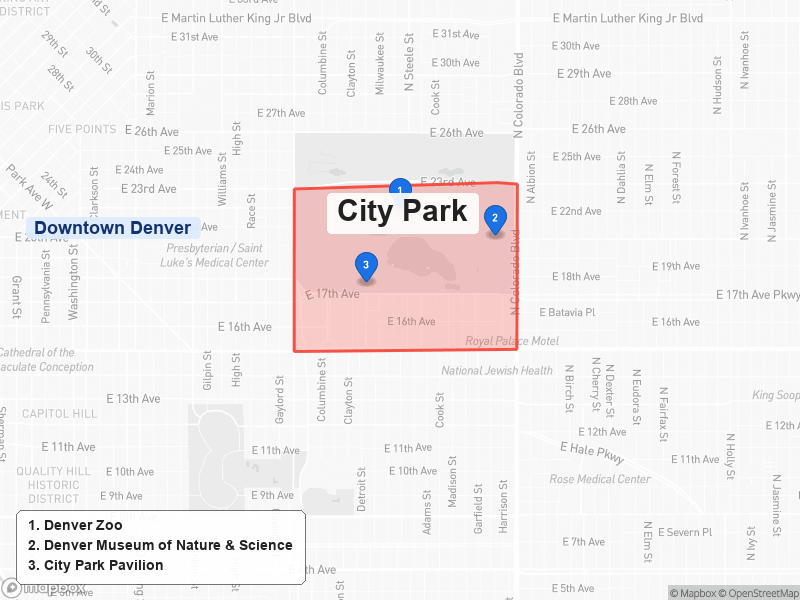
City Park is built around its 315-acre namesake park, putting the Denver Zoo and the Denver Museum of Nature & Science within walking distance of your front door [1]. That's a combination you don't find at this price point anywhere else in Denver, and it shapes everything about the neighborhood — the street grid, the weekend crowd, the pace of daily life.
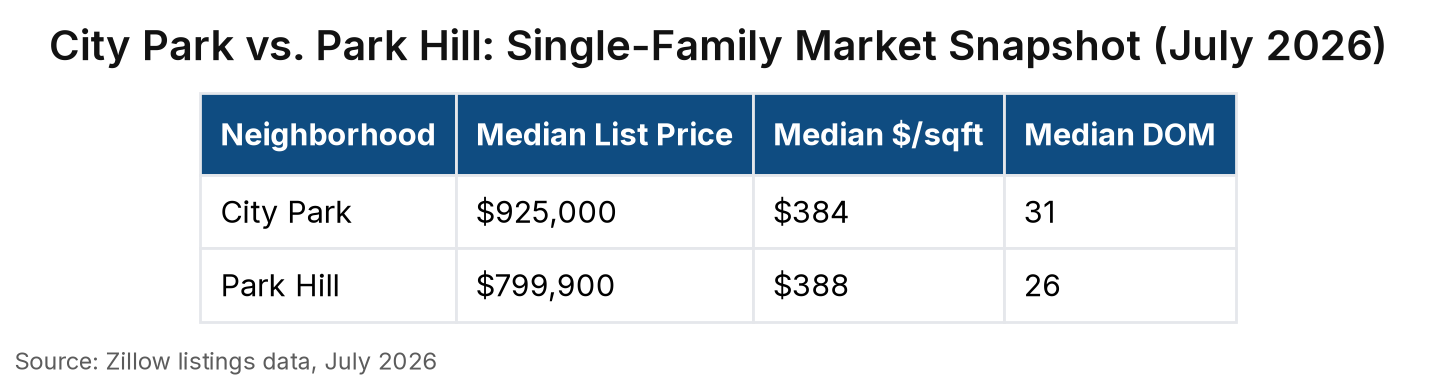
Homes here are priced above the Denver median — a typical single-family home lists at $925,000, with higher-end homes around $1,059,000 [2], compared to $825,000 across the metro [3]. They're also moving faster: 31 days on market here [2] versus 41 days metro-wide [3]. Well-priced homes don't sit.
Living in City Park
Getting Around
Biking is easy here — a Bike Score of 72 means good lanes and road connections for getting around on two wheels. Walking is a different story: a Walk Score of 44 means most errands need a car. If you're coming from a more walkable neighborhood, that's a real adjustment. Transit is in the middle — bus coverage exists, but there's no light-rail nearby [4]. If transit matters to you, pay close attention to where in the neighborhood you live. Transit sits in the middle at a Transit Score of 47 (Some Transit) — there's bus coverage, but no high-frequency rail at the neighborhood level [4].
The Houses and Streets
City Park's homes are a mix — older brick bungalows sit next to updated two-stories and new homes built between the older ones, especially on the blocks closer to the park. Unlike Park Hill, which has a consistent craftsman character, City Park doesn't have one defining style. The look of a block depends a lot on which part of the neighborhood you're in.
Condition varies a lot — some homes have been fully updated, others are original. If you're willing to dig into recent sales, that spread creates real opportunity.
What's Around
The park is the story here, and it's a substantial one. City Park itself measures approximately 315.4 acres — one of Denver's largest urban parks — and within that footprint you get the Denver Zoo, the Denver Museum of Nature & Science, Ferril Lake, and open lawn space that draws the neighborhood out on weekends. Two smaller parks round out the in-neighborhood inventory: City Park Nature Play at approximately 2.9 acres and City Park Esplanade at approximately 2.0 acres. The East 16th Avenue corridor adds a dedicated cycling and path route through the neighborhood [1].
For dining, you have good local options right here — Samburu Grille, Hooked on Colfax, Trattoria Stella, Okinawa, and Ma's Kitchen are neighborhood favorites [1]. For a bigger dining and nightlife scene, Colfax Avenue and Congress Park are both a short drive or bike ride away. The OSM count of 19 dining and drinking establishments is a floor; smaller or recently-opened spots aren't always captured.
Schools
City Park is served by Denver Public Schools [5]. The assigned schools are Hallett Academy (K–5) at 2950 Jasmine Street, Bruce Randolph Middle School (grades 6–12) at 3955 Steele Street, and East High School (grades 9–12) at 1600 City Park Esplanade [5].
Note that Denver Public Schools runs a district-wide SchoolChoice system — many areas fall in shared enrollment zones rather than having a single assigned neighborhood school, so a home's address doesn't always lock in a specific school the way strict assigned school boundaries do [5]. Verify current boundary and zone assignments directly with DPS before making school-based decisions. Per the Colorado Department of Education's 2024-25 accountability framework — which rates schools on a four-tier scale of Performance Plan, Improvement Plan, Priority Improvement Plan, or Turnaround Plan — Hallett Academy (2950 Jasmine Street, Denver 80207; K–5), the assigned elementary school, received a Turnaround Plan rating. Bruce Randolph Middle School (3955 Steele Street, Denver 80205; grades 6–12), the assigned middle school, received an Improvement Plan rating. East High School (1600 City Park Esplanade, Denver 80206; grades 9–12), the assigned high school, received a Performance Plan rating [5].
Who Lives Here
City Park skews toward renters — owner-occupancy runs 37%, which is low relative to most Denver neighborhoods and reflects the mix of apartments and rental homes near the park corridor. Median household income is $85,202, roughly in line with Denver's broader urban neighborhoods. Households here tend to be small, averaging 1.8 persons — consistent with an urban residential base where single- and two-person households are the norm [6].
Buying in City Park
The Market
City Park is priced above the Denver median, and homes move fast. The median single-family list price is $925,000 at $384 per square foot, with higher-end homes around $1,059,000 at $470 per square foot [2]. At 31 days on market [2] — 10 days faster than the 41-day metro pace [3] — well-priced homes here don't sit.
For comparison, Park Hill's median sits at $799,900 [7]. You're paying more in City Park for direct park access and the museums; Park Hill gives you more of a neighborhood feel and the craftsman character that comes with it.
Across Denver, homes are selling for about what sellers are asking [3] — no big discounts, but no bidding wars either. That holds here too: well-priced homes move at that 31-day pace; listings priced away from recent sales just sit. For context on what this price tier looks like next door, Park Hill's median sits at $799,900 ($388/sqft) [7] — City Park's premium reflects its direct park-frontage and cultural-institution proximity versus Park Hill's larger residential footprint and craftsman-dominant stock.
Strategy
At that price and pace, be ready to move when something good comes up. The spread between median and higher-end homes [2] is real — and it's driven by condition and finish, not location. A fully updated home and one that needs work can be priced very differently on the same block. When you're comparing recent sales, make sure you're matching on how updated each home is.
The 30-year fixed rate has moved up slightly over the past three months to 6.55% [8], which adds a bit to your monthly payment. Compared to a year ago, rates are a little lower [8] — so if you were watching this market in mid-2025, things are modestly better now. The recent trend is the more useful number for timing your move.
One thing to watch: the price range here is wide, and a handful of high-end listings can skew your sense of what's typical. When you're comparing recent sales, keep them tight to your target block and how updated the home is.
The right home and the overpriced one can look identical from the outside — the difference shows up when you dig into the numbers. The spread between the $925,000 median and the $1,059,000 p75 [2] is meaningful — that gap is driven by condition and finish, not location.
Ready to See City Park for Yourself?
If you're weighing City Park against Park Hill, Congress Park, or other options nearby, I'm happy to pull recent closings, show you what's active at your price point, and help you figure out whether the neighborhood fits what you're looking for. Check out the Denver Market Update: June 2026 for broader context, or see how City Park stacks up in our roundup of the most walkable neighborhoods in Denver. Schedule a 20-minute consultation and let's talk through your situation.
Sources
- OpenStreetMap — City Park amenities (Denver Open Data Statistical Neighborhoods feed, pulled 2026-05-31)
- Zillow listings data — City Park (July 2026)
- Zillow listings data — Denver Metro Detached (July 2026)
- Walk Score
- CDE District + School Performance Framework (2024-25); DPS SchoolChoice boundary lookup
- U.S. Census Bureau ACS 5-year (2020-2024)
- Zillow listings data — Park Hill (July 2026)
- Federal Reserve Economic Data (FRED) — MORTGAGE30US
---
Paul McCoy, Realtor | Fathom Realty | License #: FA.100105533 | (319) 325-0668 | pmccoy626@gmail.com
Paul McCoy is a licensed real estate professional in Colorado. Equal Housing Opportunity.