Most Walkable Neighborhoods in Denver (2026 Guide)
Looking for a walkable neighborhood in Denver? We rank LoHi, RiNo, Cherry Creek, Wash Park, and more by Walk Score, transit, and real price data.
Denver gets labeled a car city, and for most of the metro, that's fair. Sprawl is real. But that label doesn't hold in the neighborhoods closest to downtown — and if you're buying here specifically to cut down on driving, the gap between Denver's most walkable blocks and its least walkable suburbs is enormous.
The real question is which neighborhoods are actually walkable enough to change how you live — and what you'll pay to get there. That's what this guide answers. I've grouped the best walkable neighborhoods in Denver into three tiers based on real-world walkability, transit access, and bike infrastructure, with current pricing context so you can match the lifestyle to your budget.
Can You Actually Live Car-Free in Denver?
Denver sits in solid "Very Walkable" territory for a Sun Belt metro — meaningfully better than Phoenix or Houston, though not in the same league as Chicago or New York. RTD's light-rail and bus rapid transit network connects downtown to the airport, the Tech Center, and several suburban hubs, giving you real transit options beyond just walking to coffee.
Car-free living in Denver is very much neighborhood-specific. In LoHi or Five Points, you can run most errands on foot and commute downtown by bike or light-rail. In Hilltop or Cory-Merrill, you'll walk to a park easily but still need a car for most grocery runs. The neighborhoods below are ranked honestly — the tiers reflect real differences in how much you'll actually use your car.
Denver's RTD system has also expanded a lot over the past decade, and several of the neighborhoods below are within a short walk or bike ride of a light-rail station. That matters if you want to leave the car at home on workdays even if you keep it for weekends.
Highly Walkable: Urban Core Neighborhoods Where a Car Is Optional
These three neighborhoods are as close as Denver gets to true car-free living. If you're in any of them, you can handle daily errands, dining, and most commutes without a car.
LoHi (Lower Highlands)
LoHi sits on a bluff just northwest of downtown, connected to the Platte River trail system and within a short walk or bike ride of Union Station. West 32nd Avenue — the main drag — is packed with restaurants, coffee shops, and boutiques. Walk Score, Transit Score, and Bike Score all land in the high range here, thanks to the density on the street and the proximity to RTD's light-rail and bus lines at Union Station.
- Why buyers love it: Walkable restaurant and bar scene, Platte River trail access, short bike commute to downtown, strong condo and townhome inventory
- Typical prices: Condos and townhomes in LoHi span a wide range; expect to pay a meaningful premium over the Denver median of $587,000 for attached homes here
LoHi is the right pick if you want city living without giving up Denver's outdoor access — the trail system is what sets it apart from a purely urban neighborhood.
RiNo (River North Art District)
RiNo has changed faster than almost any other Denver neighborhood over the past decade. What was an industrial area is now packed with breweries, galleries, restaurants, and creative office space. It sits along the South Platte River and connects directly to the 38th and Blake light-rail station, so commuting downtown without a car is easy.
- Why buyers love it: Arts and food scene, light-rail access at 38th & Blake, Platte River trail access, strong appreciation trajectory
- Typical prices: RiNo condos and townhomes run above the Denver median; rapid development has pushed prices up alongside the neighborhood's profile
RiNo fits you if you want walkable nightlife and a dense arts scene and are comfortable with a neighborhood still mid-transformation — construction is ongoing, and the character is still evolving.
Five Points
Five Points is one of Denver's oldest neighborhoods and sits right northeast of downtown — one of the most transit-accessible spots in the city. Multiple RTD bus lines run through here, and a lot of residents walk or bike to work entirely. The neighborhood has seen a lot of reinvestment alongside RiNo's growth, with new restaurants and retail filling in next to its historic jazz-era architecture.
- Why buyers love it: Proximity to downtown, strong transit access, historic character, lower entry prices relative to LoHi and RiNo
- Typical prices: Five Points offers some of the more accessible price points among Denver's highly walkable neighborhoods, with condos and single-family homes both available below the levels typical in LoHi or Cherry Creek
Five Points is the right call if you want top walkability and transit access and want to spend less than you would in LoHi or RiNo.
Very Walkable: Polished Neighborhoods with Strong Retail Corridors
These neighborhoods aren't as dense as LoHi or RiNo, but they offer something different: established retail corridors, Denver Public Schools access, and quieter residential streets. Daily errands are genuinely doable on foot around their main streets — Cherry Creek North, South Gaylord, Old South Pearl — even where a park-centered scoring point drags the neighborhood-level number down.
Cherry Creek
Cherry Creek is Denver's best walkable luxury neighborhood. Between the Cherry Creek Shopping District and Cherry Creek North's boutique shops, you can walk to high-end grocery stores, restaurants, and fitness studios without getting in a car — that's rare in Denver. The Cherry Creek Trail connects the neighborhood to downtown and to the broader Denver trail network.
- Why buyers love it: Luxury retail and dining on foot, Cherry Creek Trail access, Denver Public Schools access
- Typical prices: Cherry Creek single-family homes carry a significant premium. The current median list price is $1,747,000, with higher-end homes around $2,375,000. Homes are sitting on the market for around 59 days — longer than the Denver average, because there are fewer buyers at this price range.
Cherry Creek suits you if walkability is one priority among several — and you're willing to pay for the combination of upscale shops on foot, trail access, and downtown proximity. For a deeper look at the neighborhood, see our Cherry Creek neighborhood guide.
Wash Park
Denver residents consistently rank Washington Park as one of the city's best places to live, and walkability is a big part of why. The park draws people out on foot every day. For most of the neighborhood, the shops, restaurants, and coffee on South Gaylord Street are within walking distance. Bike Score is strong. The neighborhood-level Walk Score reads lower than it actually feels — the scoring point sits inside the park itself, a long walk from the South Gaylord shops where you'll actually spend your time — and Transit Score is modest, since the neighborhood is a bit of a hike from light-rail.
- Why buyers love it: Washington Park itself, South Gaylord retail corridor, Denver Public Schools access, established tree-lined streets
- Typical prices: Wash Park single-family homes sell well above the Denver median; expect significant variation by block and how updated the home is
Wash Park is the right fit if you want walkable daily life centered on a park and neighborhood shops rather than nightlife — and you're planning to stay a while. For more context, see our Washington Park neighborhood overview. The 159.3-acre park anchors the neighborhood and draws residents out on foot daily.
Platt Park
Platt Park sits just south of Wash Park and has a lot of the same character — tree-lined streets, a strong neighborhood identity, and a walkable strip along South Pearl Street. The Pearl Street Farmers Market runs seasonally and is a real neighborhood institution. Walk Score is solid, the neighborhood is easy to bike, and you're connected to the broader Denver trail network.
- Why buyers love it: South Pearl Street retail and dining, farmers market, quieter residential character than Wash Park's busier blocks, slightly more accessible pricing
- Typical prices: Platt Park single-family homes typically run below Wash Park's median but above the Denver average — you get more home for the money than most of the neighborhoods on this list
Platt Park suits you if you want Wash Park's lifestyle at a lower price and would rather have neighborhood shops close by than more park acreage.
Walkable-Adjacent: Quieter Neighborhoods Worth Knowing
These neighborhoods aren't the most walkable on the list — but they're close enough to walkable areas that you can get there easily, and they offer real advantages in price, lot size, or school access that make them worth considering alongside the higher-scoring options.
Hilltop
Hilltop is one of Denver's most established luxury neighborhoods, sitting between Cherry Creek and the Crestmoor Park area. It's not a walk-to-everything neighborhood — the residential streets are quiet and the shops are sparse — but you're a short drive or bike ride from Cherry Creek's shops and the Cherry Creek Trail. Walk Score is moderate; what draws buyers here is the residential quality, not the walkability.
- Why buyers love it: Large lots, established architecture, proximity to Cherry Creek without Cherry Creek prices, Denver Public Schools access
- Typical prices: Hilltop single-family homes are priced at the top of the market; expect well above the Denver median
Hilltop fits you if you want a quiet, established neighborhood within easy reach of Cherry Creek's shops and restaurants and you're prioritizing lot size and home quality over Walk Score.
City Park
City Park and City Park West sit right next to Denver's largest park, and the park makes the neighborhood feel more walkable than its Walk Score alone suggests. Residents are out there every day — running paths, the Denver Zoo, the Denver Museum of Nature and Science, and Ferril Lake are all right there. Colfax Avenue gives you transit access and walkable shops, though the character of Colfax varies a lot by block.
- Why buyers love it: City Park itself, proximity to the zoo and museum, Colfax transit access, more accessible pricing than Cherry Creek or Wash Park
- Typical prices: City Park and City Park West offer a range of product types — condos and single-family homes both — at prices that generally run below Wash Park and Cherry Creek
City Park suits you if you want to be right next to the park and are comfortable with a neighborhood that's a bit more mixed in character than Wash Park or Cherry Creek.
Cory-Merrill
Cory-Merrill is a quieter neighborhood south of Wash Park that offers Denver Public Schools access (confirm your assignment via DPS SchoolChoice) and quiet residential streets at a lower price. Walk Score is moderate — it's easy to bike and close to Wash Park's amenities, but there's no dense shopping strip of its own. What you're getting is the combination of DPS school access and a lower price than Wash Park proper.
- Why buyers love it: Denver Public Schools access (confirm your assignment via DPS SchoolChoice), proximity to Wash Park, quieter residential streets, more home for the money than Wash Park
- Typical prices: Cory-Merrill single-family homes typically price below Wash Park's median — if school access and proximity to Wash Park matter to you, this is one of the better spots to get both without paying Wash Park prices
Cory-Merrill gives you a lower price, the same school-district access, and proximity to Wash Park's parks and shops — more home for the money than Wash Park proper.
The Best Walkable Neighborhoods in Denver: Which One Actually Fits You?
LoHi, RiNo, and Five Points are where car-free living in Denver is most realistic. LoHi and Five Points post the highest Walk Scores in this comparison, and all three pair strong Bike Scores with the best transit access on this list. If going car-free is your main goal, those three are where you start — they have the density on the street, the transit access, and the main streets that make daily life genuinely workable without a car.
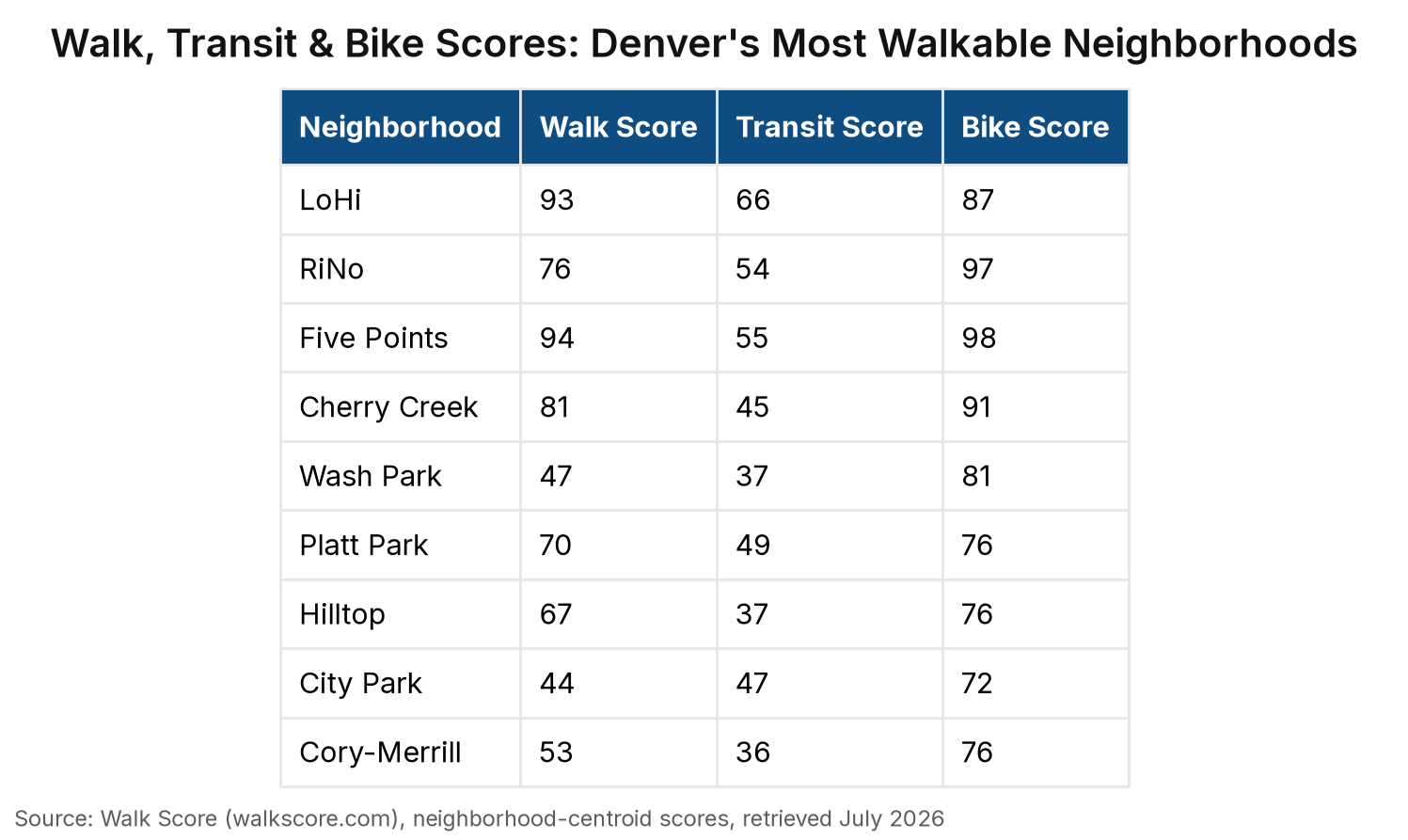
One honest caveat on the table: these are neighborhood-centroid scores, and a centroid can undersell a neighborhood whose walkable life runs along an off-center street. Wash Park is the clearest case — its scoring point sits inside the park itself, so the number comes out far lower than an afternoon on South Gaylord feels. That's also why Wash Park keeps its place in the tier above: the tiers rank what walkability actually feels like on the street; the table reports the raw neighborhood-level scores.
But "most walkable" and "best fit" aren't the same question. Cherry Creek and Wash Park pair walkable shops and restaurants with something LoHi and RiNo don't offer: established residential character, Denver Public Schools access, and quieter streets. Platt Park gives you a similar street-level feel — South Pearl Street shops, tree-lined residential blocks, easy biking — at a lower price. Hilltop and Cory-Merrill prioritize larger lots, school access, and more home for the money — at the cost of a lower Walk Score.
Walk Score is one thing to look at. School district, commute, price range, and how you actually spend your weekends matter just as much. For broader context on how these neighborhoods compare, our Denver neighborhoods overview is a good starting point.
The Denver median listing price across all property types is $587,000, but single-family homes in the neighborhoods on this list run considerably higher. The walkability premium is real — you're paying for it in every neighborhood above that price.
Thinking About Buying in a Walkable Denver Neighborhood?
Walkability is one of the harder things to evaluate from a listing page. Walk Score gives you a number, but it doesn't tell you whether the specific block you're looking at actually feels walkable, which way the neighborhood is heading, or how the price compares to what's actually selling.
If you're narrowing down neighborhoods and want a block-level look at what's available in your price range — with recent sales, not just list prices — I'm happy to do a no-commitment neighborhood comparison with you. Come with your target neighborhoods and budget; I'll bring recent closings and a shortlist based on what's actually on the market.
Reach out at pmccoy626@gmail.com or (319) 325-0668 to set something up.
---
Paul McCoy, Realtor | Fathom Realty | License #: FA.100105533 | (319) 325-0668 | pmccoy626@gmail.com
Paul McCoy is a licensed real estate professional in Colorado. Equal Housing Opportunity.