What It Actually Costs to Buy the Median Denver Home Right Now
Here's the real monthly payment to buy the median Denver home at today's 30-year fixed rate — plus the two levers that can move that number for buyers right now.
As of June 25, 2026
$3,533 per month. That's the principal-and-interest payment on the median Denver-area listing at today's 30-year fixed rate of 6.49% — with 5% down. No national averages, no estimates. That's what you're actually looking at if you're buying in Denver right now.
The Math Behind the Number
The median Denver-area listing price is $589,000 as of May 1, 2026 — that's all property types across the Denver metro (condos and townhomes included, not single-family only). At today's 6.49% rate, here's what the two most common down-payment scenarios look like:
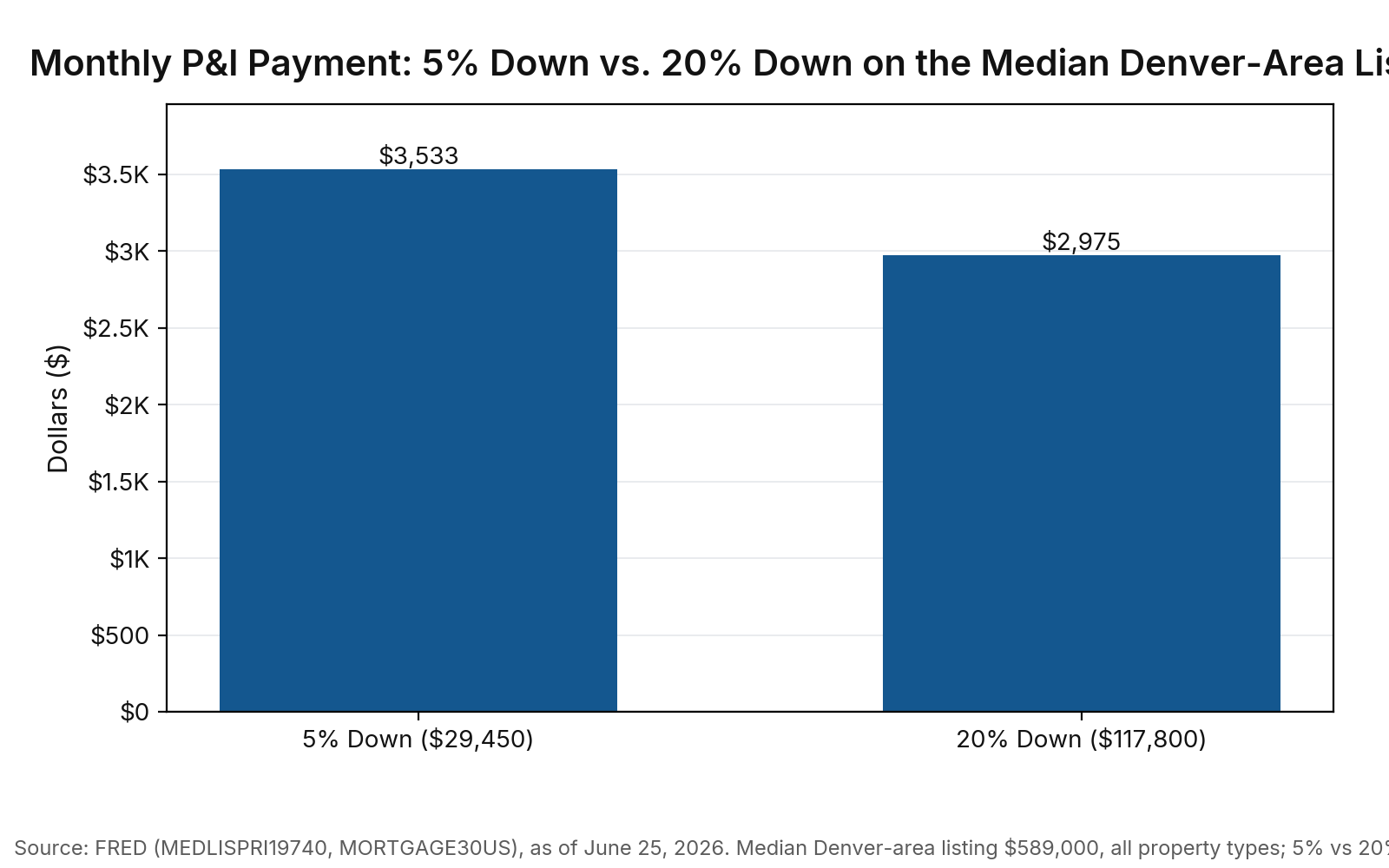
- 5% down — $29,450 out of pocket, a $559,550 mortgage, and a $3,533/month P&I payment.
- 20% down — $117,800 out of pocket, a $471,200 mortgage, and a $2,975/month P&I payment.
The difference between those two scenarios: $558/month. That's the cost of the smaller down payment, every month for 30 years.
One important note: these are principal-and-interest only. Property taxes, homeowner's insurance, and any HOA dues are on top of these figures.
Why This Number Hits Differently in Denver
The metro-wide median of $589,000 is already down 1.83% year-over-year — from $600,000 in May 2025. That's a modest softening, not a collapse. And it matters: the median Denver-area listing is meaningfully above national norms, which is why a national affordability headline doesn't tell you much about what you're actually up against here.
Supply has tightened, not loosened, which is why prices haven't dropped sharply. Homes are selling for about what sellers are asking — you probably won't talk someone down much, but you're not likely to get pulled into a bidding war either. Single-family homes in Denver are selling in about 38 days on average, though a cluster of homes has been sitting well over 200 days — mispriced homes are getting passed over while well-priced ones still move.
The market is easing at the edges, but your monthly payment hasn't moved much. The sale-to-list ratio sits at 0.999 — buyers are negotiating fractionally below list on average, not winning bidding wars, but not extracting deep discounts either. Active inventory is down 7.2% year-over-year (11,465 units in May 2026 vs. 12,354 a year prior), so supply hasn't loosened enough to push prices down sharply.
The Two Levers That Can Move Your Payment
You've already seen lever one — down payment size. Going from 5% to 20% down cuts your monthly payment by $558. That's real money, and it's the most straightforward way to lower what you owe each month.
Lever two is less obvious, and it's where I think most people buying right now are leaving money on the table: a seller-paid 2-1 buy-down.
Here's how it works on a representative $750,000 purchase with 5% down (a $712,500 mortgage): a seller contributes $16,212 — structured as a 2-1 buy-down — and your rate drops to 4.49% in year one and 5.49% in year two before stepping back to the full 6.49% in year three. That cuts your payment from $4,499/month to $3,606 in year one, and $4,041 in year two. The year-one relief alone is $893/month.
Compare that to the seller putting that same $16,212 toward a straight price cut instead. Your payment drops by $103/month — permanently, but a fraction of what the buy-down delivers up front. For the same seller contribution, the buy-down puts about $790/month more back in your pocket in year one.
I'll be upfront about the trade-off: a buy-down is a near-term tool, not a lifetime discount. The relief is front-loaded into years one and two — exactly when you're most stretched as a new buyer. After that, your payment steps back up to the full rate. That's not a flaw; that's the point. It's designed to ease the transition, and in a market where sellers are negotiating and homes are sitting 38 days on average, it's a reasonable ask.
What This Means If You're Buying in Denver This Summer
If you're putting 5% down: your P&I on the median Denver-area listing is $3,533/month at today's 6.49% rate. From there, ask your agent whether the listing has been sitting — if it's been on the market more than 30 days, a seller-paid buy-down is a reasonable concession to put on the table.
If you can stretch to 20% down: your payment drops to $2,975/month on the same median listing — $558 less every month. The trade-off is more cash tied up at closing. Whether that works for you depends on how much you have in reserve and what you need your monthly cash flow to look like.
On the buy-down: homes are selling for about what sellers are asking, and a lot of listings have been sitting well past that 38-day pace — sellers are open to concessions. Asking for a buy-down at that dollar amount isn't aggressive — it gives the seller a clean number and gets you $893/month back in year one.
When you sit down with a lender, bring your target price range, your realistic down payment, and ask about 2-1 buy-down scenarios. The math gets a lot clearer once you have your actual loan amount.
Ready to Run Your Real Numbers?
Your numbers depend on your loan amount, your down payment, and what a seller is willing to contribute. I'm happy to run the actual math on any homes you're looking at — no income assumptions, no generic estimates.
Contact Paul McCoy at Denver Property Advisors
---
Paul McCoy, Realtor | Fathom Realty | License #: FA.100105533 | (319) 325-0668 | pmccoy626@gmail.com
Paul McCoy is a licensed real estate professional in Colorado. Equal Housing Opportunity.