Sell or Rent Out Your Denver Home: A Seller's Decision Guide
Should you sell or rent out your Denver home? This guide walks through the real numbers — net proceeds, rental cash flow, tax treatment, and a Wash Park worked
You're sitting on real equity in a Denver home, and someone — maybe your financial planner, maybe a neighbor who kept their last place — has suggested you consider renting it out instead of selling. You're not crazy for thinking about it. Plenty of Denver owners have built meaningful wealth by holding a property they could have sold. The fork is genuine, and the wrong default is expensive either way.
The honest caveat: being an accidental landlord without running the math first is one of the more reliable ways to erode the equity you've spent years building. Gross rent looks great on a napkin. Net operating income, after-tax proceeds, and the capital gains clock look different. This guide walks through the variables on both sides — selling economics, rental economics, tax mechanics, and a Wash Park worked example — so you can make the call with your eyes open.
You Don't Have to Sell — But You Do Have to Run the Numbers
The decision isn't "sell vs. rent" in the abstract. It's a comparison of two return streams: equity captured now versus equity captured later, plus net rental income, minus costs and taxes. Four variables determine which path wins.
Equity capture. How much do you walk away with at closing after paying off your mortgage and covering selling costs? That's your baseline for Path A.
Net rental yield. What does the property actually generate after property management, vacancy, maintenance reserves, insurance, property taxes, and any HOA pass-through? Gross rent is not the answer to this question.
Tax treatment. The two paths are taxed very differently, and the difference is large enough to flip the outcome. The capital gains exclusion available to sellers who meet the primary-residence test is one of the most valuable tax benefits in the tax code — and it has a clock attached to it.
Opportunity cost. Equity sitting in a rental property isn't earning nothing, but it isn't earning what it would earn in an alternative deployment either. This is the variable most sellers underweight when they run the comparison.
One thing that doesn't change regardless of which path you choose: Colorado's disclosure obligations. The Seller's Property Disclosure form — published by the Colorado Real Estate Commission under DORA — requires sellers to disclose known material defects [1]. If you decide to rent instead of list, that obligation doesn't disappear; it shifts to the landlord context. Colorado is largely a caveat emptor state for items not explicitly disclosed [2].
Selling Economics: Net Proceeds, Closing Costs, and the Capital Gains Exclusion Window
Net proceeds equal your sale price minus closing costs minus your mortgage payoff. That's the structural math, and every seller needs to run it before comparing paths.
Colorado real estate transactions close through title companies, not attorneys [3]. Your closing-cost line items will include title insurance, escrow fees, agent commission, any transfer taxes, and prorations for property taxes and HOA dues. The specific percentages vary by transaction — your title company will produce a net sheet with exact figures once you have a contract — but the component categories are consistent. Get that net sheet before you decide anything. Sellers who skip this step routinely overestimate what they'll walk away with.
The most valuable tax benefit on the sell side is the federal capital gains exclusion for primary residences. If the home was your primary residence for at least two of the last five years, you can exclude a substantial portion of your gain from federal capital gains tax — the thresholds differ for single filers versus married couples filing jointly, and for many Denver homeowners who bought five to ten years ago, the exclusion covers the entire gain. That's a significant number that disappears if you wait too long.
The clock matters more than most sellers realize. If you rent the home first and then sell, you may still qualify for the exclusion — but only if you sell before the two-of-five-year primary-residence window closes. Renting for more than three years before selling will likely reduce or eliminate the exclusion entirely. The non-qualified use rules that apply to rental periods after your last primary-residence period reduce the excludable gain proportionally. This is the mechanism sellers most often miss, and it's the reason "rent first, sell later" often looks better on a gross-rent basis than it does on an after-tax basis.
If you want to understand how the Denver home selling process works in more detail — from listing prep through closing — that guide covers the full sequence.
Rental Economics: What the Numbers Actually Look Like After Expenses
Gross rent is the number sellers fixate on. Net operating income is the number that actually matters, and the gap between them is larger than most first-time landlords expect.
Here are the operating cost categories you need to model before you can call a property cash-flow positive:
- Property management fees — professional managers in Denver typically charge a percentage of gross monthly rent plus a leasing fee when they place a new tenant. If you self-manage, you save the fee but absorb the time and legal exposure.
- Vacancy allowance — no property is rented twelve months a year indefinitely. A realistic vacancy allowance reduces your effective gross income before you calculate anything else.
- Maintenance reserve — the durable rule of thumb is roughly one percent of the home's value per year. On a representative Wash Park home, that's a meaningful annual figure that needs to come out of gross rent before you count profit.
- Landlord insurance — not your homeowner's policy. Landlord policies cover different risks, and in Colorado the exposure is real: the state ranks second nationally behind Texas for hail insurance claims, and hail accounts for roughly half of Front Range homeowners-insurance premiums [4]. Your landlord policy will carry similar exposure.
- Property taxes — Colorado's effective property tax rate is approximately 0.50% of market value statewide, among the lowest in the nation [5]. This is a genuine advantage for landlord operating-cost math compared to most comparable metros.
- HOA pass-through — if your home is in an HOA, those dues don't stop when you become a landlord. They're your obligation, not your tenant's, unless your lease explicitly addresses it.
Cash-on-cash return is the right framework for comparing the rental path against selling and deploying the proceeds elsewhere. The calculation is annual net operating income divided by the equity you have deployed in the property. If your net operating income is modest and your equity is large, the cash-on-cash return may be lower than what that equity could earn in a different investment. That comparison is the one most sellers don't make — and it's the one that most often changes the answer.
Get actual quotes from two or three Denver property managers before you decide. The fee structures vary, and the difference between a well-run management relationship and a poorly-run one has a real impact on your net returns.
Tax Treatment: What Changes When You Rent First
The tax mechanics of this decision are where the two paths diverge most sharply, and where the most expensive mistakes happen.
The primary-residence clock. You need two of the last five years as your primary residence to qualify for the federal capital gains exclusion. Renting the home doesn't automatically disqualify you — if you've lived there for four years and rent for one, you still qualify when you sell. But if you rent for three years after living there for two, you've used up your window. The clock runs from the date of sale, not the date you moved out.
Non-qualified use. Periods of rental use after your last primary-residence period reduce the excludable gain proportionally. If you rented the home for two of the five years preceding the sale, roughly 40% of your gain may be treated as non-qualified use. This is the mechanism most sellers miss when they model "rent for a few years, then sell."
Depreciation. When you rent a residential property, the IRS allows you to depreciate the structure on a straight-line schedule over the applicable recovery period. This reduces your taxable rental income each year — a real benefit while you're renting. The catch: every dollar of depreciation you take must be recaptured when you sell, and depreciation recapture is taxed at a rate separate from and typically higher than long-term capital gains rates. The longer you rent, the more depreciation accumulates, and the larger the recapture liability at sale.
Colorado state income tax. Net rental income reported on federal Schedule E is subject to Colorado's flat state income tax rate of 4.40% [6]. Add this to your federal tax liability when modeling the rental path.
The interaction of these three mechanics — exclusion reduction, depreciation recapture, and state income tax — is why the rental path often looks better on a gross-rent basis than it does on an after-tax basis.
This section covers process mechanics only and is not legal or tax advice — consult your CPA and attorney for guidance specific to your situation.
Who Should Sell, Who Should Rent, and Who Should Wait
Sell now if:
- You need the equity for your next purchase and don't have another source for the down payment.
- You're approaching the end of your primary-residence exclusion window — fewer than two years of qualifying use remaining means selling now almost always beats renting and paying full capital gains later.
- You're carrying two mortgages and the cash flow doesn't cover both.
- You have no genuine interest in being a landlord, even if the numbers look positive on paper. Reluctant landlords tend to make expensive decisions under pressure.
Rent if:
- The property cash-flows positively after all expenses — not just gross rent minus your mortgage payment. If you haven't modeled management fees, vacancy, maintenance reserves, insurance, and property taxes, you haven't run the number.
- You have a genuine five-plus-year investment horizon. The rental path's advantages compound over time; a three-year hold with a large recapture liability and a reduced exclusion often doesn't pencil out.
- You can absorb management fees or self-manage without it becoming a second job.
Wait if:
- The home needs pre-list repairs that would materially improve sale price. Selling a home that needs work in a market where buyers have options means leaving money on the table. See home improvements that pay off before selling for a framework on which projects earn their cost.
- You're mid-lease on a current rental and your personal timeline isn't settled.
When signals conflict — positive cash flow but a closing tax window — the tax clock usually wins. It's the one variable you can't recover once the window closes.
The move most sellers don't know to make: if you're within two years of losing your primary-residence exclusion, selling now and investing the proceeds elsewhere almost always beats renting and paying full capital gains later.
Denver Landlord Reality: Obligations, Insurance, and the Self-Management Question
Becoming a Denver landlord isn't just a financial decision — it's a legal one. Colorado landlord obligations are real and non-trivial from day one.
Colorado law requires landlords to maintain habitable conditions, provide required lease disclosures, and follow specific rules on security deposits — including timelines for return and itemization of deductions. These apply regardless of whether you're managing the property yourself or through a professional. Sellers who treat the landlord role as passive income without understanding the legal framework tend to find out the hard way that it isn't.
Insurance is the cost variable most Denver landlords underestimate. Colorado ranks second nationally behind Texas for hail insurance claims, and hail accounts for roughly half of Front Range homeowners-insurance premiums [4]. Landlord policies carry the same exposure as homeowner's policies, sometimes more, because the insurer is covering a non-owner-occupied property. Budget for this before you model your net operating income.
On the property tax side, Colorado's effective rate of approximately 0.50% of market value is a genuine advantage [5]. It makes Denver's landlord operating-cost math more favorable than comparable metros where property taxes run two to three times higher.
The self-management question is the operational decision that determines whether renting is actually passive. Professional property managers handle tenant screening, lease execution, maintenance coordination, and legal compliance — for a fee that comes directly off your gross rent. In my experience, owners who underestimate the time cost of self-management are the ones most likely to sell the property within two years at a worse time than they would have chosen otherwise.
Single-family rentals in Denver tend to attract longer-tenancy tenants than condos. Lower turnover means fewer leasing fees, fewer vacancy months, and less wear-and-tear between tenants — a real operating-cost advantage worth factoring into your comparison.
Worked Example: A Wash Park Home — Sell Now vs. Rent Three Years, Then Sell
Scenario setup: A married couple owns a Wash Park home they've lived in as their primary residence for four years. They're deciding whether to sell now or rent it for three years before selling.
Path A — Sell Now
Gross sale proceeds come from the agreed sale price. Subtract closing costs — agent commission, title and escrow fees, transfer taxes, and prorations. The specific percentages vary; your title company will produce a net sheet with exact figures. After closing costs and mortgage payoff, the couple arrives at their net proceeds.
On the tax side, they've lived in the home for four of the last five years, so they qualify for the full primary-residence capital gains exclusion for married couples filing jointly. Their gain is likely fully excluded from federal capital gains tax. Colorado's flat 4.40% state income tax [6] applies to taxable income, but a fully excluded gain produces no Colorado taxable gain either. Result: they keep the net proceeds with no capital gains tax owed.
Path B — Rent Three Years, Then Sell
During the three-year rental period, the couple collects gross rent. Subtract property management fees, a maintenance reserve, landlord insurance (with Colorado's hail exposure factored in [4]), property taxes at approximately 0.50% of market value [5], and any HOA dues. The remainder is net operating income — and Colorado's 4.40% state income tax [6] applies to that net income each year.
At the end of year three, they sell. But now the tax picture has changed. Three of the five years preceding the sale were rental years — non-qualified use under the post-2009 rules. A portion of their gain no longer qualifies for the primary-residence exclusion. Additionally, three years of depreciation on the structure has accumulated, and that depreciation must be recaptured at sale at a rate separate from and typically higher than long-term capital gains rates.
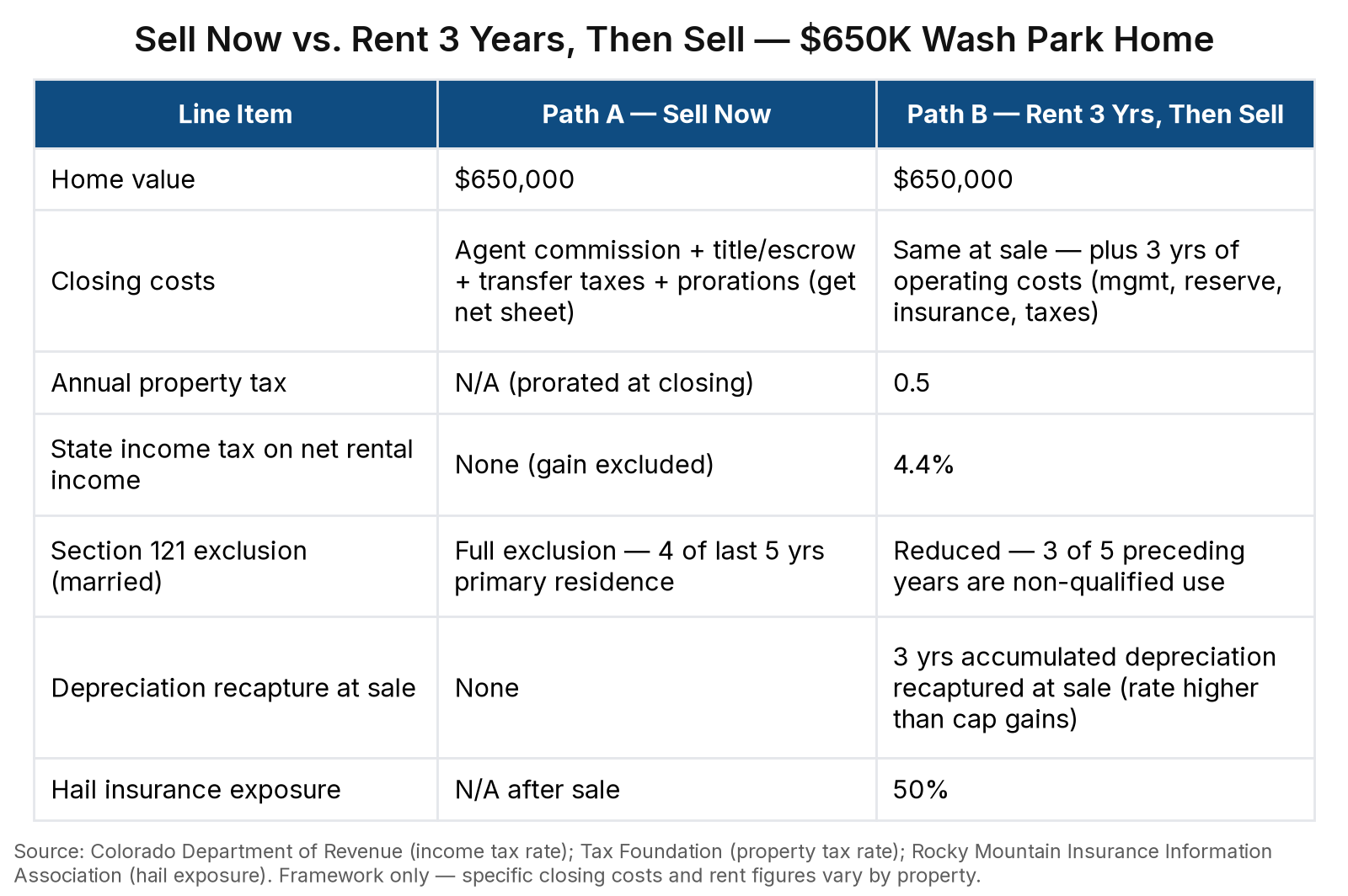
The non-obvious result: Path B often generates more gross dollars over the combined period — three years of rent plus a sale — but less after-tax dollars once the exclusion reduction and depreciation recapture are applied. The gap between gross and after-tax is the number most sellers don't model until it's too late to change the answer.
Specific closing-cost percentages, management fee rates, and current rent figures are not in this guide — they vary by property and market conditions. Before you decide, get a net sheet from a title company for Path A and actual quotes from two Denver property managers for Path B. Then run the after-tax comparison with your CPA.
Six Questions That Point You to the Right Answer
Before you make the call, answer these six questions about your own situation.
Q1: How many years of primary-residence use remain in your exclusion window? If you have fewer than two years of qualifying credit remaining in the last five-year period, selling now is almost always the right call.
Q2: Does the property cash-flow positively after all expenses? Not gross rent minus your mortgage. After management fees, vacancy allowance, maintenance reserve, insurance, property taxes, and HOA. If the answer is no, the rental path is a wealth-erosion strategy, not a wealth-building one.
Q3: Do you have a genuine five-plus-year investment horizon? If you're likely to want the equity within three years, the rental path's tax drag and transaction costs on the back end will likely outweigh the rental income.
Q4: Can you absorb the landlord obligations — legally, operationally, and emotionally? Colorado landlord law is real. Habitability standards, security deposit rules, and lease disclosure requirements apply from day one.
**Q5: Do you need the equity for your next purchase? See pricing strategy for Denver home sellers for how to position the sale to maximize what you walk away with.
Q6: Does the home need pre-list work that would materially improve sale price? If yes, wait and do the work first. Selling a home that needs attention in a market where buyers have options means accepting a discount you didn't have to take.
When your answers point in different directions — positive cash flow but a closing tax window — the tax clock wins. It's the one variable you can't recover.
Not Sure Which Path Makes Sense? Let's Model It for Your Home.
The one thing to do this week: run your own net-proceeds number for Path A and your own cash-on-cash number for Path B, side by side, on an after-tax basis. If you haven't done that yet, everything else — the gross rent, the market timing, the neighbor's advice — is speculation. The numbers are specific to your equity position, your tax clock, and your property. No one else's worked example is your answer.
This is general information, not legal or tax advice — consult your attorney or CPA.
I'll do a 30-minute sell-vs.-rent modeling session with you — your specific equity position, your primary-residence exclusion clock, your property's operating cost profile — no commitment required. Come with your purchase price, your current mortgage balance, and a rough sense of what the home would rent for. I'll come with a framework that turns those inputs into a side-by-side comparison you can actually make a decision from. Reach out through the sellers hub to schedule a time.
Sources
- Colorado Department of Regulatory Agencies — Seller's Property Disclosure form: https://dre.colorado.gov/contracts-forms
- Colorado Division of Real Estate — Seller's Property Disclosure: https://dre.colorado.gov/division-resources/commission-approved-contracts
- Colorado Division of Real Estate: https://dre.colorado.gov/
- Daily Gazette (secondary) — quoting Rocky Mountain Insurance Information Association on Colorado hail claims: https://www.dailygazette.com/tribune/hail-damage-driving-colorado-s-high-insurance-rates/article_bf692499-f375-54d7-a86b-d34403604cc7.html
- Tax Foundation — Property Taxes by State (Colorado effective rate): https://taxfoundation.org/location/colorado/
- Colorado Department of Revenue — Individual Income Tax: https://tax.colorado.gov/individual-income-tax
---
Paul McCoy, Realtor | Fathom Realty | License #: FA.100105533 | (319) 325-0668 | pmccoy626@gmail.com
Paul McCoy is a licensed real estate professional in Colorado. Equal Housing Opportunity.