What Does It Actually Cost to Sell Your Denver Home?
What does it actually cost to sell your Denver home? This guide breaks down agent commission, closing costs, pre-listing repairs, and how to estimate your real net
If you're getting ready to sell your Denver home, you're probably asking yourself some version of the same questions: How much will I actually walk away with? What does my agent's commission really cost me? Do I have to fix things before I list — and if so, which things? And what are all these closing costs I keep hearing about?
The problem is that most sellers focus on the offer price and don't think through the cost stack until they're sitting at the closing table. By then, the surprises are already locked in. The gap between your gross sale price and your actual net proceeds is where plans fall apart — and it's almost always bigger than you'd expect.
The honest caveat upfront: every seller's cost stack is different. Your property condition, your mortgage payoff, the terms you negotiate, and the market conditions at the time you list all shift the final number. This guide can't give you a single figure, because there isn't one. What it can do is walk you through each cost category, explain what's fixed by Colorado custom or law versus what's negotiable, and give you the framework to build a real net-proceeds estimate before you sign a listing agreement.
The Full Cost Stack: Six Categories Every Denver Seller Needs to Budget
Before we get into the detail on each category, it helps to have the full map in front of you. There are six cost buckets that make up your cost stack as a Denver seller:
- Agent commission — the listing fee and, depending on how your transaction is structured, some contribution toward the buyer's agent compensation
- Buyer concessions and incentives — closing cost credits, rate buydowns, or repair credits you agree to as part of the deal
- Colorado closing costs and transfer tax — the documentary fee and other transaction costs
- Title and escrow fees — the owner's title policy and settlement services
- Pre-listing repairs — work you do before you list to avoid inspection objections
- Staging — from basic cleaning and decluttering to full vacant staging
Taken together, these costs represent a meaningful share of your sale price — enough that if you don't plan for them, you'll feel it at the closing table.
One thing worth knowing upfront: Colorado transactions close through title companies, not attorneys [1]. If you're coming from New York, New Jersey, Massachusetts, or another attorney-closing state, the workflow here is different. Your title company coordinates settlement and handles the closing — you won't have a real estate attorney at the table unless you hire one separately. This is standard in Colorado and in most western states, and it's worth knowing before you start comparing notes with friends in other markets.
Colorado's property tax rate is one of the lowest in the country — approximately 0.50% of market value statewide [2]. But here's the line item that catches sellers off guard: because Colorado reassesses to current market value, property taxes are prorated at closing. You'll credit the buyer for the portion of the tax year that elapsed before closing — meaning a chunk of your tax bill for the year comes out of your proceeds at the table, even if you haven't paid it yet. It's not a large number relative to the sale price, but it's real, and it belongs in your estimate.
Which costs are fixed by Colorado custom or law, and which are negotiable? The title insurance owner's policy, the property tax proration, and the documentary fee are standard seller-side line items — you'll see them on virtually every transaction. Agent commission, concessions, and staging are negotiated. Pre-listing repair spend is a decision you control before you ever go under contract. Knowing the difference tells you where you can push and where you can't.
Pre-Listing Repairs and Staging: What to Spend and What to Skip
Not every repair dollar comes back at closing. The rule is simple: spend where buyers will notice or where inspection objections are likely, and skip cosmetic upgrades that won't move the price. The goal is to avoid deal-killers and take away the buyer's ammunition for repair credits — not to renovate the house.
On the exterior, two categories consistently return more than they cost. Nationally, garage door replacement leads all remodeling projects in resale ROI — a $4,672 investment that returns $12,507 in resale value, a 267.7% return [3]. Steel entry door replacement is the second-highest ROI project in the same survey, returning $5,270 in resale value on a $2,435 job cost — a 216.4% return [3]. These are worth doing: visible, inexpensive, and they come back more than they cost. If your garage door is dated or your front entry looks tired, fix it before you list.
On the interior, a minor (mid-range) kitchen refresh — new paint, updated hardware, fresh appliances — clears break-even on average nationally, returning $32,141 in resale value on a $28,458 job cost, a 112.9% return [3]. A full gut renovation is a different story — major kitchen remodels rarely return their full cost at resale, and living through a renovation while trying to list is a headache you don't need. If your kitchen is functional and reasonably clean, spend on the small stuff and leave the cabinets alone.
Inspection-flagged repairs are a different category entirely. Roof issues, HVAC problems, sewer line failures, and radon mitigation needs aren't cosmetic — they're deal-killers if left unaddressed. Buyers will find them, and when they do, you'll either negotiate a credit, drop your price, or watch the deal fall apart. Get trade quotes before you list, not after you're under contract. Once you're under contract, you're negotiating from a weak position. Before you list, you can decide whether to fix the issue, price around it, or disclose it and let the market respond — and that's a much better place to be.
One tactic worth knowing: when a contractor gives you a single-line quote, ask them to break it into labor and materials separately, and get at least two quotes from different trades. A single-line quote from one contractor is the most expensive way to handle a repair. Breaking the job apart and getting competitive bids is how you keep pre-listing repair costs from running away. For a deeper look at the full pre-listing preparation process, see our guide on preparing your Denver home to sell.
On staging, there are three paths, each with a different cost and a different use case:
Basic cleaning and decluttering is the floor — pack away personal items, do a deep clean, and make the home feel orderly and neutral. You should always do this, whether you do anything else or not. A cluttered, dirty home signals lower quality to buyers before they've looked at a single feature.
Occupied staging means a professional stager works with the furnishings you already have — rearranging, removing excess pieces, and adding accent items as needed. Unless you're in a white-hot seller's market where listings go under contract within a day, I'd generally recommend this if you're still living in the home. It costs less than vacant staging and makes a real difference in how the home photographs and shows.
Vacant staging — bringing in rented furniture for an empty home — is typically reserved for vacant properties or higher-end listings where the presentation stakes are higher. It costs more and makes the most sense when the home would otherwise show as an empty shell.
For a full breakdown of staging options and when each makes sense, see our guide on staging your Denver home for sale.
Denver-Specific Cost Drivers That Don't Show Up in National Guides
Three things about selling in Denver will show up in your cost stack that national seller guides don't mention: Colorado's mandatory disclosure form, Denver's specific environmental inspection risks, and how market conditions shift what buyers ask for in concessions.
The Seller's Property Disclosure Form
Colorado sellers are required to complete a Seller's Property Disclosure (SPD) form — published by the Colorado Real Estate Commission under DORA — disclosing known material defects, repairs, and material facts about the property [4]. The form is typically delivered with the listing or shortly after contract acceptance. Fill it out carefully and accurately. Colorado is largely a caveat emptor state for items not explicitly disclosed [5], but that doesn't protect you from claims about things you knew and didn't disclose — undisclosed issues that surface after closing are among the most common sources of post-closing disputes.
Radon
Denver-metro counties — Denver, Adams, Arapahoe, Boulder, Broomfield, Douglas, Jefferson, and El Paso — sit in EPA Zone 1, the highest radon-potential category [6]. About 44% of Colorado homes that have been tested measure at or above the EPA's 4 pCi/L action level, the threshold at which the EPA recommends remediation [7]. That's roughly half of homes — not a fringe risk.
Test before you list. If your home tests high, you can mitigate before going to market — radon mitigation systems are a well-understood fix — and disclose the result and the remediation on your SPD. That's a much stronger position than having a buyer's inspector find elevated radon mid-contract, when you're negotiating under time pressure and the buyer has every advantage.
Hail
Colorado ranks second nationally behind Texas for hail insurance claims, and hailstorms have caused more than $5 billion in insured damage across the state over the last decade [8]. Along the Front Range, hail accounts for a significant share of homeowners insurance premiums —.
Roof damage from hail is a near-universal inspection finding on older Denver homes. Before you list, get a roof assessment. If there's damage, you have three options: repair it, price the home to reflect it, or disclose it and let buyers factor it in. What you don't want is to find out mid-contract — at that point, you're reacting instead of deciding.
Expansive Clay Soils and Foundation Movement
Expansive clay soils are widespread under the Denver metro [9]. The Colorado Geological Survey identifies these formations as one of the state's most significant and costly geologic hazards — the soil swells when wet and shrinks when dry, which stresses foundations over time. Foundation movement is a common inspection finding in Denver-area homes, and it's one of the issues buyers and their agents look for specifically.
Review your SPD carefully for any prior foundation work and disclose it. If you've had repairs done, document them. Undisclosed foundation issues are one of the most common sources of post-closing disputes in Colorado, and the same caveat emptor standard that otherwise protects you won't cover something you knew about and didn't disclose.
Market Conditions and Concession Pressure
What buyers ask for in concessions — closing cost credits, rate buydowns, repair credits — moves with market conditions. In a seller-favoring market with low inventory and multiple offers, concession requests are rare and modest. In a balanced or buyer-favoring market, you should budget for them as a normal part of the deal, not as surprises. Check our current market updates before you set your pricing and concession expectations.
Worked Example: How the Cost Stack Plays Out on a $750,000 Denver Sale
Here's how the cost stack typically plays out on a $750,000 Denver home sale. This is an illustrative scenario — actual figures vary based on your property, your negotiated terms, and market conditions when you list. The point is to show how quickly the categories add up.
| Cost Category | Estimated Amount | Notes |
|---|---|---|
| Agent commission | Negotiated | Varies by listing agreement and buyer-agent compensation structure |
| Buyer concessions | Negotiated | Closing cost credits, repair credits, or rate buydowns — varies with market conditions |
| Colorado documentary fee (transfer tax) | Statutory | Set by Colorado law; calculated on the sale price |
| Title insurance (owner's policy) | Seller-customary | Standard seller-side line item in Colorado |
| Settlement / closing fee | Seller-customary | Paid to the title company coordinating closing |
| Property tax proration | Varies | Seller credits buyer for the portion of the tax year elapsed before closing [2] |
| Pre-listing repairs | Your decision | Spend on high-ROI exterior projects and deal-killer repairs; skip major renovations |
| Staging | Your decision | Basic cleaning is the floor; occupied staging for most sellers still in the home |
| Total estimated costs | Meaningful share of sale price | The gap between $750,000 and your net proceeds is the number that matters |
The number that matters for your next move — whether that's a down payment on your next home, paying off debt, or something else — is not $750,000. It's $750,000 minus everything in the table above. If you don't build this estimate before you list, you'll often find yourself short of what you needed, or locked into a list price that doesn't leave enough room.
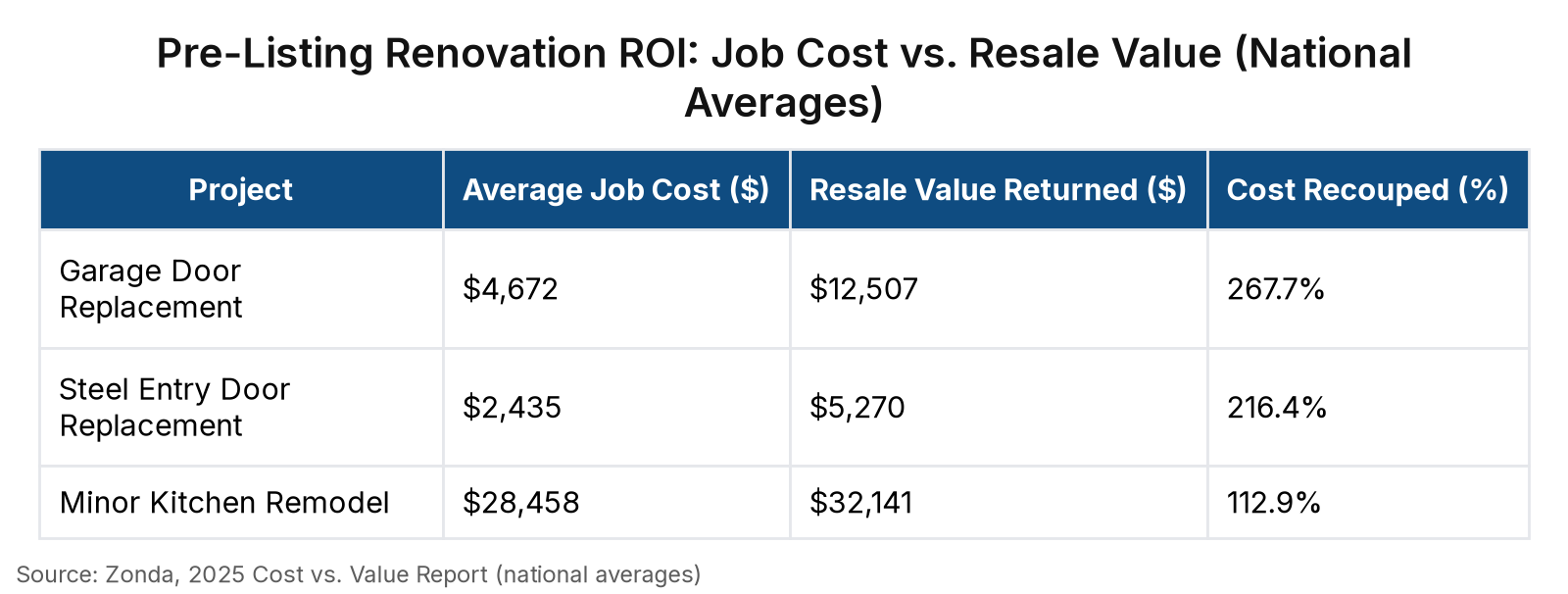
The three renovation categories with grounded national data tell a consistent story: exterior projects with low cost and high buyer visibility — a garage door, a front door — return far more than they cost [3] [3]. A minor kitchen refresh clears break-even [3]. That's the hierarchy to follow when you're deciding where to spend before you list.
How to Build Your Net-Proceeds Estimate Before You List
Here's how to put it all together — three steps, not a summary of the cost categories.
Step 1: Ask your agent for an itemized estimated settlement statement before you agree to a list price. This is what makes the net number real. A good listing agent will build this for you — it walks through every line item, including commission, estimated concessions, closing costs, title fees, and property tax proration. If your agent isn't offering this proactively, ask for it. It should shape your list price, not come after you've already set one. For help finding the right agent for your situation, see our guide on choosing a Denver listing agent.
Step 2: Walk the property with your agent and sort out what to fix, what to credit, and what to leave alone. Not every issue needs to be fixed before you list. Some are better handled as a price adjustment or a concession credit. Your agent should help you make that call based on what buyers in your price range and neighborhood are likely to object to — and what they're likely to overlook.
Step 3: Confirm your mortgage payoff with your lender. The net-proceeds estimate only works if it accounts for what you actually owe. Your payoff amount isn't your current balance — it includes accrued interest through the closing date and any prepayment terms. Call your lender and get the number in writing before you finalize your estimate.
Ask for it before you sign a listing agreement.
Get a Real Net-Proceeds Estimate for Your Denver Home
If you build your net-proceeds estimate before you list — not after you've accepted an offer — you won't be surprised at the closing table. This guide gives you the framework. The next step is running the actual numbers against your specific property, your payoff, and current market conditions in your neighborhood.
I'm happy to build that estimate with you. We'll walk through your property's condition, talk through the repair and staging decisions that make sense for your situation, and put together a realistic net-proceeds projection before you commit to a list price. Schedule a short consultation and we'll figure out the best next step.
Sources
- Colorado Division of Real Estate: https://dre.colorado.gov/
- Tax Foundation — Property Taxes by State (Colorado effective rate): https://taxfoundation.org/location/colorado/
- Zonda — 2025 Cost vs. Value Report (Top 10 national averages, publication page): https://zondahome.com/2025-cost-vs-value-report/
- Colorado Department of Regulatory Agencies — Seller's Property Disclosure form: https://dre.colorado.gov/contracts-forms
- Colorado Division of Real Estate — Seller's Property Disclosure: https://dre.colorado.gov/division-resources/commission-approved-contracts
- Colorado Department of Public Health and Environment — Understanding Radon; U.S. EPA Map of Radon Zones: https://cdphe.colorado.gov/hm/understanding-radon
- U.S. Environmental Protection Agency — Map of Radon Zones page: https://www.epa.gov/radon/epa-map-radon-zones
- Daily Gazette (secondary) — quoting Rocky Mountain Insurance Information Association on Colorado hail claims: https://www.dailygazette.com/tribune/hail-damage-driving-colorado-s-high-insurance-rates/article_bf692499-f375-54d7-a86b-d34403604cc7.html
- Colorado Geological Survey — Expansive Soil and Rock (and EG-07, Potentially Swelling Soil and Rock in the Front Range Urban Corridor): https://coloradogeologicalsurvey.org/hazards/expansive-soil-rock/
---
Paul McCoy, Realtor | Fathom Realty | License #: FA.100105533 | (319) 325-0668 | pmccoy626@gmail.com
Paul McCoy is a licensed real estate professional in Colorado. Equal Housing Opportunity.