Earnest Money in Colorado: What Denver Buyers Need to Know
Learn how earnest money works in Colorado — how much to offer, when it's refundable, and what CREC contract forms mean for Denver buyers at offer time.
When you make an offer on a Denver home, earnest money isn't a formality — it's real cash you're putting on the line from the moment the contract is signed. At Denver's current median list price of $579,798, even a 1% deposit means nearly $6,000 committed before you've had a single inspection.
Every buyer writing an offer in Denver faces two questions: how much earnest money to put up, and under what conditions they can get it back. Colorado law and the Colorado Real Estate Commission's Contract to Buy and Sell Residential Real Estate — the CREC contract — govern both. This guide walks you through exactly how it works.
Why Earnest Money Matters More Than Most Buyers Expect
Denver homes are selling for about what sellers are asking right now — you probably won't talk someone down much, but you're not likely to get pulled into a bidding war either. Homes are sitting on the market for a median of 51 days. That's not a frenzied pace, but it's not a soft one either: well-priced homes move, and a weak offer gets passed over.
In that environment, earnest money is one of the clearest signals you can send. A thin deposit on a competitive offer tells the seller you're not fully committed. A strong one says the opposite. And because the CREC contract's contingency structure gives you real protection when you use it correctly, putting up a meaningful deposit doesn't have to feel like a gamble — it's a calculated move.
The two questions you need answered before you write any offer: how much is appropriate for this market, and what are the exact conditions under which you get it back if something goes wrong.
What Earnest Money Is (and What It Isn't)
Earnest money is a good-faith deposit you submit shortly after your contract is executed. It goes into escrow — held by the title company, not the seller and not the listing agent. Under the CREC Contract to Buy and Sell Residential Real Estate, the title company is the designated escrow holder for these funds.
A few things earnest money is NOT:
- Not a down payment — though it typically credits toward your down payment or closing costs at closing.
- Not a fee — it's not paid to anyone; it sits in escrow until the transaction closes or terminates.
- Not non-refundable by default — Colorado's CREC contract is a contingency-rich form, and buyers who use those contingencies correctly have real rights to recover their deposit.
The authoritative source for how earnest money is handled in Colorado is the CREC contract itself, published by the Colorado Real Estate Commission. If you haven't read the contract your agent is using, ask to see it — the deadline dates in your specific contract are what govern your rights, not general rules of thumb.
How Much Earnest Money Is Standard in Denver
In Colorado, earnest money is negotiable — there's no statutory minimum or fixed amount. The CREC contract sets it by agreement between buyer and seller. In Denver-area practice, the norm runs around 1% of the purchase price, though competitive offers in multiple-offer situations often go higher to signal commitment.
At Denver's current median list price of $579,798, here's what common deposit levels look like in dollar terms:
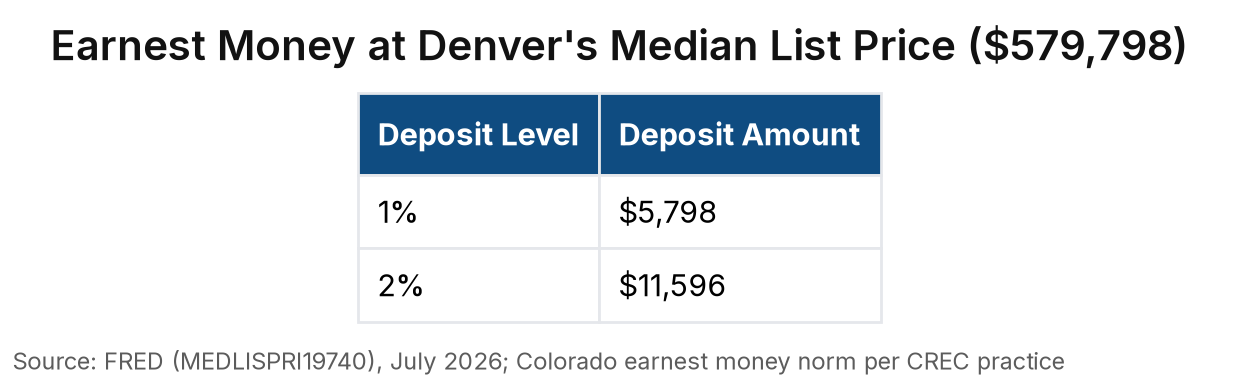
Use these figures as a floor, not a ceiling. In a multiple-offer situation, a higher deposit can differentiate your offer when price and terms are otherwise similar. In a slower negotiation where you have more leverage, staying closer to 1% is reasonable. I'll advise on what's appropriate given the specific property and competitive context. One practical note: the deposit amount is visible to the seller — it's part of the offer package, so size it intentionally.
When Colorado Law Lets You Get It Back
This is the most important part to understand. The CREC contract is built around contingencies — defined windows during which you can terminate and recover your earnest money. If you use these windows correctly and on time, your deposit is protected. If you miss a deadline, the protection disappears.
Here are the major contingency termination rights in the standard CREC contract:
Inspection Objection / Termination Deadline
After your inspection, you have until a negotiated deadline to submit a written objection or to terminate entirely. In Denver-area practice, this deadline is commonly set around 7–10 calendar days from acceptance — though it's negotiated, not fixed. Missing it means you've waived your inspection contingency; trying to exit afterward puts your deposit at risk.
Loan Objection Deadline
If your financing falls through, you have until this deadline to terminate and recover your deposit. After it passes, a financing failure doesn't automatically protect your earnest money. This is why buyers working through loan requirements for Denver buyers should get fully underwritten — not just pre-approved — before this deadline expires.
Appraisal Objection Deadline
If the home appraises below contract price, you have a defined window to object or terminate. After the appraisal objection deadline, you've accepted the result — and a low appraisal no longer gives you a clean path to your deposit.
Title Review Period
You have a window to review the title commitment and object to any defects or encumbrances. If something in the title history is a problem, this is the window to raise it in writing.
The Colorado-specific mechanic that matters most: termination must be delivered in writing, on or before the deadline. A verbal notice, a text, or a phone call does not preserve your right. Written notice, delivered on time, is what the contract requires. Every deadline is negotiated at contract time — review your specific dates and put every one on your calendar the day you go under contract.
When You Can Lose Your Earnest Money
The CREC contract protects buyers who use it correctly. It doesn't protect buyers who miss deadlines, waive contingencies, or change their mind after their protection windows have closed.
Missing a contingency deadline and then trying to terminate
If your inspection objection deadline passes without a written objection or termination notice, you've waived that contingency. Trying to exit afterward — even for a legitimate concern — puts your deposit at risk.
Waiving contingencies in a competitive offer and then backing out
Waiving inspection or appraisal contingencies is a legitimate strategy to strengthen an offer. But it means you've given up the protection those contingencies provide. If you waive the inspection contingency and discover a major problem, you don't have a clean contractual path to your deposit.
Changing your mind after all contingency windows have closed
Once every contingency period has expired, the contract offers very little protection. If you simply decide you don't want the home, the seller has a strong claim to your earnest money as liquidated damages.
The inspection-objection nuance worth knowing: submitting an inspection objection is not the same as terminating. An objection opens a negotiation over repairs or credits. If that negotiation fails and you want out, you need to follow through with a formal Notice to Terminate — a separate written document. Objecting and then walking away without a termination notice is not a clean exit.
The dispute mechanic: when forfeiture is contested, Colorado requires either a signed mutual release from both parties or a court order before the title company can disburse the funds. The money doesn't automatically go to the seller just because they claim it — but you'll need to engage the process to get your deposit back if the seller disputes your right to it.
How Earnest Money Disputes Work in Colorado
If a dispute arises, here's how the process typically unfolds:
Step 1 — One party claims the deposit. Either the buyer asserts their right to a refund (typically after a termination notice) or the seller claims the deposit as damages (typically after a buyer default).
Step 2 — The other party contests. The title company is notified that the release is disputed.
Step 3 — The title company holds the funds. The title company cannot release earnest money without a signed mutual release from both parties or a court order. Neither party can unilaterally access the money while the dispute is active.
Step 4 — Mediation typically applies before litigation. The standard CREC contract includes a mediation clause. In practice, most earnest money disputes in Colorado resolve through negotiation or mediation — the title company's hold obligation gives both sides time to reach agreement without the cost of a lawsuit.
If a dispute arises, bring all written notices, your contract with deadline dates highlighted, and any written communications with the seller. Document everything in writing throughout the transaction — a clean paper trail is your best asset. This is process education, not legal advice; if you're in a genuine dispute, consult a Colorado real estate attorney.
What This Means When You're Writing a Denver Offer
Earnest money is a negotiating signal, not a formality. Size it intentionally based on the competitive context — a stronger deposit on a competitive offer can be the difference when price and terms are otherwise close.
The CREC contract's contingency structure gives you real protection, but only if you use it correctly and on time. Written notice, delivered before the deadline, is what preserves your rights. A missed deadline is a waived contingency, and a waived contingency means your deposit is exposed.
If you're also navigating selling and buying at the same time in Denver, the deadline management gets more complex — two transactions, two sets of contingency windows, and real money on the line in both directions. The buyers who lose earnest money in Colorado almost always lose it the same way: they didn't know a deadline had passed until it was too late. That's entirely preventable with the right agent and the right process.
Ready to Write a Strong Offer in Denver?
Understanding how earnest money works is step one — knowing how to size and time it in your specific offer is where I come in. When you're ready to write an offer, I'll advise on deposit sizing for the competitive context, track every contingency deadline in your contract, and make sure written notices go out correctly and on time.
Bring your target price range, your timeline, and your questions — I'll bring current market context and what I know about how these contracts actually play out. Book a consultation and let's talk through your situation.
---
Paul McCoy, Realtor | Fathom Realty | License #: FA.100105533 | (319) 325-0668 | pmccoy626@gmail.com
Paul McCoy is a licensed real estate professional in Colorado. Equal Housing Opportunity.