Denver's Fall Selling Window Opens Now: What September–October Data
Denver's fall selling window runs roughly six weeks. Here's what DMAR data shows sellers who list in September–October actually get — and what waiting until spring
As of Labor Day 2026, Denver's fall selling window is open — and it runs roughly six weeks before buyer activity fades into the holiday slowdown. Sellers on the fence right now are not making an abstract decision. They are making a real one with a real dollar consequence attached. If you have watched a window close before, you know the feeling.

How the Fall Window Actually Works — and Why Timing It Matters More Than Usual This Year
After Labor Day, the casual summer browsers leave the market. What remains is a smaller but more serious pool of buyers — people who have settled into the school year, are planning around year-end finances, or are under deadline pressure to close before the holidays. Motivated buyers move faster and negotiate less aggressively on price. That is why fall absorption historically accelerates even as total transaction volume drops: fewer buyers, but more of them are ready to act.
In 2026, Denver's inventory is elevated and homes are sitting on the market longer. The fall window concentrates the serious buyers into a shorter period — a seller who lists at the window's open faces less fresh competition than one who waits until other fence-sitters also decide to list in October.
A seller who waits until spring re-enters a market that has fully reset: new competition, a spring inventory surge, and no certainty that rates or buyer demand have shifted in their favor. The gap between the fall window's close and the spring market's open is carrying-cost time with no transaction — and at today's rates, that cost is not small.
What the Numbers Show: Denver's Fall Window by the Data
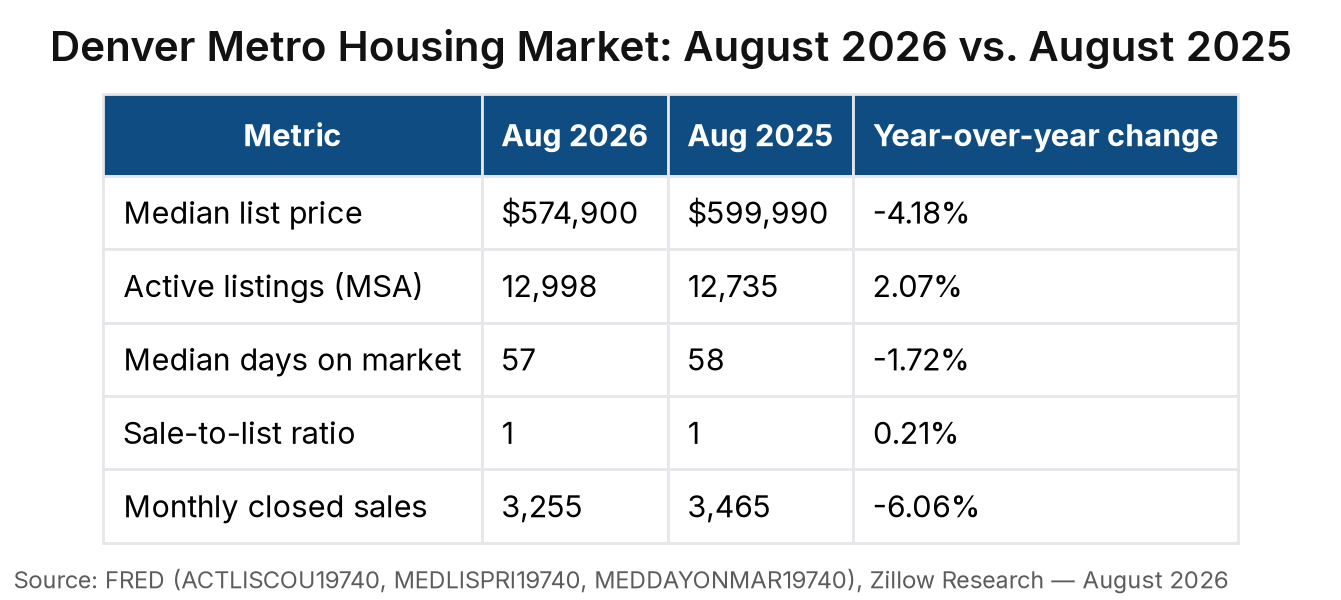
Denver enters the fall window with prices down and inventory up year-over-year. The median list price across the Denver metro is $574,900 as of August 2026 — down from $599,990 a year ago. Active listings have grown to 12,998, up from 12,735 a year prior. Homes are sitting at a median of 57 days on market, and monthly closed sales of 3,255 are down from 3,465 a year ago. The sale-to-list ratio is 1.000 — homes are selling for essentially what sellers are asking, with no meaningful discount either way.
What this means for a seller: the market is competitive and buyers have options. A home that sits past mid-October without an offer will likely carry through the holiday slowdown and re-list in spring — with days on market already on the clock. At today's 6.95% 30-year fixed rate, a seller carrying a mortgage on the home they are leaving is paying $3,615 per month in principal and interest on a home at the Denver-area median with 5% down. Every month of delay is a real cost.
Why This Matters More in Denver Than the National Headlines Suggest
The national housing narrative — tight supply, rising prices — does not describe Denver's 2026 market. Active inventory is up year-over-year, and the median list price is down. There are more homes for sale than the current pace of demand can absorb quickly. That makes the timing of your entry into the fall window more consequential, not less.
A seller who lists in the first two weeks of September is not competing with the October fence-sitters. By the time those sellers list, the most motivated buyers — the ones under deadline pressure — have already made their moves.
The 30-year fixed has climbed to 6.95% as of September 17, 2026 — up from 6.26% a year ago. That increase has pushed monthly payments higher and slowed demand. The buyers who are still active in this environment are serious. They are not browsing; they are buying.
The Take: List in the Window or Wait Until Spring
Denver's fall selling window is a structural feature of the market, not a 2026 anomaly. It recurs every year because of the buyer-psychology shift after Labor Day. The sellers who plan for it get materially better outcomes than those who drift into it or past it.
In Denver's current market — elevated inventory, prices down year-over-year, closed sales declining — the cost of missing the fall window is concrete: more days on market, more carrying costs, and re-entering a spring market with reset competition.
Homes priced correctly are still selling at asking price. Price it right, list it now, and you are fishing in the most motivated buyer pool of the second half of the year. This is a present-tense strategy read, not a prediction about where prices or rates go from here.
What This Means for You
If you are selling:
- The fall window is roughly six weeks. A home that sits past mid-October without an offer will likely carry through the holiday slowdown and re-list in spring — with days on market already on the clock. Price it to move in the window, not to test the market.
- In an elevated-inventory market, the first two weeks of a listing get the most buyer attention. Ask your agent what comparable homes have sold for in the last 30 days — not longer — and price from there. Most sellers do not realize how quickly the comparable set shifts in a seasonal market.
- If you are also buying, the carrying-cost math cuts both ways. At today's 6.95% rate, the monthly principal-and-interest payment on a home at the Denver-area median with 5% down is $3,615. Every month you wait to sell is another month of that payment on the home you are leaving.
If you are buying:
- Seller motivation is highest in the fall window. Sellers who list in September know the holiday slowdown is coming — they are more likely to negotiate on price, closing costs, or a rate buy-down than they will be in a spring market with fresh competition. For roughly $16,560 in seller help, a 2-1 buy-down delivers $913 per month in year-one payment relief — far more effective than the same amount applied as a price cut, which moves the payment by only $109 per month.
- Ask your agent to flag homes that have been listed since August — those sellers have already watched the summer market pass them by and are the most motivated to close before the holidays.
For more on where the Denver market stands right now, see the Denver Market Update (Latest). And if you are thinking through the full cost of a sale, What Does It Actually Cost to Sell Your Denver Home? walks through the numbers.
Ready to Make the Fall Window Work for You?
Denver's fall selling window is a recurring structural feature of the market driven by buyer psychology after Labor Day. Sellers who plan for it intentionally get better outcomes than those who list reactively or wait until spring.
If you want to know whether the fall window is the right move for your specific home and neighborhood, I am happy to pull the current inventory picture, look at what comparable homes have sold for in the last 30 days, and give you a straight read on your timing. Schedule a 20-minute conversation and we will look at your situation together — no obligation, just the numbers.
---
Paul McCoy, Realtor | Fathom Realty | License #: FA.100105533 | (319) 325-0668 | pmccoy626@gmail.com
Paul McCoy is a licensed real estate professional in Colorado. Equal Housing Opportunity.