Sell As-Is or Fix It Up? A Denver Seller's Decision Framework
Should you sell your Denver home as-is or invest in repairs first? This framework walks through the key factors — price band, timeline, and ROI — so you can decide.
If you're getting ready to list your Denver home, one question comes up before almost everything else: do you sell it as-is and price accordingly, or do you put money into repairs and try to capture a higher sale price? The answer depends on your timeline, your capital, your price band, and what the current market will actually reward.
Denver has shifted meaningfully from the seller's market of 2021 and 2022. The median list price across the metro is down year-over-year, homes are sitting on the market longer than they were at the peak, and buyers have more options than they did. That doesn't mean you have to renovate before you list — but you can no longer count on buyers overlooking deferred maintenance the way they once did. The decision deserves a real framework, not a gut call.
This post gives you that framework. We'll cover what "as-is" actually means under Colorado law, the conditions that genuinely favor each path, how your price band changes the math, and a four-question checklist you can apply to your own situation.
What "Selling As-Is" Actually Means in Colorado
"As-is" is one of the most misunderstood terms in real estate, and getting it wrong can cost you real money.
In Colorado, selling as-is means you're telling buyers you won't make repairs as a condition of the sale. It limits your obligation to fix things after an inspection — but it does not waive your disclosure duties under Colorado law. You still have to complete the Seller's Property Disclosure (SPD) form, which requires you to disclose known defects, prior repairs, and material facts about the property. Colorado is largely a caveat emptor state for items that aren't explicitly disclosed.
In practice: as-is language in your listing contract tells buyers to expect no repair credits or concessions. It does not give you a clean slate on disclosure. If the roof has a known leak, the SPD still requires you to disclose it. If a buyer discovers an undisclosed defect after closing, they have legal recourse — regardless of the as-is language in the contract.
Get clear on this before you list. It affects how you price, how you negotiate, and what your liability looks like after the sale.
When Selling As-Is Makes Sense
There are real situations where as-is is the right call — not a compromise, but the genuinely better strategy:
You inherited the property or it's an estate sale. You may not know the full repair history, you may not have the capital to invest, and a quick, clean sale often serves the estate better than a drawn-out renovation process. Investors and buyers who plan to renovate anyway are a natural fit.
You have no capital available for repairs. Pre-listing repairs require cash upfront, and not every seller has it. If financing repairs would add debt you can't carry through the sale, going as-is avoids that risk. You price to reflect the condition and let the buyer factor in their own renovation budget.
Your timeline is tight. Repairs take time — contractor scheduling, permitting, and the work itself can add weeks or months before you're ready to list. If you need to be under contract quickly, going as-is gets you there faster.
The property has structural or mechanical issues that would cost more to fix than they'd return. Foundation problems, major roof replacements, outdated electrical panels — expensive repairs that don't always come back dollar-for-dollar in sale price. If the repair cost approaches or exceeds what it adds, you're better off pricing the condition in and letting the buyer decide.
Your home is in a price band where investors are the likely buyers. At the lower end of the market, a good share of buyers are investors who plan to renovate anyway and will price their offer based on after-repair value minus their renovation budget. Spending money on repairs before listing often doesn't move the needle here — those buyers will still run their own numbers.
When Targeted Repairs Pay Off
The as-is path isn't always the right one. A small number of targeted projects consistently return more than their cost — but most large renovations don't. The key word is targeted.
The projects that tend to pay off in Denver are the ones that affect first impressions and move-in readiness: fresh interior paint, refinished hardwood floors, landscaping and curb-appeal work, and minor kitchen updates like hardware, fixtures, and cabinet paint. These are low-cost, high-visibility improvements that signal to buyers that the home has been cared for — and they reduce the discount buyers mentally apply when they walk through a place that looks tired.
The projects that tend not to pay off are the big-ticket ones: full kitchen remodels, bathroom additions, or anything that requires significant permitting and construction time. Buyers in Denver right now often want to pick their own finishes.
The table below summarizes the general ROI direction for common pre-listing project categories. Denver-specific numbers shift by neighborhood and price band, so treat these as a rough guide — get contractor bids before committing to any project.
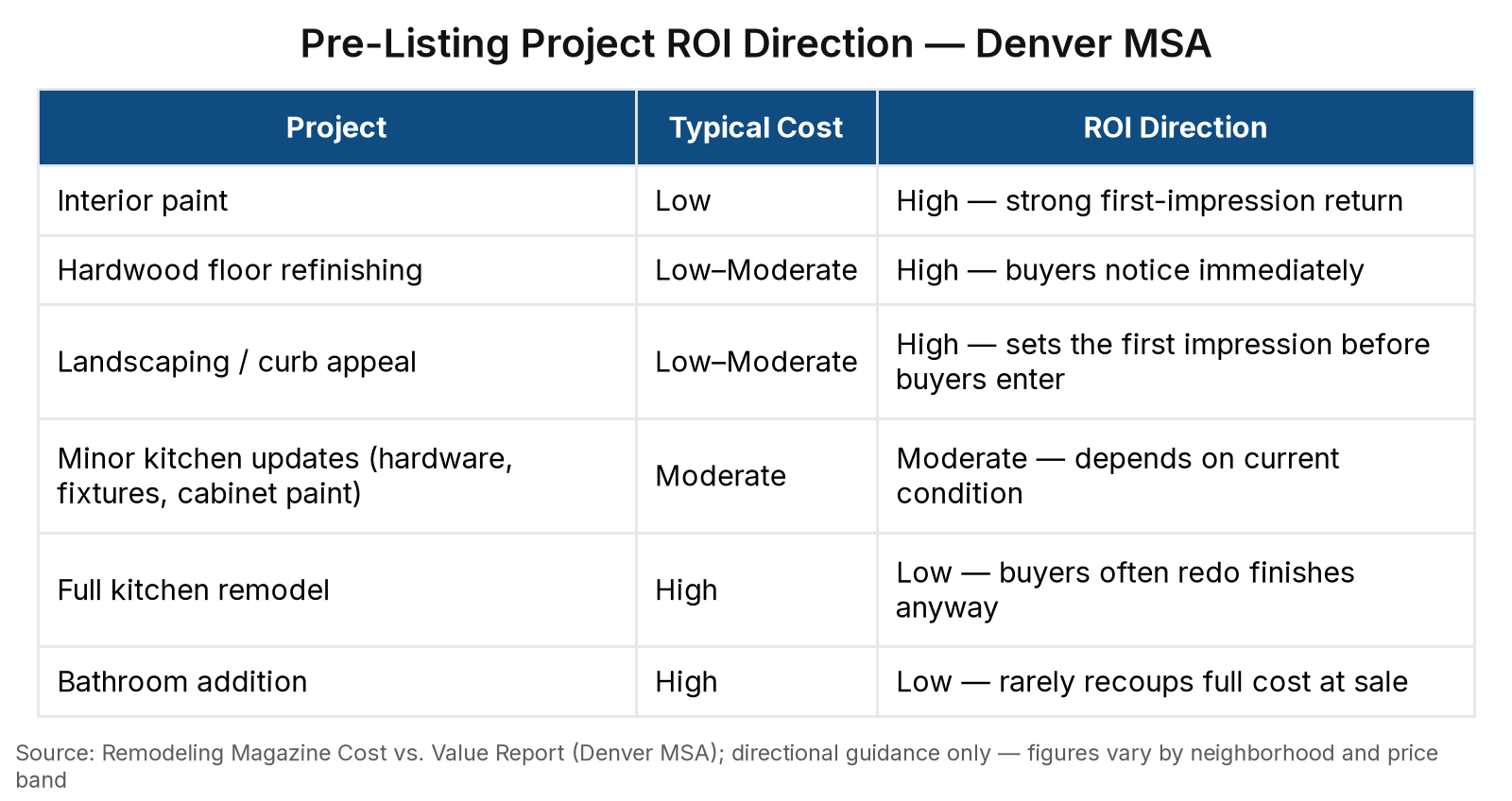
The action here is straightforward: focus repair dollars on the highest-ROI categories, get at least two contractor bids before you commit, and run the numbers against a realistic estimate of what the improvement will do to your list price. Your agent should be able to give you a before-and-after comparative market analysis — what similar homes in your neighborhood are fetching in updated versus original condition. That gap is your ceiling for repair spending.
For a real-world example of curb-appeal ROI, see our lawn renovation case study.
How Your Price Band Changes the Math
The as-is versus fix-up math isn't the same at every price point. Buyer expectations, how hard inspectors push, and how many competing listings you're up against all shift as you move up.
Below the metro median. At the lower end of the market, buyers are often stretching to qualify and have limited cash after the down payment. They're more likely to be investors or buyers who plan to put work into the home. Deferred maintenance is less likely to kill a deal here — buyers in this range often price it in rather than walk away. As-is listings are more common and more accepted. That said, basic cleanliness and safety still matter; a home that looks neglected will attract lower offers no matter what it's priced at.
Around the metro median. At this price point, buyers are typically owner-occupants who plan to move in and live there. They're more sensitive to condition because they're not budgeting for a renovation. Deferred maintenance is more likely to trigger inspection objections, price reduction requests, or buyers walking away after the inspection. Targeted repairs — paint, floors, curb appeal — tend to pay off here because they close the gap between what the home looks like and what buyers at this price expect.
At the upper end of the market. Buyers shopping above the median have more options and higher expectations. They're comparing your home against other well-presented listings, and condition matters more here. An as-is listing at this price point signals something — buyers will wonder what you're not telling them, and they'll price that uncertainty into their offers. If your home is in good structural shape but just needs cosmetic work, investing in presentation before listing is usually worth it. If there are genuine structural or mechanical issues, disclose them clearly and price accordingly rather than trying to paper over them with cosmetic updates.
The price band doesn't change the framework — it changes the stakes. The higher you go, the more condition matters to the buyers you're trying to reach.
The Framework: Four Questions to Make the Call
You don't need a complicated model here. You need honest answers to four questions.
1. What is your realistic timeline?
If you need to be on the market within a few weeks, repairs may not be feasible. Contractor availability in Denver can push timelines out significantly, and rushing a renovation often produces results that don't move the needle. A tight timeline is a real argument for going as-is.
2. Do you have capital available for repairs, or would you need to finance them?
Repairs require cash upfront — you won't recoup the cost until closing. If you have the cash and the repair return justifies the spend, it's worth doing. If you'd need to take on debt to fund the work, the math gets harder. Factor in carrying costs and the risk that the sale takes longer than expected.
3. What does a comparative market analysis show as the gap between as-is value and post-repair value?
This is the most important question, and it requires real data — not a guess. Comparing similar homes in original condition versus updated condition in your neighborhood will tell you what buyers are actually paying for the improvement. If the gap is larger than the repair cost, targeted repairs make sense. If the gap is smaller, you're better off pricing the condition in.
4. Which repairs does your agent flag as worth doing for your price band and neighborhood?
Not all repairs are equal, and what works in one neighborhood or price band may not work in another. Your agent should be able to walk through the home with you and tell you which projects are worth the spend and which aren't. A general renovation checklist is not a substitute for someone who knows what buyers in your area are responding to right now.
Work through these four questions honestly. The answers will point you toward one path or the other. For more on how sellers are navigating pricing and prep decisions right now, see our Denver seller FAQs on pricing and prep.
What Denver's Current Market Means for This Decision
Right now the market tilts toward rewarding preparation.
Denver has moved away from the seller's market of 2021 and 2022. Prices are down year-over-year, and homes are taking longer to sell than they did at the peak. Homes are selling for about what sellers are asking — you probably won't get pulled into a bidding war, but you're not likely to get much above asking either. Buyers have time to be selective.
In that environment, deferred maintenance is more likely to trigger inspection objections and price reduction requests than it was when buyers were waiving contingencies to compete. A home that looks tired or needs obvious work gives buyers a reason to negotiate — and right now, they'll use it.
| Metric | Current Value | YoY Change | What It Means for Sellers |
|---|---|---|---|
| MSA median list price (all types) | $579,798 | −3.4% | Prices have softened; condition matters more when buyers have options |
| MSA active inventory | 12,813 units | −2.9% | Supply is roughly flat; competition among listings is real |
| MSA median days on market | 51 days | −1.9% | Homes are moving, but not instantly — presentation affects time on market |
| Sale-to-list ratio | 1.000 | Flat | Sellers are getting asking price on average, but not overbids |
Source: FRED (MEDLISPRI19740, ACTLISCOU19740, MEDDAYONMAR19740), Zillow Research, July–June 2026
Presentation quality matters more in Denver right now than it did three years ago. That raises the stakes of the as-is versus fix-up call — not because you have to renovate, but because the cost of getting it wrong is higher. An overpriced as-is listing will sit. A well-prepared home priced accurately will move.
To understand who has the advantage in Denver right now and how that affects your negotiating position, that market update has the current read.
Making the Right Call for Your Listing
The four questions above are the right starting point. But the comparative market analysis and the repair-return estimate require someone who knows your specific neighborhood and price band — a general framework only gets you so far.
I'll pull a comparative market analysis that shows what similar homes in your area are selling for in updated versus original condition. We'll walk through the property together and I'll tell you which repairs are worth the spend and which aren't — based on what buyers in your price band are actually responding to right now, not a generic checklist. And I'll give you a clear recommendation on which path — as-is or targeted repairs — is most likely to get you the most out of the sale given your timeline and budget.
You bring your timeline and your honest sense of what you're willing to spend. I'll bring the data and the recommendation.
If you're weighing this decision and want useful context on what buyers at your price point are dealing with, what it actually costs to buy the median Denver home is a good place to start. When you're ready to talk through your specific situation, reach out and we'll figure out the right path together.
---
Paul McCoy, Realtor | Fathom Realty | License #: FA.100105533 | (319) 325-0668 | pmccoy626@gmail.com
Paul McCoy is a licensed real estate professional in Colorado. Equal Housing Opportunity.