Central Park, Denver: Living in the Planned Neighborhood Built
Central Park is Denver's master-planned neighborhood built around an 80-acre park. Here's what buyers need to know about homes, schools, and daily life.
Central Park at a Glance
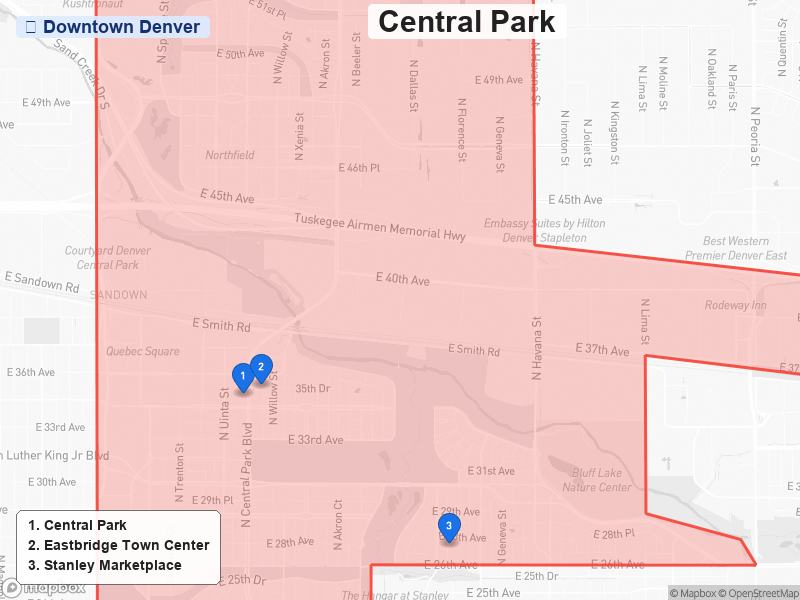
Central Park sits on Denver's northeast side, built on the former Stapleton International Airport site. It's one of the few neighborhoods in the city designed from scratch — wide streets, dedicated green space woven throughout, and a commercial core at Northfield all planned together rather than grown organically. The centerpiece is Central Park itself, at over 80 acres, which gives the neighborhood a geographic identity you can feel the moment you arrive [1].
The market here reflects the neighborhood's appeal. Across Denver, inventory has been building and list prices have softened year-over-year — the metro-wide median list price stood at $569,900 in September 2026, down roughly 5% from a year prior [2]. Buyers shopping here are entering a market where sellers are increasingly competing on price.
Living in Central Park
Getting Around
Central Park trades walkability for transit access — and that's a real trade-off worth knowing before you buy. The big win here is the A-Line light-rail connection to Union Station, which gives you a fast commute downtown or to the airport that most Denver neighborhoods can't match. Biking is functional too, with the Sand Creek Trail running through the neighborhood for nearly 5 miles [1][3].
For comparison, Park Hill scores higher on walkability and biking but lower on transit:
| Neighborhood | Walk Score | Bike Score | Transit Score |
|---|---|---|---|
| Central Park | 39 | 66 | 60 |
| Park Hill | 66 | 83 | 42 |
If the A-Line matters to you, Central Park is the clear winner here. If you want to run errands on foot, Park Hill is the stronger choice.
The Houses and Streets
Central Park is a planned neighborhood, and the homes reflect that. You'll find a mix of newer construction — townhomes, single-family single-family homes, and some attached products — laid out on a grid with wider lots and more green space between properties than you'd find in older Denver neighborhoods. The architecture skews toward newer builds, with a range of builders and styles across different sub-sections.
Homes here tend to be newer than most of Denver. Buyers who choose Central Park are generally choosing the planned layout and the park access over historic charm.
What's Around
The park is the anchor. Central Park itself covers over 81 acres, and Greenway Belt Park and The Bluffs add another 73-plus acres of green space within the neighborhood [1]. The Sand Creek Trail gives you nearly 5 miles of dedicated path for running and biking, with connections to Denver's broader trail network [1].
For shopping and dining, Northfield is the neighborhood's commercial hub [1]. The dining scene includes over 35 restaurants, bars, cafes, and pubs — Anthony's Pizza and Pasta, Blue Fin Sushi, Udi's Bread Cafe, and Little India among them [1]. For a broader nightlife scene, you're a short drive from Park Hill and the broader northeast Denver corridor.
Schools
Central Park is served by Denver Public Schools [4]. At the elementary level, families choose from 6 schools through the DPS SchoolChoice process rather than being assigned to one:
| School | Grades |
|---|---|
| Inspire Elementary | K–5 |
| Isabella Bird Community School | K–5 |
| Swigert International School | K–5 |
| Westerly Creek | K–5 |
| William (Bill) Roberts | K–5 |
| Willow Elementary | K–5 |
At the middle level, Central Park is in the Greater Park Hill/Central Park Middle School Enrollment Zone, with 5 choice schools: Denver Green School Northfield, DSST: Conservatory Green Middle School, DSST: Montview Middle School, McAuliffe International School, and William (Bill) Roberts [4]. From there, students feed into Northfield High School (grades 9–12, located at 5500 Central Park Blvd) [4].
Who Lives Here
About 70% of homes in Central Park are owner-occupied — one of the higher ownership rates across Denver neighborhoods [5]. Median household income is approximately $182,515, and the average household size is 2.6 persons [5].
Buying in Central Park
The Market
Central Park is part of a broader Denver market that's rebalancing. Across Denver, inventory is up and list prices have softened from a year ago [2]. Homes are selling for about what sellers are asking — you probably won't talk someone down much, but you're not likely to get pulled into a bidding war either [2]. For current neighborhood-level figures, the Denver Market Update: September 2026 has the latest.
| Neighborhood | Median list price | Price per sq ft | Median days on market | As of |
|---|---|---|---|---|
| Denver metro (MSA-wide) | $569,900 | $279 | 58 days | Sep 2026 |
More inventory and softer prices mean buyers have more options than a year ago, but sellers aren't capitulating — homes are still clearing at list. If you find a well-priced home in Central Park, don't expect to negotiate much off the ask.
Strategy
Central Park's planned layout makes comp selection more straightforward than in older neighborhoods with wide variation in condition and finish. That said, the neighborhood spans a range of sub-sections and builders, and homes can be priced differently based on proximity to the park, lot position, and how recently the home was updated.
If you're comparing Central Park to the Park Hill neighborhood spotlight or the City Park neighborhood spotlight, the lifestyle trade-offs are real: Central Park gives you newer construction, planned green space, and the A-Line; those neighborhoods give you walkability, architectural character, and a more urban feel.
The right home and the overpriced home can look similar from the outside — the difference shows up when you compare recent sales, and that's exactly what I'll walk you through.
Ready to See Central Park for Yourself?
If you're weighing Central Park against Park Hill, City Park, or other northeast Denver options, the lifestyle and price trade-offs are worth working through with current data. I'm happy to pull recent closings, show you what's active at your price point, and help you figure out whether the neighborhood fits what you're looking for. Book a consultation and let's talk through your situation.
Sources
- OpenStreetMap
- FRED (MEDLISPRI19740, ACTLISCOU19740, MEDDAYONMAR19740, MEDLISPRIPERSQUFEE19740); Zillow Research
- Walk Score
- CDE District + School Performance Framework (2024-25); Denver Public Schools SchoolChoice
- U.S. Census Bureau ACS 5-year (2020-2024)
---
Paul McCoy, Realtor | Fathom Realty | License #: FA.100105533 | (319) 325-0668 | pmccoy626@gmail.com
Paul McCoy is a licensed real estate professional in Colorado. Equal Housing Opportunity.