Cory-Merrill, Denver: The Quiet Value Play Between Wash Park and Platt Park
Cory-Merrill sits between Wash Park and Platt Park with strong bikeability, mid-century homes, and a quieter residential feel. Here's what buyers need to know.
Cory-Merrill at a Glance
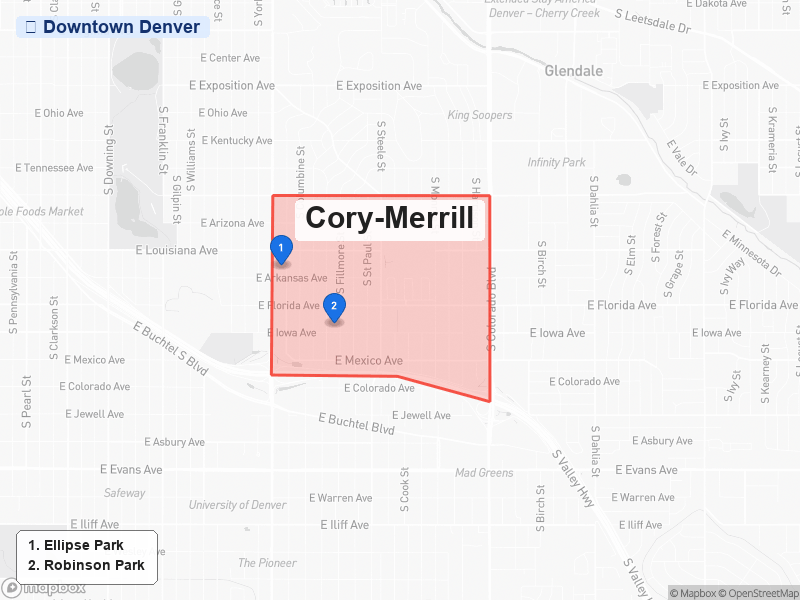
Cory-Merrill sits on Denver's south side, between Wash Park to the north and Platt Park to the south. It's quiet, easy to bike, and one of the highest ownership-rate neighborhoods in Denver — which means homes don't change hands often and inventory stays thin. If you're comparing south-side neighborhoods, Cory-Merrill is the one that tends to get passed over for Wash Park or Platt Park — and that's exactly where you get more home for the money.
Homes here cost a bit more than the Denver median — the typical single-family home is listed at $872,950, with higher-end homes reaching $2,170,000. That spread comes from original bungalows and larger new builds sitting on the same block [1]. Homes are sitting on the market for about 42 days [1], close to Denver's 37-day pace [2]. Across Denver, homes are selling for about what sellers are asking — no bidding wars, but don't expect much room to negotiate either [2].
Living in Cory-Merrill
Getting Around
Cory-Merrill's standout mobility score is bikeability — a Bike Score of 76 out of 100 (Very Bikeable) puts it well above most Denver neighborhoods for two-wheel access, with a functional network of bike lanes and road connectivity for local trips. Walkability is more modest: a Walk Score of 53 (Somewhat Walkable) means most errands still require a car. Transit is the weakest leg, with a Transit Score of 36 (Some Transit) indicating basic route coverage but no robust bus or light-rail access nearby [3]. If you're car-dependent for daily errands, that's the honest trade-off here — the bike infrastructure is real, but the walk and transit scores trail most inner-Denver neighborhoods.
The Houses and Streets
Cory-Merrill has a real mix of homes — older brick bungalows alongside new construction and occasional luxury new builds, often on the same block. There's no single defining style; you'll see original mid-century homes sitting next to much larger new builds that have gone up as the neighborhood has appreciated. That contrast is what you'll notice walking the streets.
The prices reflect that directly: the typical home is listed at $872,950, with higher-end homes reaching $2,170,000 [1]. The entry point and the luxury end really do sit on adjacent lots. The original bungalows run smaller; the newer builds run considerably larger. The wide price spread between the $872,950 median and the $2,170,000 p75 reflects this mix directly [1].
What's Around
The neighborhood itself is quiet — mostly houses, with a handful of dining and coffee spots nearby, including Starbucks, Ding Tea, Lollicup, Beard Papa's, and IHOP [4]. There are likely a few more spots not captured in any list.
The bigger draw is what's nearby. You're an easy bike ride from South Pearl Street in Platt Park and the Wash Park area to the north — tons of restaurants, coffee shops, and independent retail. The neighborhood itself is quiet; the action is just a short ride away.
Schools
Cory-Merrill is served by Denver Public Schools [5]. The assigned schools are Cory Elementary School (grades 1–5, 1550 South Steele Street), Merrill Middle School (grades 6–8, 1551 South Monroe Street), and South High School (grades 9–12, 1700 East Louisiana Avenue) [5].
Denver Public Schools operates a district-wide SchoolChoice system — families apply across the district, and many areas share enrollment zones rather than being assigned to a single neighborhood school. Confirm current zone assignments directly with DPS before making school access a factor in your search [5]. Per the Colorado Department of Education's 2024-25 accountability framework — which rates schools on a four-tier scale of Performance Plan, Improvement Plan, Priority Improvement Plan, or Turnaround Plan — Cory Elementary School (grades 1–5, 1550 South Steele Street, Denver 80210), the assigned elementary school, received a Performance Plan rating.
Who Lives Here
Cory-Merrill skews heavily toward owners — owner-occupancy runs approximately 86%, among the highest of any tracked Denver neighborhood. That level of owner concentration means turnover is structurally low and inventory stays thin; you're competing in a pool where most owners aren't moving. Median household income is approximately $154,958, well above the Denver metro median. Households here average 2.3 persons [6].
Buying in Cory-Merrill
The Market
Cory-Merrill sits just above the Denver median — the typical single-family home is listed at $872,950, against Denver's $825,000 median [2]. Higher-end homes here reach $2,170,000 [1], and that wide price range comes from smaller original bungalows and larger new builds sitting side by side.
Homes are sitting on the market for about 42 days [1], just a few days above Denver's 37-day pace [2]. Across Denver, homes are selling for about what sellers are asking — no bidding wars, but don't expect much room to negotiate either [2]. A handful of luxury listings have been sitting for a while, which pulls the average up; for entry- and mid-range homes, that 42-day figure is the more useful guide.
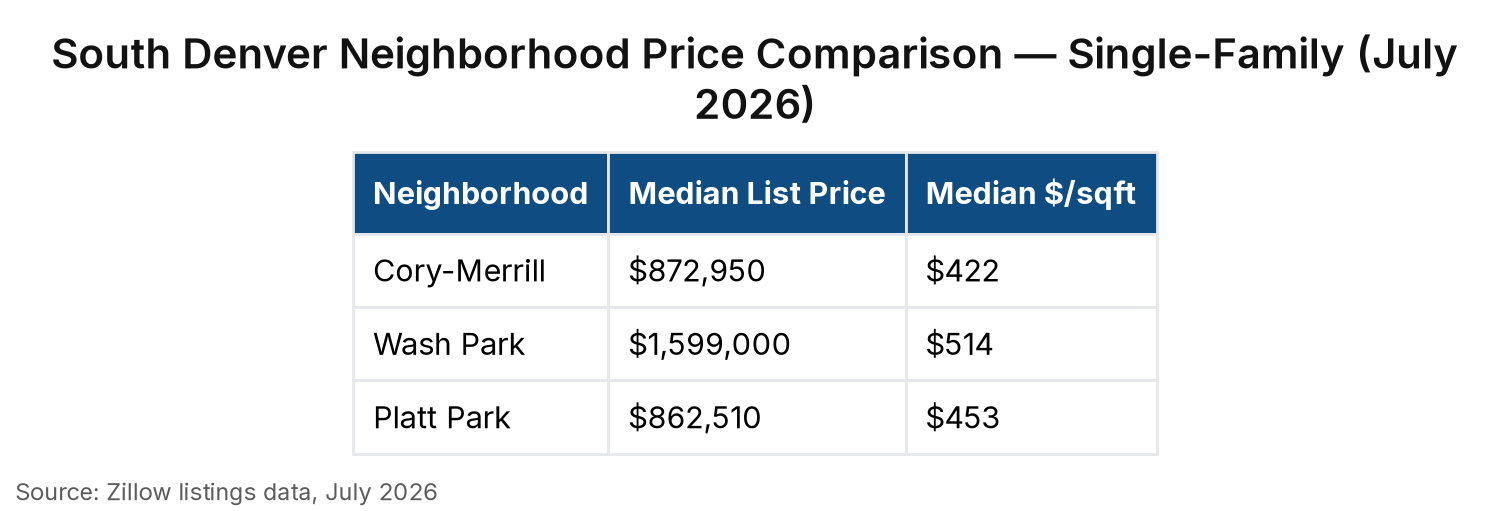
For comparison, Wash Park's median is $1,599,000 ($514/sqft) and Platt Park's is $862,510 ($453/sqft) — Cory-Merrill sits between the two in price, closer to Platt Park, but quieter and with a much higher share of owner-occupied homes [7]. The median single-family list price is $872,950, with the median price per square foot at $422; the 75th percentile reaches $2,170,000 at $563 per square foot [1].
Strategy
The wide price range here means comparing recent sales carefully is how you protect yourself. Two homes on the same block can be priced very differently based on size, how updated the home is, and whether you're looking at an original bungalow or newer construction [1]. If you're targeting the larger, newer end of the market, don't use the median as your reference — and don't assume the higher-end figures say anything about what a well-priced bungalow should cost.
The 30-year fixed rate has moved up over the past three months, from 6.30% to 6.55% [8], though it's still lower than it was a year ago [8]. The recent direction is what matters for what you'll actually be paying — the year-over-year drop is useful context, but plan around where rates have been going lately, not where they came from.
Luxury listings that have been sitting a while are a fact you can use when negotiating — but don't take them as a sign the whole neighborhood is slow. Well-priced homes at the entry and mid range are moving at or near that 42-day pace; the ones sitting longer have pricing or condition issues specific to those properties. The right home and the overpriced one can look similar from the outside — the difference shows up when you dig into recent sales. Year-over-year, the rate is 20 basis points lower than where it stood a year ago [8] — so the short-term and longer-term signals point in opposite directions.
Ready to See Cory-Merrill for Yourself?
If you're weighing Cory-Merrill against the Wash Park neighborhood spotlight or Platt Park, I'm happy to walk you through current comps, recent closings, and what active inventory looks like at your price point. Check out the Denver Market Update for the broader metro context. Reach out — happy to talk through your situation.
Sources
- Zillow listings data — Cory-Merrill (July 2026)
- Zillow listings data — Denver Metro Detached (July 2026)
- Walk Score
- OpenStreetMap
- CDE District + School Performance Framework (2024-25); DPS SchoolChoice boundary lookup
- U.S. Census Bureau ACS 5-year (2020-2024)
- Zillow listings data — Wash Park and Platt Park (July 2026)
- Federal Reserve Economic Data (FRED) — MORTGAGE30US
---
Paul McCoy, Realtor | Fathom Realty | License #: FA.100105533 | (319) 325-0668 | pmccoy626@gmail.com
Paul McCoy is a licensed real estate professional in Colorado. Equal Housing Opportunity.