Cherry Creek vs. LoHi Denver: Which Neighborhood Fits Your Life?
Cherry Creek and LoHi are two of Denver's most competitive neighborhoods — but they're built for different buyers. Here's how price, lifestyle, and walkability
Cherry Creek and LoHi both show up on every short list of Denver neighborhoods worth buying in. They're both walkable, restaurant-dense, and close to downtown. They both attract buyers who want to leave the car at home most days. And they both move fast when the right home hits the market.
But they reward fundamentally different lifestyles — different price profiles, different housing types, a different feel day to day. Which one fits you depends on how you get around, what your evenings look like, and what kind of home you actually want to own.
This post compares Cherry Creek and LoHi across four dimensions — price and homes, walkability and transit, lifestyle and amenities, and what the data says about each neighborhood's character — so you can see which one actually fits your life.
Price and Housing: What Your Budget Gets You
Cherry Creek runs at a higher price point than LoHi, and the gap matters because you're buying a different kind of home. Cherry Creek is mostly condos and luxury townhomes — newer builds, high-finish interiors, often with HOA fees on top of your mortgage. LoHi leans toward rowhomes and newer condos, with fewer single-family homes than there used to be as new construction has filled in the gaps over the past decade.
What we do have is the metro-wide context: the Denver metro median list price across all property types was $569,900 as of September 2026, down about 5% year-over-year. That's the backdrop both neighborhoods are operating against, though both Cherry Creek and LoHi trade meaningfully above that metro median.
Across Denver, homes are selling for about what sellers are asking. You probably won't talk someone down much, but you're not likely to get pulled into a bidding war either. Inventory is up about 7% year-over-year metro-wide, which gives you more options than buyers had in 2025.
Before you compare price numbers across the two neighborhoods, get clear on what you're actually comparing. A Cherry Creek condo and a LoHi rowhome are different purchases — different HOA structures, different maintenance, different resale dynamics. If your budget is at or below what a typical LoHi home costs, Cherry Creek's entry point gets you into a different type of home entirely. Sort out the housing type first, then look at the numbers.
Walkability, Transit, and Getting Around
LoHi wins on walkability, with a 93 Walk Score that puts daily errands on foot from almost anywhere in the neighborhood. Cherry Creek scores 81 — still very walkable, but you'll need a car or a bike for some trips that LoHi handles on foot.
Transit is where the gap widens further. Cherry Creek has bus coverage, but frequency and route options are limited. LoHi has meaningfully stronger service — more routes, more often.
On biking, Cherry Creek actually edges ahead. The Cherry Creek Trail is the reason — it's a practical commute and recreation route that connects the neighborhood to downtown and beyond. LoHi has the Platte River Trail and excellent bike infrastructure, but Cherry Creek's trail connectivity gives it a slight edge if you're a dedicated cyclist.
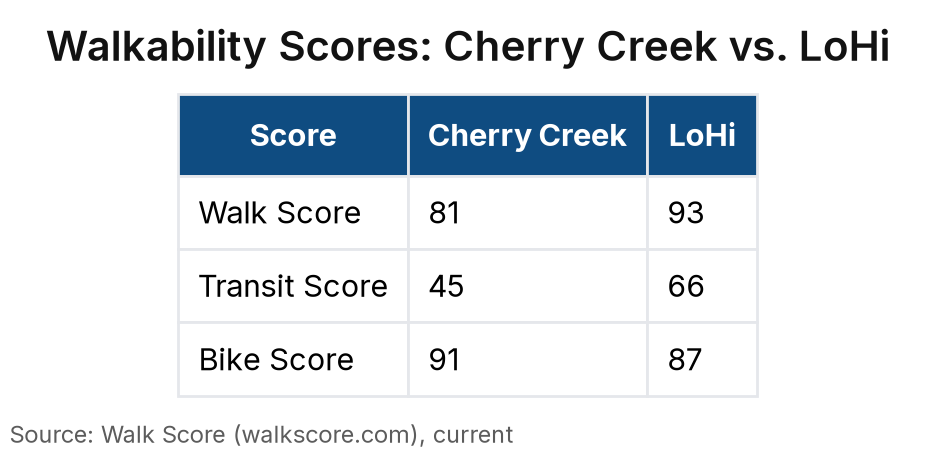
In daily life, Cherry Creek's walkability is built around the Cherry Creek Shopping District and the trail corridor. LoHi's is built around the restaurants and bars along West 32nd Avenue and the Platte River Trail to the south.
Neither neighborhood is a transit-first choice if you're commuting without a car. LoHi has no light-rail stop within the neighborhood core — you're on buses or a bike to reach light-rail. Cherry Creek's bus access is better than its Transit Score suggests for some routes, but if your commute depends on light-rail, you'll want to map your specific route before you commit to either neighborhood. Both rank among the most walkable neighborhoods in Denver — the question is whether you care more about getting around on foot, on a bike, or by transit.
Lifestyle and Amenities: The Day-to-Day Feel
Both neighborhoods are walkable and restaurant-dense, but the vibe is distinct enough that buyers who'd love one sometimes find the other doesn't fit.
Cherry Creek
Cherry Creek is polished and retail-anchored. The Cherry Creek Shopping District sets the tone — it's one of the better outdoor retail corridors in Denver, with a mix of national brands and independent shops. The dining scene skews toward sit-down restaurants and wine bars rather than late-night spots. The Cherry Creek Trail gives the neighborhood a quieter recreational dimension that runs alongside the commercial energy.
Why buyers love it:
- The Cherry Creek Trail for running, cycling, and commuting
- A walkable retail and dining corridor that handles most errands on foot
- Newer condo and townhome construction with high-finish interiors
- Quieter residential streets set back from the commercial core
Cherry Creek suits buyers who want a polished, lower-key environment with strong trail access and walkable retail. The trade-off: the energy is quieter and more retail-oriented than bar-forward, and the HOA landscape on condos and townhomes adds a layer of monthly cost and governance worth reviewing before you buy.
LoHi
LoHi is louder, younger in character, and bar-forward. West 32nd Avenue is the spine of the neighborhood — a dense concentration of restaurants, bars, and coffee shops that makes the area feel active most nights of the week. The RiNo neighborhood is a short bike ride away, which extends the dining and nightlife options further east.
Why buyers love it:
- West 32nd Avenue's restaurant and bar density — walkable from most of the neighborhood
- Platte River Trail access for running and cycling
- Strong transit scores relative to most Denver neighborhoods
- Rowhome and newer condo stock with good walkability from front door to amenities
LoHi suits buyers who want to be in the middle of the action — walkable to dinner and drinks, close to the trail, and in a neighborhood that feels active. The trade-off: the energy is higher and the residential streets closer to 32nd can be louder, especially on weekends. Single-family homes are increasingly rare as new construction has filled in the gaps.
So Which Neighborhood Actually Fits You?
Cherry Creek and LoHi are both strong neighborhoods. They win on different things.
Cherry Creek wins on: biking and trail access, walkable retail, and a quieter residential feel. If the Cherry Creek Trail is part of your daily routine — commuting by bike, running the corridor, or just having a practical connection to downtown without getting in a car — Cherry Creek is hard to beat. Most of the homes are condos and townhomes with higher finishes, which works well if you want low-maintenance ownership.
LoHi wins on: walkability, transit, and day-to-day energy. With a 93 Walk Score, more of your daily life happens on foot without planning around it. Transit is meaningfully stronger than Cherry Creek, which matters if you're car-light rather than car-free. And the West 32nd corridor gives you a concentration of dining and nightlife that Cherry Creek's more retail-oriented scene doesn't match.
Three questions worth sitting with: How do you actually get around — on foot, by bike, or by transit? What kind of home fits what you want to own — a condo with HOA coverage, or a rowhome with more autonomy? And what does your evening routine look like — quieter dinners and trail runs, or a neighborhood that's active late into the week?
Both neighborhoods sit in a broader Denver market where inventory is up and you have more room to negotiate than you did a year ago. The question isn't which neighborhood is doing better right now — it's which one fits the life you're actually planning to live.
Thinking About Buying in Cherry Creek or LoHi?
A listing page can tell you the price and the square footage. It can't tell you which blocks within each neighborhood are moving fastest right now, what the HOA situation looks like on the condos you're considering, or how offers play out differently between the two neighborhoods at your price point.
When you work with me, here's what we'd cover: recent sales in both neighborhoods, a look at how fast homes are moving at the type you're targeting, and a shortlist based on what matters most to you — trail access, transit, housing type, or price. You bring your budget, your timeline, and your priorities. I bring the neighborhood-level data and the context on how to negotiate it.
Book a consultation and let's figure out which one fits.
---
Paul McCoy, Realtor | Fathom Realty | License #: FA.100105533 | (319) 325-0668 | pmccoy626@gmail.com
Paul McCoy is a licensed real estate professional in Colorado. Equal Housing Opportunity.